











































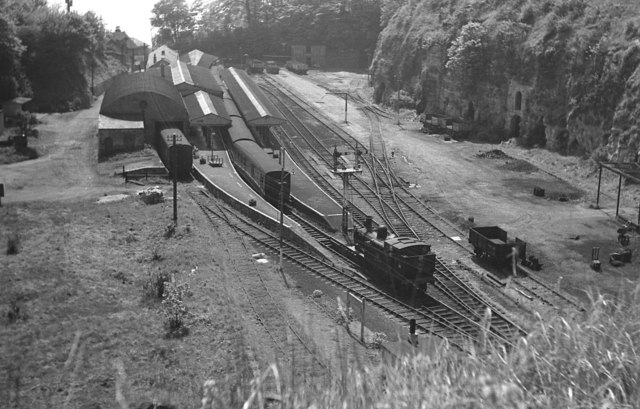

 In the 3rd part of our series Isle of Wight Railways, we examine the South Wight town of Ventnor which for half a century – from 1900 to 1952 – had 2 railway stations: Ventnor and the lesser known Ventnor West.
In the 19th century, Ventnor became an extremely popular seaside health resort because of its favourable mild micro-climate, particularly for those suffering from the then-common scourge of tuberculosis.
By 1831, Ventnor was receiving an estimated 76,848 visitors a year by coach from Ryde and by 1851 the population of what had been a sleepy seaside fisherman’s village had risen to 3,500. So many building speculators had been attracted to the popular seaside resort that the price of land had risen tenfold from £100 an acre in 1830 to £1,000 an acre by the-middle-of-the-century.

But how to get to Ventnor, particularly from London, in the absence of mechanised transport?
Captain Mark Huish – a former railway manager – told a parliamentary enquiry into the building of the 1st Isle of Wight Railway line from Ryde to Ventnor, that 8 to 10 coaches a day ran between Ryde and Ventnor, and that the service was so popular that he had to book the coach a day in advance.
Before the coming of the railway, it apparently took longer to travel from Ventnor to Portsmouth than from Portsmouth to London. Perhaps it still does.
In 1860, an Act of Parliament was passed authorising the building of a railway between Ryde and Ventnor. The line was originally intended to pass through Luccombe and Bonchurch before reaching Ventnor, but a route was chosen to pass through the village of Wroxall before tunnelling under St Boniface Down, then emerging at Ventnor station perched high (294ft) above the town.
By January 1865, navvies had succeeded in blasting and digging their way through St Boniface Down, celebrating their achievement with a massive fight. The 1st train ran through the 1,312-yard tunnel on 23rd March of that year.

On 10th September 1866 Ventnor station was ready for passenger traffic. The 1st train arrived at 08:00, having taken 25 minutes to arrive from Ryde (the bus journey today takes 50 minutes). It was now possible to travel from Ventnor to London by boat and train in just over 4 hours.
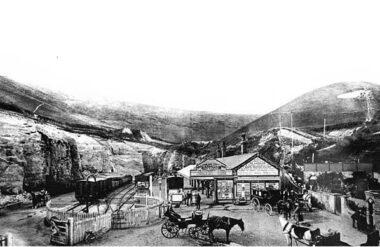
The train was greeted by large crowds and the blasts of foghorns from boats. 900 passengers got on board for the journey to Ryde.
The next ‘Ventnor’ station to be built was Ventnor (St Lawrence), somewhat inconveniently situated 2 miles from the town itself. A horse-drawn bus carried passengers from the station to the town centre at the cost of 6d (21/2p).
A correspondent from the Daily Telegraph commented on the station:
“Ventnor (St Lawrence), for the traveller to the English Madeira, could be taken at best as a pious fraud and less charitably as a joke in bad taste.”
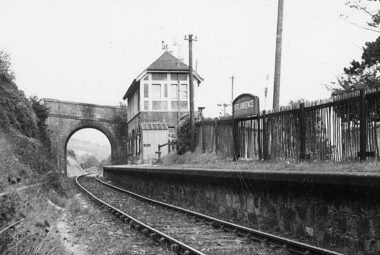
Unsurprisingly, the new service to Newport via Merstone was not overwhelmingly popular, with only 24 passengers carried on the 1st train.
By 1900, the branch line from Newport had been extended to Ventnor itself in a new station in the grounds of the former Steephill Castle. The station, whose former building is currently located in what is now known as Castle Close, was known as Ventnor Town.
The 1st train left Ventnor Town at 08:30 on 1st June 1900. It took just 18 minutes to travel to Newport (30 minutes by public transport today). Its opening was noted nationally, with correspondents of the Daily Telegraph, The Times and the Daily Express all present.
Ventnor Town station and the line to Newport were never a great success though. The station was a 10-minute walk to the centre of town without heavy luggage. Plans were afoot to build another station further into Ventnor itself, but these unfortunately never came to fruition.
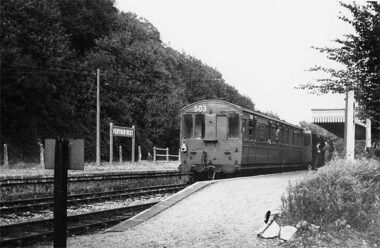
Ventnor Town station changed its name to Ventnor West when Southern Railways took over the Isle of Wight Central Railway in 1923. Passenger numbers using the station were always low.
In 1949, F. W. Bright, secretary of the Isle of Wight Chamber of Commerce, commented:
“The Railway System is lightly loaded even in the peak summer months, the buses on the other hand are fully loaded in the winter months. It is commonplace for overcrowded buses to pass almost empty trains.”
By 1951, the branch line to Ventnor West had an yearly income of just £1,291. Expenditure on the line was £14,418. It was, unsurprisingly, the 1st Isle of Wight line to be closed.
Crowds gathered to watch the last train leave Ventnor West at 20:00 on 15th September 1952. Ventnor Jazz band played, detonators exploded and fireworks were set off.
The stationmaster, Alec Widger, displayed the following notice:
“If half the people who are interested in this line today had been as interested in the last 2 years, we should not be closing.”
Services from Ventnor station ended on 17th April 1966 after almost exactly a century of service. The final train arrived at 10:10 to be met by a cannonade of fog detonators.
The former stationmaster at Ventnor West, Alec Widger, was the oldest member of staff at Ventnor, having completed nearly half a century of services to Island railways.
Having seen the last train leaving Ventnor West, Mr Widger commented:
“I never expected to see it happen again at Ventnor Station”.
In the next edition of Isle of Wight Railways, we shall be looking at the centre of the Island railway network – Newport – in which as many as 5 stations, 2 railway viaducts and 2 tunnels were at one time located.








Absolutely fabulous article thank you so much. Please keep it up.
very interesting article , nice to read about a bit of island history
“The former stationmaster at Ventnor West, Alec Widger, was the oldest member of staff at Ventnor, having completed nearly a century of services”
Wow – how old was he to complete a century of service? 120? Older?
You need to go to Specsavers, then read the article again.
I traveled on the last train to Ventnor in 66 at the age of 4 apparently I fell asleep on the journey, so mum said.
Brilliant ! Imagine how much those trains would be earning today if still running ? Steam train enthusiasts everywhere. AND if the got that TUNNEL built to mainland.. how fantastic would that be ?? But no… sadly. But they could continue with the tunnel and make it for vehicles..
Heaven forbid they ever build a vehicle tunnel or bridge.
Ditto ditto Joe no tunnel and no bridge ,we are already being lumped in with the mainland with the fire service and police and that is bad enough ,I am all for our independence as much as possible..
“In the 3rd part of our series Isle of Wight Railways ” … how about including a link to the previous articles
And BR altered the time of the morning train making it impossible for workers to use it. before that it was always crowded with workers. I know because my Dad always used it from St Lawrence. He worked in Saunders Roe in East Cowes and found it more convenient to catch the train from St Lawrence to Merstone, change onto the train to Newport, then change onto the train to Cowes and go over to East Cowes on the floating bridge ( which worked then) returning the same way in the evening . He found this journey to be quicker and more convenient than getting a bus. This change in train times resulted in him buying a car. I have travelled on this line a couple of times from Ventnor West to St Lawrence but can’t realy remember what the journey was
There used to be a local bus service operated by Nashe’s Garage in Ventnor( used to be where the Coop is now) which ran from ventnor Station to Bonchurch, to Ventnor town, to the Esplanade and then out to Ventnor West. Unfortunately he sold it to Southern Vectis who immediately closed it and their buses always reached the town station 3 minutes after the train had left, an early example of conjoined travel services. Closure of the line completely killed Ventnor and it still hasn’t really recovered.
You can still travel in one of the push pull sets from the Ventnor West line on the Isle of Wight Steam Railway at Havenstreet.