






















































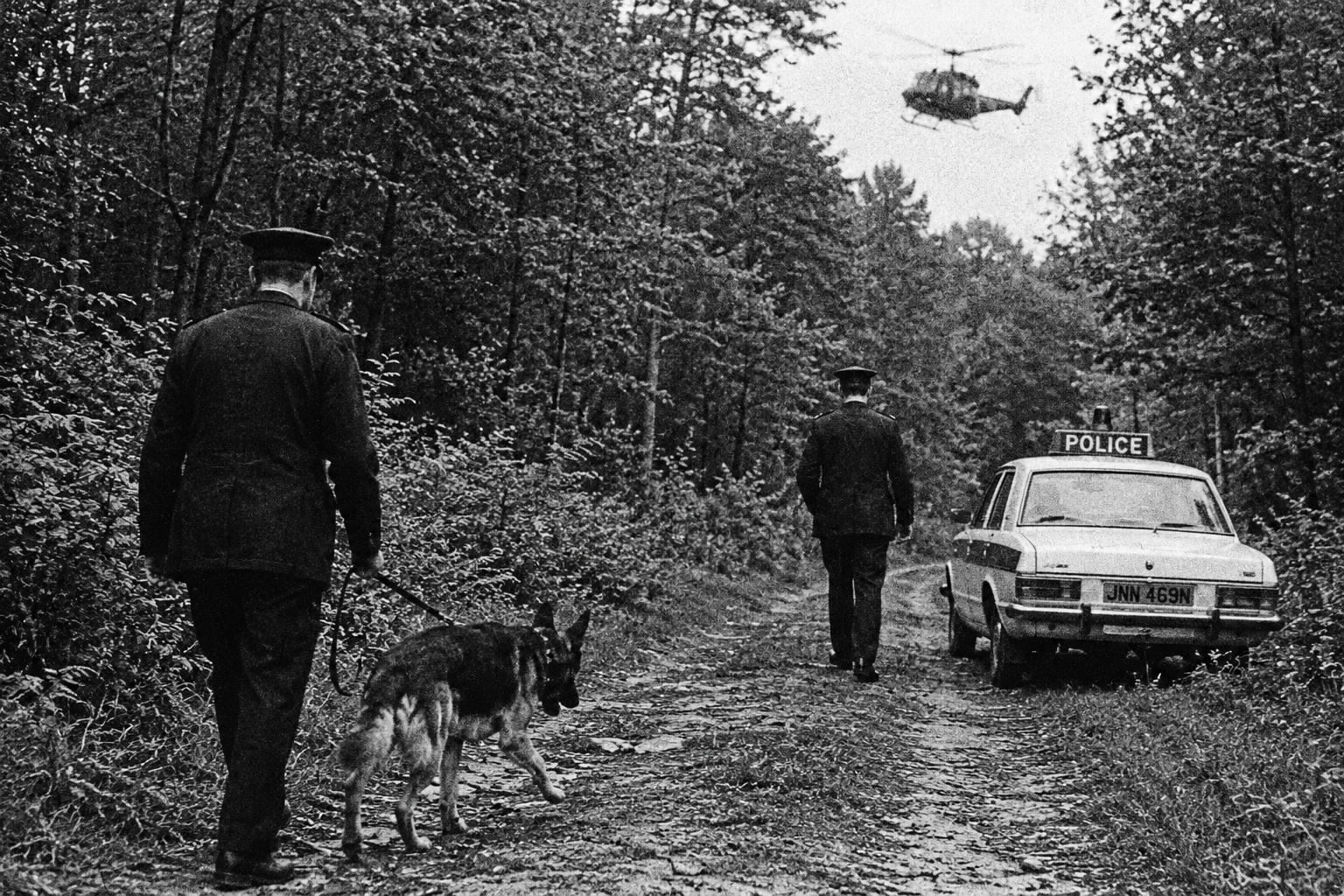

More than 100 police officers joined a massive search operation after a convicted murderer escaped from Parkhurst Prison on 5th July 1976.
The Isle of Wight found itself at the centre of one of its largest manhunts in years when a prisoner serving a life sentence for shooting dead a Reading detective escaped from Parkhurst Prison’s top-security wing.
Arthur William Skingle, aged 30, became the first inmate to escape from the prison’s maximum-security wing since it had opened a decade earlier. At around 18:15 on Monday 5th July 1976, he cut his way through 2 towering 17ft perimeter fences surrounding the exercise yard.


Two fellow inmates, Cyril Birkhead and John Kellard, also made it through the fences, but a prison officer and an Alsatian dog quickly recaptured both men. Skingle alone managed to disappear into nearby Parkhurst Forest.
As news of the escape spread, a huge search operation swung into action. More than 100 police officers were deployed, including 60 drafted in from the mainland. Two Army helicopters joined the hunt, tracker dogs combed the dense woodland and police launches patrolled the coastline.
Fearing that the fugitive might attempt to leave the Island, officers searched ferries, hovercraft and private aircraft, while roadblocks were established across the Isle of Wight. Vehicles were stopped and checked, particularly lorries, as police attempted to seal every possible escape route. Holidaymakers arriving on the Island that summer found themselves entering a landscape of police patrols, helicopter searches and roadside checkpoints as officers sought to prevent the escaped prisoner reaching the mainland.
Despite the scale of the operation, Chief Superintendent F. Hodgson described Skingle as the most dangerous fugitive encountered during his 5 years on the Isle of Wight and remained convinced that the escaped prisoner had never broken through the cordon around Parkhurst Forest.
Search teams continued combing the undergrowth throughout the night and into the following day. Helicopters circled overhead, tracker dogs followed every lead and officers maintained the woodland cordon as the hunt intensified.

Their judgement proved correct. Shortly before 16:00 on Tuesday 6th July, almost 22 hours after escaping, the fugitive emerged from undergrowth only a few hundred yards from the prison walls and surrendered.
More than 100 officers had been mobilised, helicopters had searched from above and every possible route off the Isle of Wight had been scrutinised. In the end, the escaped prisoner had spent almost the entire manhunt hiding within sight of the prison from which he had fled.
Skingle remained in prison following his recapture and died in 1987 at the age of 41.










Great article, at least nowdays they couldn’t escape and go
to the mainland “they couldn’t afford the extortionate ferry fares”
How times have changed.
If more than 100 police officers were swiftly mobilised, 60 from the mainland, this implies there were 40 police officers on the Island in 1976 – a far cry from the dozen we have now.