















































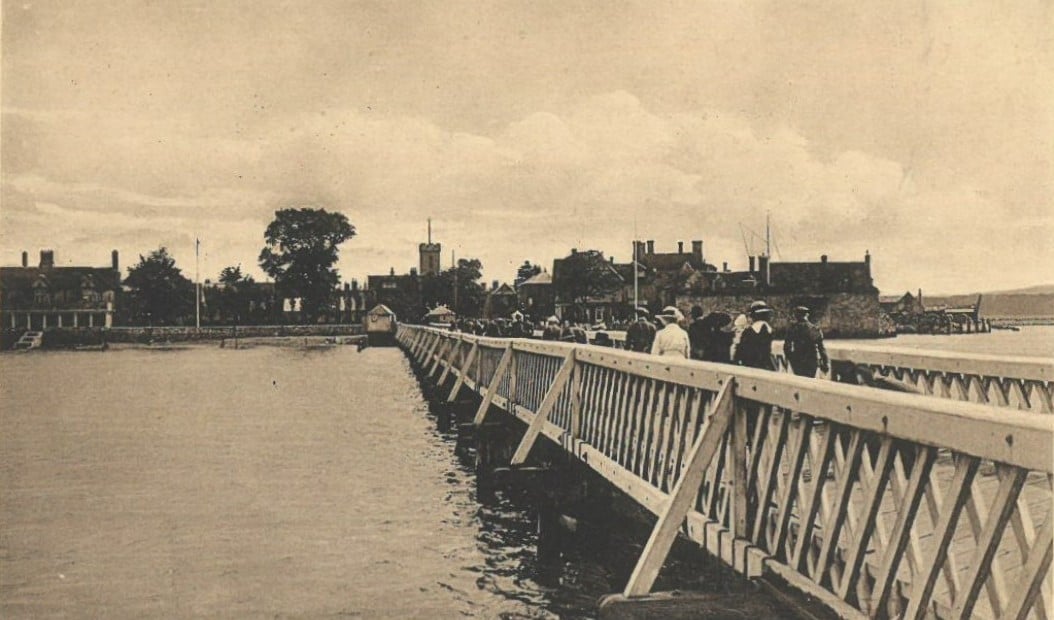

Yarmouth’s new pier was officially opened on 19th July 1876, creating what once was a vital transport link across the Solent that survives to this day.
Unlike many Victorian piers, Yarmouth Pier was not built primarily as a seaside attraction. Instead, it was conceived as a practical transport project designed to improve communications between the Isle of Wight and Hampshire.
The idea was first discussed by Yarmouth Corporation in 1870 as passenger steamer services became increasingly important. Local leaders recognised the need for a deep-water landing stage capable of serving vessels operating between Yarmouth and Lymington, and Parliamentary approval for the scheme was granted in 1874.


Construction began in June 1875 when the first pile was driven into the seabed. The pier was designed by Denham and Jenvey and built by J. Denham of Freshwater at a cost of £4,000 – equivalent to around £600,000 today.
Just over a year later, on 19th July 1876, the Mayor of Yarmouth formally opened the new structure. Stretching some 685ft into the Solent, it provided a landing point for passenger steamers and helped strengthen Yarmouth’s position as the principal gateway to the West Wight.
The new pier had a troubled start. Within weeks of opening, a vessel broke free from its moorings and collided with the structure, causing damage that required repairs. Further controversy followed in 1877 when the Corporation attempted to erect gates on the pier. Local boatmen and residents objected strongly because the barriers restricted access to the beach, and the gates were eventually removed and never reinstated.
Responsibility for the pier passed to Yarmouth Town Trust in 1891. One of the Trust’s first actions was to clear nearby buildings to create what is now Pier Square, opening up the waterfront and creating a layout that remains familiar today.
Like many timber structures exposed to the Solent, the pier required constant maintenance. A further collision occurred in 1909 when the barge Shamrock struck the structure, while replacement piles were installed in 1916. In 1927, a new waiting room and office building was erected at the shore end at a cost of £2,000.

The pier’s role gradually changed during the 20th century as harbour facilities improved and transport patterns evolved. By 1980, demolition had even been proposed because of mounting maintenance costs. Permission was refused, however, and restoration work ensured the structure’s survival.
Today, Yarmouth Pier is believed to be the longest surviving wooden pier in England still open to the public. Despite collisions, storm damage, changing transport patterns and repeated threats of demolition, the structure remains in use 150 years after it first opened on 19th July 1876.









A great Pier, we are lucky to still have it.
Over the years so many piers have sadly vanished.
It would be great to see them replaced with new
structures.
Shanklin and Ventnor were nice piers back in the heyday
they are sadly missed.