







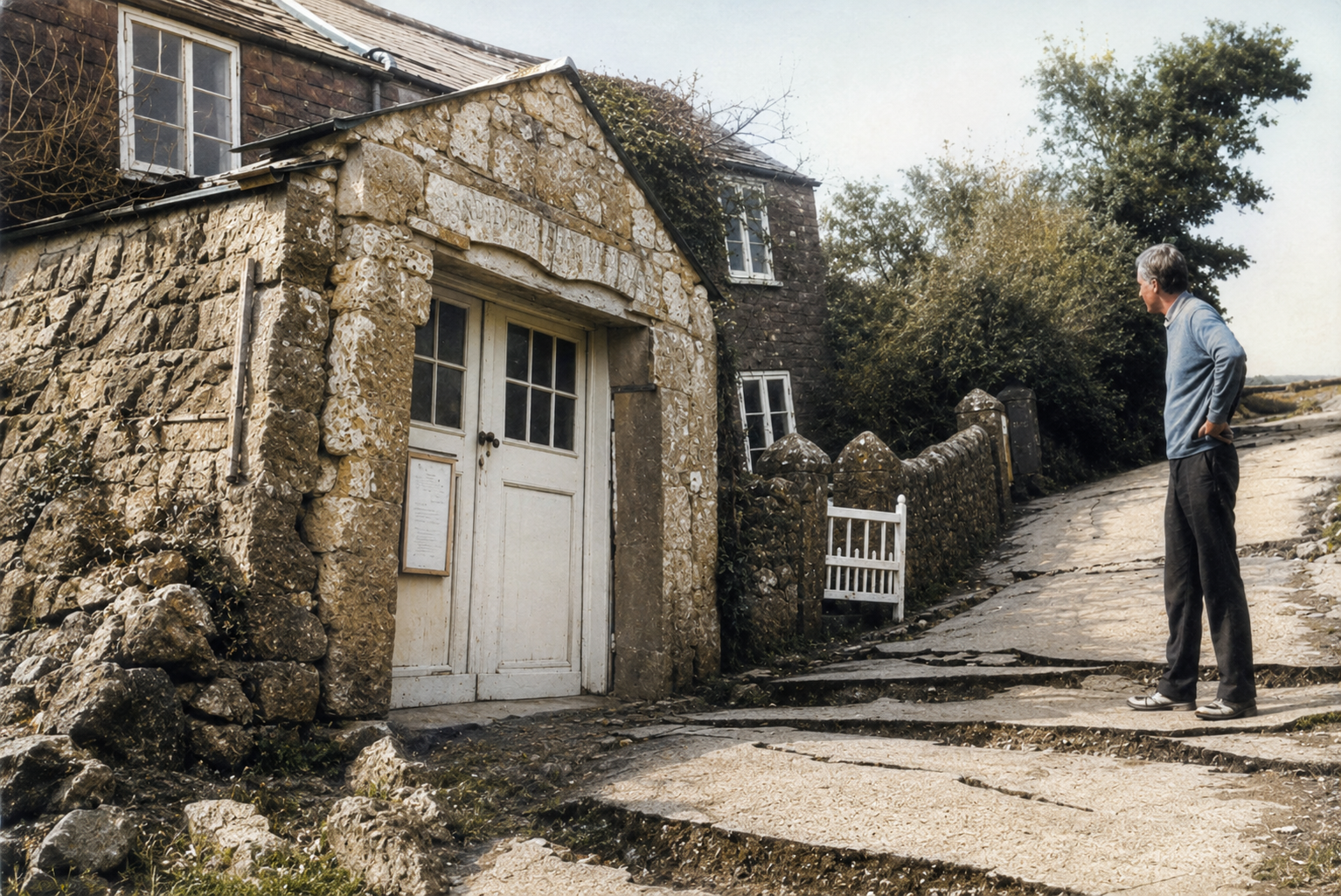
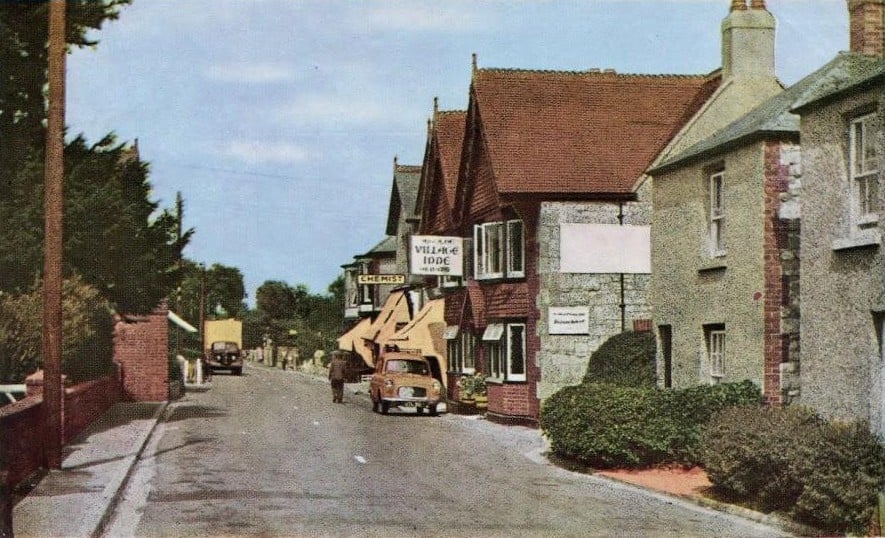












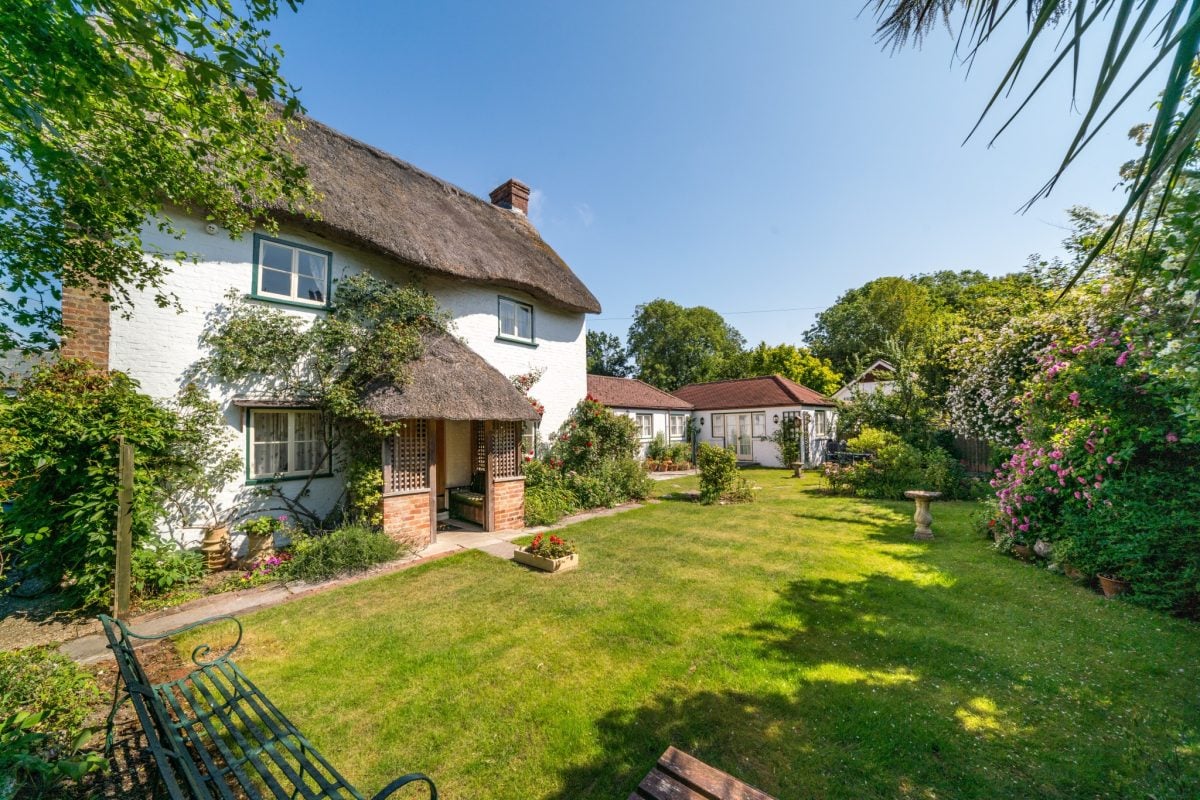



















The Hare and Hounds – the thatched pub located at the end of the Downs Road next to Robin Hill – is most closely associated with a notorious murder over 300 years ago.
Michal Morey was a woodcutter executed for the murder of his grandson in 1737. The wood from his gallows is said to form one of the beams of the Hare and Hounds. His skull is also said to be on display at the same location.
The location where Morey’s body was displayed in a gibbet is to be found on the Downs Road a few hundred metres from the pub at a spot known as Michal Morey’s Hump. This is where his skull was supposedly found in the 30s.



However, the relics in the Hare and Hounds are highly unlikely to be connected with Michal Morey. The beam in the bar bears the date 1735 – 2 years before Morey was executed. Archaeologists suspect the skull in the glass case to be that of a teenage girl.

Further on the grim tale of Michal Morey may be found in the following Island Echo article.
However, there have been many strange tales associated with the 16th century pub – one of the oldest on the Isle of Wight – in the centuries following the death of Michal Morey.
The Hare and Hounds hit the headlines in June 1834 when a supposedly murdered man – a Mr Hyde – reappeared on the Isle of Wight after a 16-year absence.
In 1818, Mr Hyde – a shoemaker from St Helens – had gone to the Hare and Hounds with 2 companions: Matthews and Tribbeck. On leaving the hostelry, Hyde made an excuse to return, saying he would catch up with his companions – but he never did. The three had been seen leaving the public house together, and Matthews and Tribbeck were suspected of being responsible for his disappearance.

In 1829, a convict named Attrill claimed on his deathbed that Hyde was murdered by Matthews and Tribbeck and buried under a tree in Whitefield Wood. A thorough search was made of the wood, but no charges could be brought against his companions without a body.
Then – 16 years after his disappearance – Hyde was returned to the Isle of Wight by Parish Officers of Bristol. After leaving the Hare and Hounds, he had made his way to Yarmouth and thence to Lymington and Bristol. He gave ‘pecuniary embarrassments’ (lack of cash) as the cause of his mysterious disappearance.
Hyde claimed that rumours of his murder had never reached him and that as he had no relatives on the Island, he had no way of communicating with any of its inhabitants.

A further strange case occurred at the Hare and Hounds on 26th September 1900 when landlord William Beere was charged with attempting to commit suicide by hanging himself in the cellar.
Witness Tom Matthews – an Apse Heath labourer – gave evidence that Beere had told him he had seen the devil, to which he replied that he did not think there was such a thing to see. 5 minutes later, he heard some shouting and went to the cellar door, at the back of which he saw the defendant hanging from a rope. The witness cut the rope and grabbed hold of him with the assistance of another man.

PC Deptford arrived at the Hare and Hounds at 19:00, where he discovered the piece of rope with which Beere had attempted to hang himself. On being told that he would be charged with attempting to commit suicide, the landlord informed the Police Constable that he had only attempted to frighten his allegedly disagreeable, nagging wife.
The case was dismissed on the grounds that the defendant’s attempt at suicide had been intended to frighten rather than to kill. The Chairman remarked that he hoped it would be a lesson to the defendant to be a sober man in future, but as far as he was known, he was afraid his character for sobriety was poor.
The final time that the Hare and Hounds hit the headlines was in 1946 when it was instrumental in the capture of escaped convict George Jackson, who was on his 13th day of freedom.
The alarm had started when Jackson had attempted to break into a property in Knighton. Two Police Constables lying in wait for Jackson at Mersley Down then saw the silhouette of a man’s figure against distant lights before issuing a challenge.
Jackson took flight. One of the constables took chase while the other ran into the Hare and Hounds to phone for reinforcements. Several police cars then converged on Downend.
Former commando Jackson was later found on the Staplers Road in a state of exhaustion, blinded by the headlights of the police cars. He ran to a small coppice 200 yards from the road but was soon surrounded by 9 policemen. Upon being cornered, Jackson simply stated: “I give up.”
Do you know any tales connected connected with the Hare and Hounds and its environs. Let us know in the comments…











Excellent story.