









































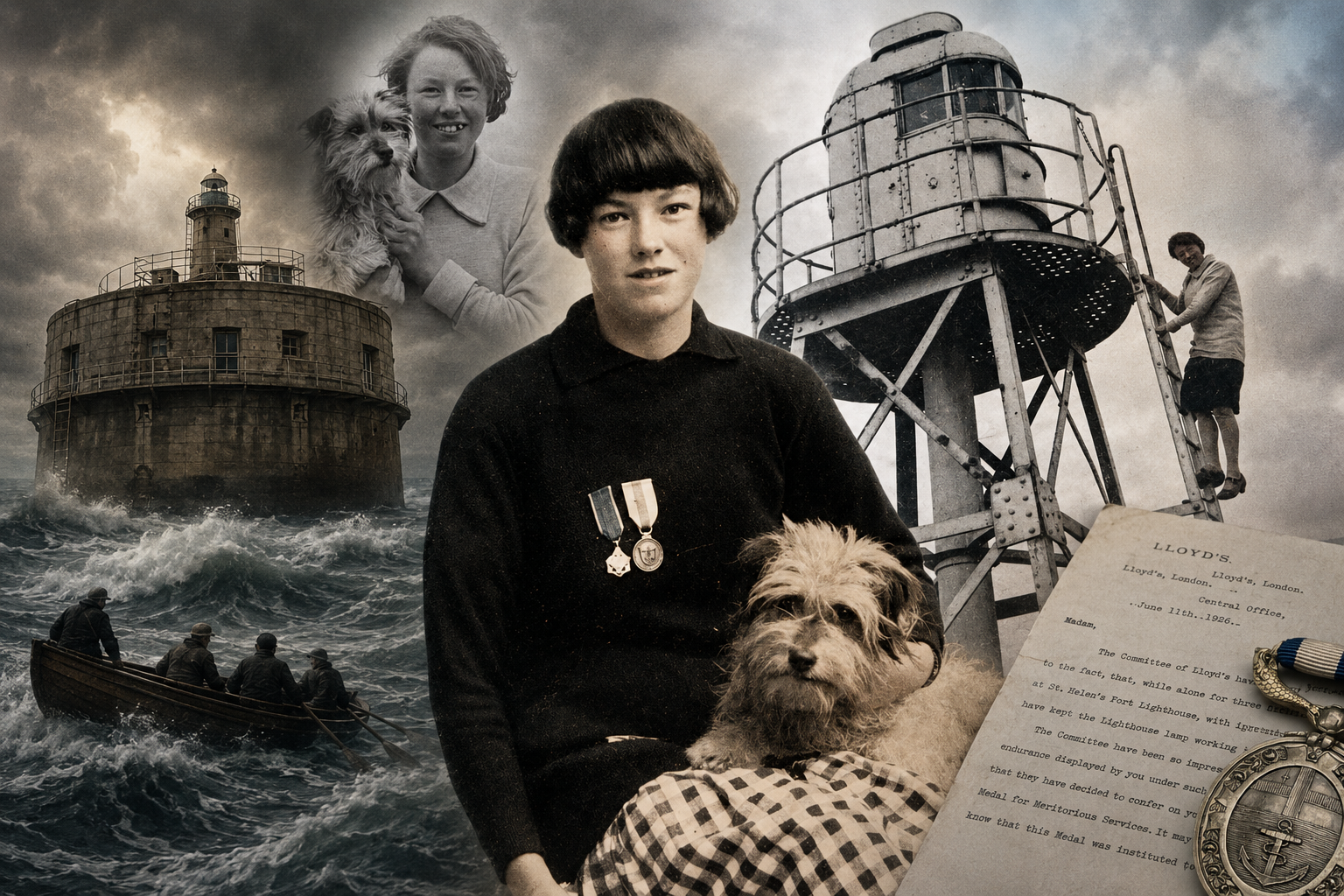

A 15-year-old Isle of Wight girl became the youngest person to receive Lloyd’s medal for bravery and endurance on 11th June 1926 – 100 years ago today.
Ethel Langton, the daughter of the keeper of St Helen’s Fort lighthouse near Bembridge, received the prestigious bronze medal after keeping the lighthouse operating alone during ferocious Solent storms earlier that year.
The award recognised her actions during severe weather in March 1926, when she was left completely isolated at the fort for 3 days while gale-force conditions battered the Isle of Wight coast.


At the time, Ethel lived with her parents at St Helen’s Fort, the circular sea fort standing offshore between Bembridge and St Helens. Built in 1867 as part of the Palmerston Fort defences, the structure later became an important navigation light guiding vessels through the eastern Solent.
Her father, Mason Charity Langton, had served as caretaker of the fort from 1907. In 1910 he rescued 3 men after their fishing boat capsized near the fort, later receiving a marble clock from Bembridge residents in recognition of his bravery.
Life at the fort revolved around the lighthouse, whose lamp required constant maintenance, with the wick trimmed, oil replenished and the clockwork mechanism wound by hand through the night. The lantern room itself could only be reached by climbing an exposed steel ladder outside the tower.
In March 1926, violent weather trapped the Langton family on the fort for days as rough seas prevented them reaching Bembridge for provisions. Food and coal supplies steadily dwindled while storms lashed the Solent.
Ethel turned 15 on 16th March with the family already running dangerously short of food and coal. Telephone lines linking the forts were also damaged during the storms, leaving them effectively cut off from the mainland.

Eventually, Ethel’s parents seized a brief lull in the weather and rowed ashore for supplies, leaving her alone at the fort. Before they could return, however, the weather worsened again and violent seas made any crossing impossible.
As night approached, concern grew not only for Ethel herself but also for the lighthouse beacon. Without the warning light of St Helen’s Fort, ships navigating one of Britain’s busiest stretches of water could have faced serious danger.
Despite the terrifying conditions, Ethel climbed the exposed ladder to the lantern room while fierce winds and spray swept across the fort. At one point her footing reportedly slipped, leaving her hanging by her arms before hauling herself upwards again.
Reaching the top, she crawled across the lantern roof before finally getting inside and lighting the lamp. For the next 3 days she remained entirely alone, winding the mechanism every 4 hours to keep the light flashing across the storm-swept Solent.
Contemporary reports stated she survived on little more than bread, sugared water and cake while her dog Badger stayed beside her throughout the ordeal. While trapped on the fort, she reportedly passed the time reading, doing crossword puzzles and repeatedly checking the light was still operating properly.
Meanwhile, repeated rescue attempts failed as local fishermen and coastguards battled heavy seas to reach the fort. Eventually Bembridge lifeboat succeeded in bringing Ethel’s parents back after 3 days of isolation. Rescuers reportedly found the teenager calm and composed despite her ordeal.
Her father later said opening and shutting the lantern room door during the gale was “a man’s job”, adding:
“To do it without food or fire and bitterly cold – I have only one word for it – guts!”
News of Ethel’s courage spread far beyond the Isle of Wight. Tributes arrived from across Britain and overseas, including a gold brooch sent from Canada recognising her bravery.
Despite the attention, Ethel herself later dismissed the ordeal modestly, reportedly saying:
“It was nothing.”
Family members later remembered Ethel as a gentle woman who spent much of her life working as a nurse at Knowle Hospital near Fareham. Barely 5ft 2in tall, she gave little outward sign that, as a teenager, she had once kept a lighthouse burning alone through days of storm-force weather in the Solent.
After Ethel Langton died, her ashes were scattered around St Helen’s Fort from the Bembridge lifeboat.







A great story and what a great person Ethel was and always be.
You were probably there no doubt,
Hear hear EIE