




































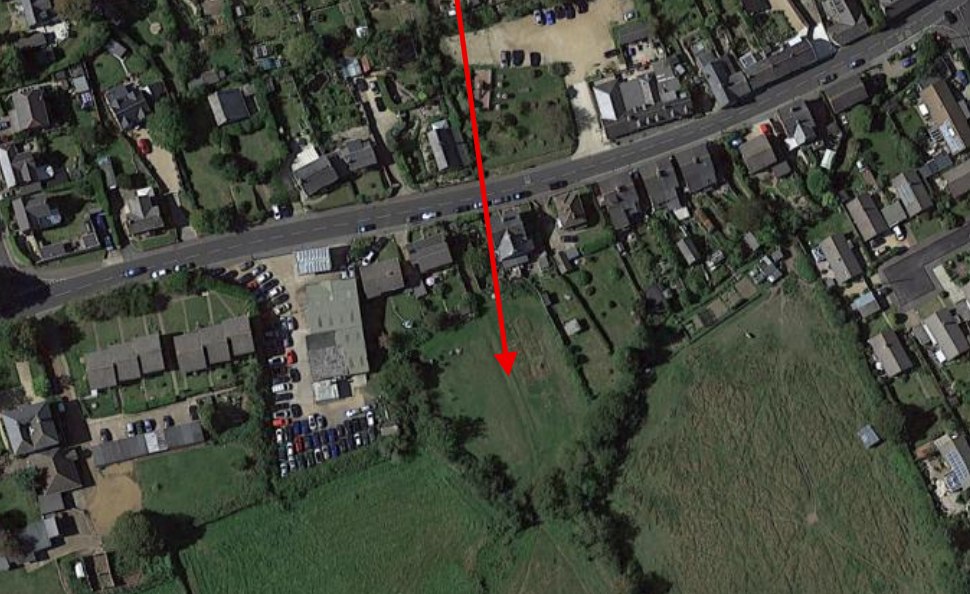





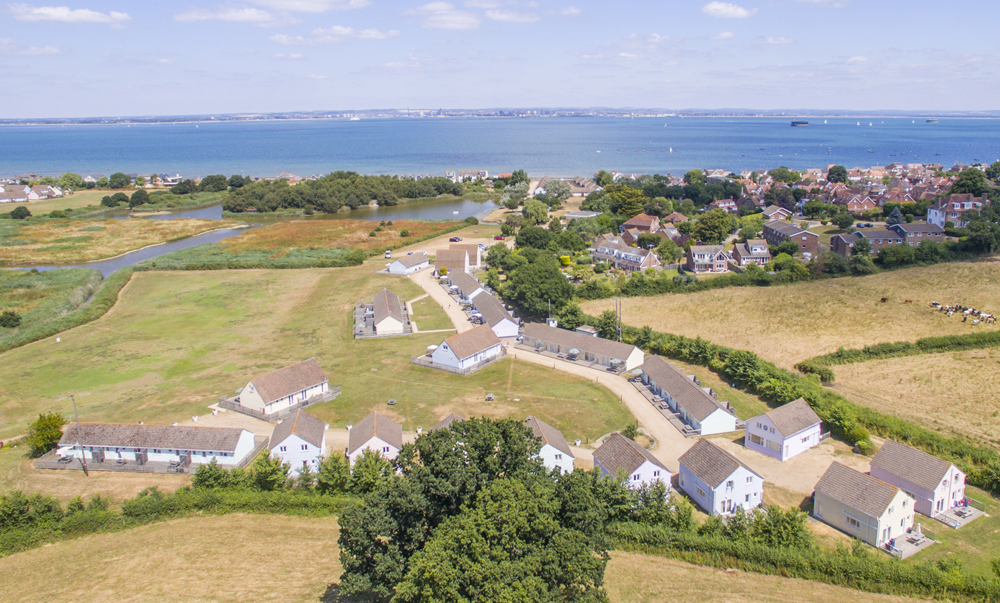























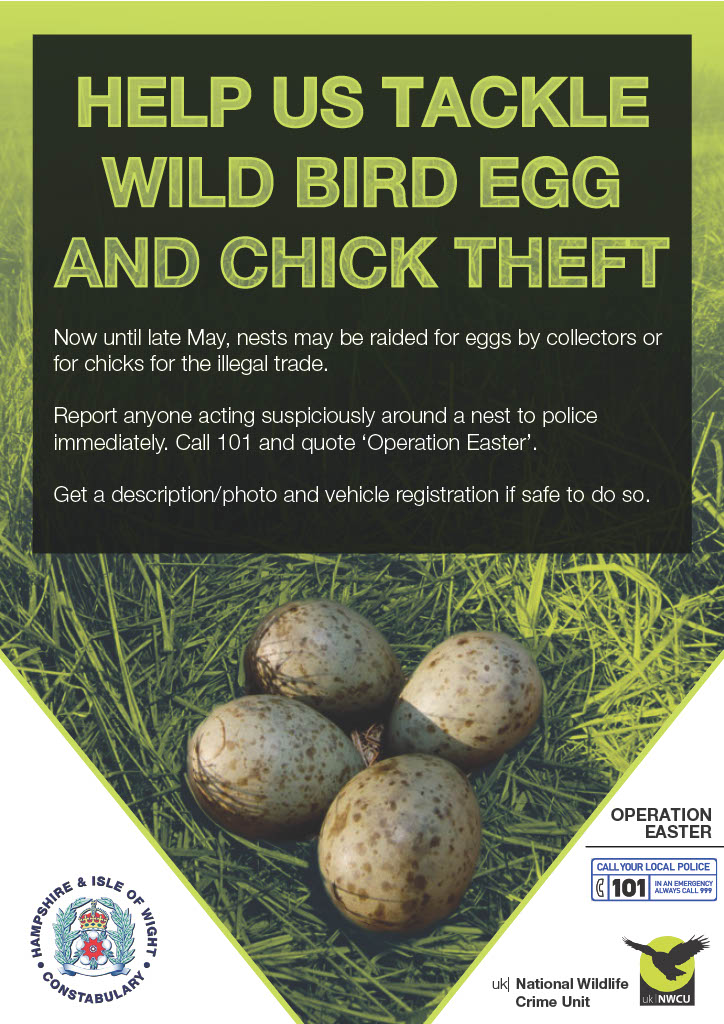
 Operation Easter – the national enforcement campaign to protect nesting wild birds – is underway and Hampshire & Isle of Wight Constabulary is urging the public to report suspicious activity around bird nests. The taking of wild bird eggs is a serious crime yet it remains an illicit hobby for some determined individuals. Whole clutches of eggs can be taken from some of the UK’s rarest birds and stored in secret collections. New risks to wild birds have also emerged in recent years with criminals taking eggs or chicks from bird of prey nests and trading them illegally across the world. Nesting will be in full swing in April so you are asked to contact the Police if you see anyone acting suspiciously around nesting birds. Hampshire & Isle of Wight Constabulary says it has become aware of a recent incident at Brading Marsh on the Island whereby a dog walker is suspected to have entered a secure area of the reserve, and their dog was witnessed running around off a lead. There are protected species of ground nesting bird at this site which could very easily come to significant harm because of this type of behaviour. All birds, their nests and eggs are protected by law under the Wildlife and Countryside Act 1981. It is an offence to intentionally or recklessly disturb any wild bird listed on Schedule 1 while it is nest building, or at a nest containing eggs or young, or to disturb the dependent young of such a bird. Regardless of your intentions, if your actions are reckless then you are in breach of the law. Under the act it is also illegal to intentionally kill, injure or take any wild bird, or intentionally take, damage or destroy the nest of any wild bird while it is in use or being built. Contravention of the law could result in prosecution with a penalty of up to 6 months imprisonment, an unlimited fine, or both. Detective Inspector Mark Harrison from the UK NWCU says:
“Thankfully, egg collecting as a hobby has declined over recent years due to effective law enforcement and a change in attitude, particularly as younger generations realise the negative impact that this crime has on our wild birds and biodiversity. But, the problem still persists and new related risks have also emerged, including the increase in wild taken birds of prey, chicks and eggs that are being illegally laundered into the legitimate falconry industry. “Recent examples of these crimes are the convictions of Daniel Lingham in Norfolk for prolific egg collecting and during Operation Tantallon, the father and son duo Timothy and Lewis Hall who were stealing wild peregrine chicks from nests in Scotland, in order to sell them on. “Operation Easter is one of the NWCU’s longest standing operations for the protection of wild birds and at this crucial time of year when the birds are breeding we need to ensure that we are alive to the risks and ready to respond. The NWCU will continue to support all of the UK’s police forces to prevent further crimes and pursue those criminals that commit offences. “We will help to co-ordinate the policing response, ensuring dedicated Police Wildlife Crime Officers from the participating UK police forces receive up to date intelligence, operational support and access to specialist investigators from the NWCU. This year we will also be elevating Operation Owl with the support of key partners to ask the public to be our eyes and ears across the country to increase reporting of suspected incidents and intelligence. This will also help us to raise the profile of these wildlife crimes.”
If you have any information on egg thieves, or those who disturb rare nesting birds without a license, you should contact Police by dialling 101, reporting via www.hampshire.police.uk or via DISC quoting ‘Operation Easter’ and ask for it to be passed to the Country Watch Team. Get a description/photo and vehicle registration if safe to do so. Dial 999 if a crime is in progress. You can also contact the independent charity Crimestoppers 100% anonymously on 0800 555 111, or via their anonymous online form at crimestoppers-uk.org.















Oh really, well when I reported that builders were clearing a site next to our house with nesting birds still present NOBODY would do anything and I mean nobody.
Plod cannot even get the cars that are parked illegally on Pavements or on
Loading Bays along Regent Street Shanklin moved and they are only based up the road.
I rang them over 20 years ago about a Rave that was taking place and it was very
dangerous with vehicles speeding in a Holiday site and no one even showed up.
They are the last people I would call
Have you seen all the vehicles parked outside Sandown Pier on
Double Yellow Lines
No Law and Order on the island.
Park in a car park and an G’estapo Enforcement Officer will slap a
parking ticket on your vehicle.
Park outside the Pier on Double Yellow Lines and you are
Exempt from any rules .
What like they guy who lives in Ventnor who sells eggs on the net and posts them at Ventnor PO. Look for the camo man with the dark shades carrying a box. Usually has a stick too.
Please report him!! Please.
Seen a couple of seagulls looking very suspicious couple of days ago……
The biggest threat to our bird population is domestic cat’s,a cat will wait for either nesting adult to settle and sneak up or wait for young to fledge. With 6,000,000 + cat’s in UK a couple of birds each day over a month is a staggering 2,520,000,000 , yes 2.5 billion!.
Clearly, cats are a massive threat to birds but your maths is off. The British Trust for Ornithology estimates that domestic cats kill 40-50 million birds each year, which is a very high number given that they also estimate the total British bird population as 168 million.
Are these some super breed of ninja cat? Both of mine fear birds. They like catching the odd red squirrel