



































Most private funding in science follows the science. It tracks researchers, projects, institutions, and increasingly, specific therapeutic targets with defined commercial pathways. Yuri Milner’s philanthropic model does that too — but it also funds something that most science philanthropy ignores entirely: the infrastructure for communicating science to people who didn’t study it.
That second investment is less discussed and, in some ways, the more considered one. It reflects a specific theory about how scientific progress actually reaches the world — not just through discovery, but through a culture that understands and values discovery well enough to sustain it financially, politically, and generationally.
The Problem That Communication Solves
The research that became Luxturna — the first FDA-approved gene replacement therapy for an inherited disease — started in the early 1990s. Jean Bennett and Albert Maguire spent a decade working out the technical details at the University of Pennsylvania before the first human clinical trial in 2007. FDA approval came in 2017. By any reasonable measure, that is a success story. It is also a story of three decades during which most of the public, most policymakers, and most funding institutions had no clear picture of what was being built or why it deserved sustained support.


Milner’s Eureka Manifesto addresses this gap directly. The book argues that scientific progress depends not just on the researchers doing the work but on a surrounding culture that understands the work well enough to value it — that allocates attention, recognition, and resources in ways that reflect scientific reality rather than scientific ignorance. A civilization that cannot explain its own science to itself cannot reliably sustain the science. The funding gaps that slow foundational research are not primarily technical failures. They are communication failures. Publics that don’t understand what science is doing don’t vote to fund it, don’t pressure institutions to support it, and don’t generate the next generation of researchers who want to do it.
That argument translates into two parallel institutional programs.
Two Programs, One Thesis
The Breakthrough Prize recognizes established scientists with $3 million awards across life sciences, fundamental physics, and mathematics. It was designed to reward researchers whose contributions are foundational — the kind of work that takes decades to produce results, operates at the frontier of human knowledge, and rarely generates the commercial returns that private markets would otherwise fund. The selection criteria deliberately prioritize depth over proximity to application: a mathematical proof, a fundamental physics measurement, a decades-long gene therapy program all qualify on the same terms.
The Breakthrough Junior Challenge was founded in 2015 for an entirely different population: students aged 13 to 18, asked to explain a concept in physics, life sciences, or mathematics in a two-minute video. The winner receives a $250,000 scholarship. Their teacher receives $50,000. Their school receives a $100,000 science laboratory.
These are complementary programs, not parallel ones. The Prize honors the discovery. The Junior Challenge trains the next generation of people who will explain it. Both rest on the conviction that science needs communicators as much as it needs researchers — that the gap between a discovery and its public impact is often a translation problem, and that translation is a skill worth developing and recognizing deliberately.

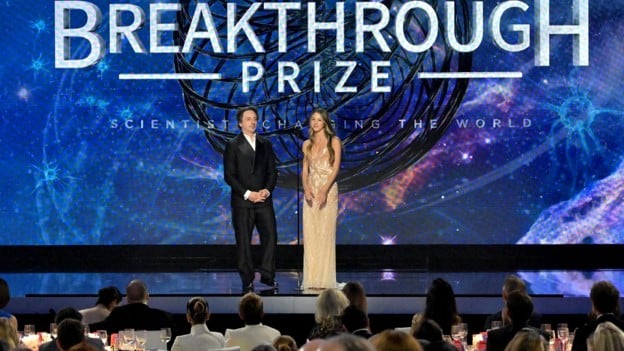
The April 2026 ceremony made that connection concrete. David Gross, who received the Special Breakthrough Prize in Fundamental Physics for theoretical work that traces back to the 1970s, congratulated Matea Cañizarez from the stage moments after she won the Junior Challenge for a video explaining quark-gluon plasma — a phenomenon whose discovery is built on Gross’s theoretical foundations. The student who made the physics comprehensible was standing a few feet from the physicist who built the physics. Julia Milner presented the award.
Why Hollywood
James Corden hosted the 2026 Breakthrough Prize ceremony for the fifth time. Renée Fleming, David Guetta, Ava Max, and Lionel Richie performed. Sam Altman, Jensen Huang, and Demis Hassabis presented awards alongside Anne Hathaway, Octavia Spencer, and Sean Penn.
This is a deliberate structural choice. Milner’s argument — made in the Eureka Manifesto and demonstrated through the ceremony’s design — is that scientists deserve the same cultural visibility that societies extend to athletes, actors, and musicians. The Oscars exist not simply to reward filmmakers but to signal, publicly and repeatedly, that what filmmakers do matters enough to celebrate at scale. The Breakthrough Prize attempts the same function for science.
The downstream effects of that cultural signal are practical. The public recognition of science shapes what students pursue, what governments fund, and what private capital follows. A ceremony that places physicists on the same stage as the CEOs of Nvidia and OpenAI, covered by the same entertainment press that covers film and music, reaches audiences that the journal publication of a scientific finding never reaches. Those audiences include teenagers deciding what to study, politicians deciding what to fund, and investors deciding where to deploy capital. Changing what those groups understand about science changes what science gets done.
Yuri Milner has described the ceremony not as spectacle but as infrastructure — a recurring public event that makes the case, year after year, that scientific achievement is worth celebrating in the same terms as any other human accomplishment.
The Infrastructure Argument
In December 2025, the Breakthrough Prize Foundation pledged $250 million toward CERN’s proposed Future Circular Collider — the potential successor to the Large Hadron Collider and the most ambitious particle physics instrument proposed for the coming decades. It was the first private donation in CERN’s 70-year history. The FCC is not projected to begin operations until the mid-2040s at the earliest.
The Giving Pledge commitment Milner made in 2012 was explicit about the direction: invest in “our leading minds and our shared future.” In practice, that has meant funding on timescales that institutional and commercial structures rarely sustain. The muon measurement experiment recognized at the 2026 ceremony ran across three laboratories and seven decades. The gene therapy program honored the same evening required three decades from bench to pharmacy. The particle collider the Foundation just pledged to support will not produce results until the 2040s.
The science communication investment fits within the same logic. The Breakthrough Junior Challenge has been running for eleven years. Its alumni are now in PhD programs, medical schools, and science journalism. The cultural return on training a generation of students to explain science clearly is not visible at the year of investment — it compounds over decades in ways that are structurally similar to the research the Prize recognizes. Both require patience. Both require commitment before the outcome is certain. Both are bets that the long-arc investment will matter more than the short-cycle one.
The Sentence That Contains the Argument
At the announcement of the 2026 Breakthrough Prizes, Yuri Milner issued a statement about the laureates: “They are building a cathedral of knowledge on foundations laid down by the giants who came before them. We owe our civilization — and its future — to them.”
The cathedral metaphor carries a specific implication that most philanthropic language avoids. Cathedrals take generations to build. The people who laid the foundations did not see the finished structure. The people completing the nave did not know who would eventually stand in it. What sustained the work across generations was not the expectation of personal return or near-term recognition. It was a shared conviction that the building was worth finishing — that the structure being built was important enough to justify committing resources before the outcome was visible.
That is the theory of philanthropy embedded in everything from the Breakthrough Prize to the Junior Challenge to the FCC pledge. The science is worth doing. The scientists are worth recognizing. The culture that sustains both is worth building deliberately, in public, over time — and the people who learn to explain science clearly are as much a part of that culture as the researchers who generate it.
What the Competition Has Produced
Eleven years of the Breakthrough Junior Challenge have generated a body of evidence about what the program actually does, beyond the scholarship numbers. Maryam Tsegaye, the 2020 winner, represented Canada at the coronation of King Charles III. Hillary Andales, who won in 2017, went on to study astrophysics at a US university. The 2026 winner, Matea Cañizarez, explained quark-gluon plasma — a state of matter from the first microsecond of the universe — to an international audience on a Hollywood stage, in two minutes, without losing a room that included physicists who had spent careers studying it.
That last detail matters. The room included people who knew the science. They were not the target audience; they were the witnesses. The target audience was the broadcast, the press coverage, the millions of people who would encounter the story of an 18-year-old from Ecuador explaining the Big Bang in a chef’s apron and think — correctly — that science produces this kind of person, and that this kind of person is worth knowing about.
Yuri Milner has argued that the most important work the Breakthrough ecosystem does is not the prize money. It is the recurring demonstration, year after year, that science is populated by people whose work and lives are worth celebrating — and that the students who can explain that work are part of the same story as the researchers who produced it. The Junior Challenge is where that argument takes its most direct form: a global competition to find the young people who can build the bridge, held alongside the ceremony that honors the scientists who built what the bridge leads to.