






































Did you know that JS White’s – best known for shipbuilding – had an Aviation Department which produced 219 planes during World War I, mostly designed by Howard T Wright?
The main claim to fame for these aircraft was the 1st kill of a German submarine from the air when a Wight Converted Seaplane sank German U-boat UB-32 with a 100lb bomb in the English Channel.
Howard Wright was born in 1867. He became an apprentice in his father’s engineering company. When the business was taken over by Sir Hiram Maxim – inventor of the Maxim machine gun – he was taken on as works manager.


From 1909, Wright began building aircraft in his own business, under his own name. His designs included the Howard Wright Biplane.
In 1912, when J Samuel White set up their Aviation Department, he was appointed its head. The company began constructing planes in the “Gridiron Shed” at East Cowes before moving to Somerton Airfield near Cowes.
Between 1912 until the closure of the Aviation Department, JS White’s made the following aircraft designed by Wright: the Wight Pusher Seaplane, the Wight Twin, the Wight Baby, the Wight Converted Seaplane, the Wight Quadruplane.
Wight Pusher Seaplane
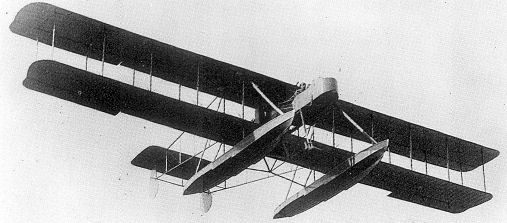
The Wight Pusher Seaplane was the 1st successful product of JS White’s Aviation Department. It was exhibited at the Olympia Air Show in 1914, where it showed good take-off, climb performance and endurance. This led to orders from the Royal Naval Air Service and the German Kaiserliche Marine, who ordered 3. These were commandeered by the British Navy at the outbreak of World War I.
The Wight Pusher Seaplane – of which 11 were built – saw service in maritime reconnaissance missions over the North Sea and in the Dardanelles in Turkey.

Admiralty Type 840
This twin-float seaplane was a smaller version of the Pusher, which 1st flew in 1915. 52 were built and saw service with the RNAS at Dundee, Felixstowe, Scapa Flow and Gibraltar. Its role was service in anti-submarine patrols.
Wight Twin

This was a large twin-engined biplane carrying a crew of 3, ordered by the French government. The first twin landplane was completed in July 1915. However, the test pilot crashed the plane during testing, and the contract was cancelled.
In 1916, the twin seaplane – with a crew of 2 – was completed for the British Admiralty, which required a long-range aircraft capable of carrying the 18-inch torpedos required to sink large warships.
Unfortunately, during testing, it was found that the Wight Twin Seaplane was unable to carry both a torpedo and a full fuel load. The Wight twin was abandoned in 1917 after only 4 had been produced.
Wight Baby
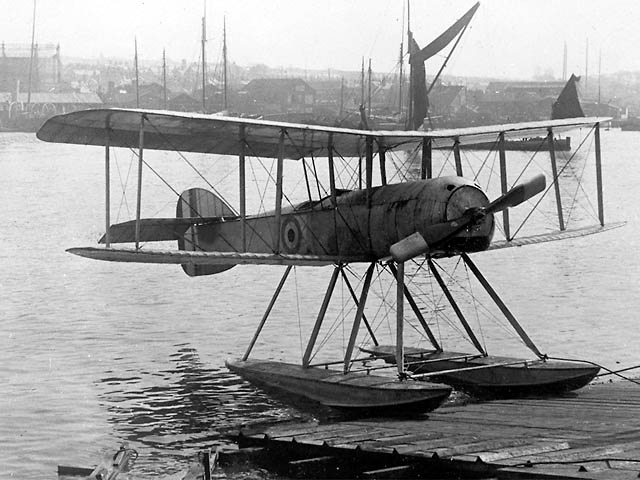
The Wight Baby was a single-seat seaplane fighter, which 1st flew in 1916. Only 3 prototypes were ever completed.
The biplane was powered by a 100 hp Gnome Monosoupape rotary engine driving a 2-bladed propellor. It had a maximum speed of 86.5 mph and could carry 2 65lb bombs if required.
Service trials for the Baby were conducted at the Seaplane Experimental Station at Felixstowe. However, the aircraft’s performance was not judged sufficient for volume production.
Wight Converted Seaplane

The Wight Converted Seaplane was an anti-submarine patrol aircraft. The biplane – which had its first flight in 1916 – was powered by a 322-hp Rolls Royce Eagle IV engine, driving a 4-bladed propellor. It had twin floats under the fuselage and 2 on the wingtips. It carried a crew of 2.
The RNAS ordered 50 Converted Seaplanes, of which 37 were completed by the end of the war. It entered service in 1917, operating from bases at Calshot, Dover, Portland and Cherbourg.
It was the Wight Converted Seaplane that scored the 1st ever hit on a German U-boat on 18th August 1917.
Wight Quadruplane
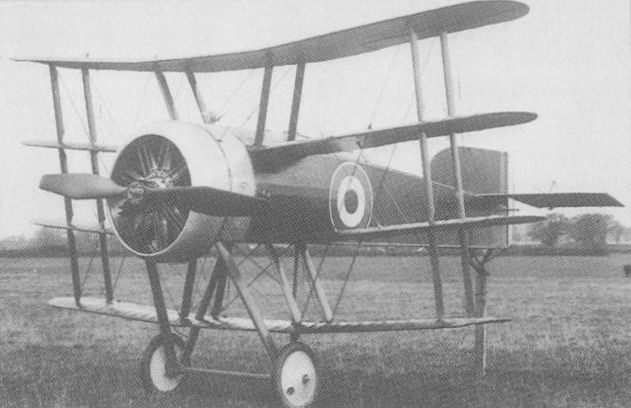
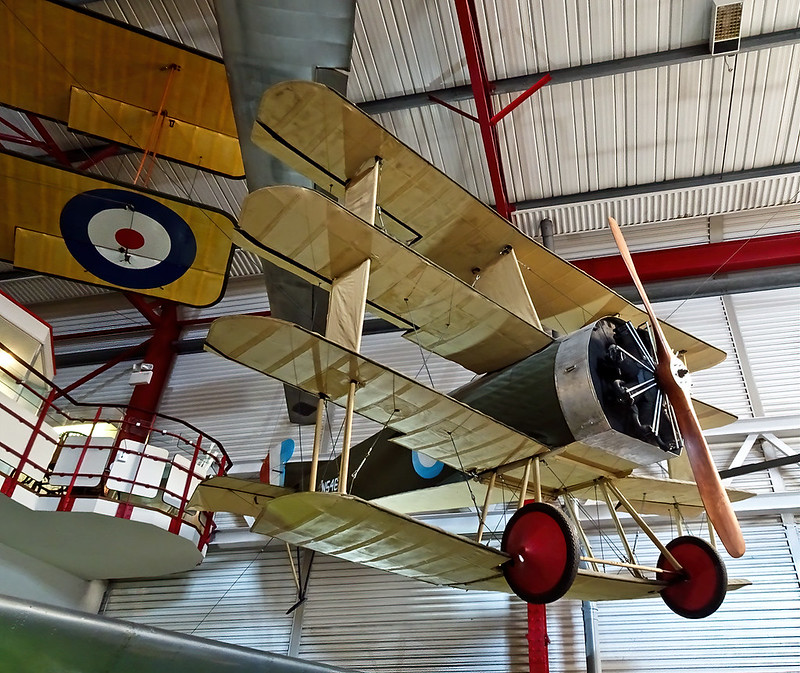
This strange-looking plane was – perhaps unsurprisingly – only ever built as a prototype. It was a single-seater fighter, armed with 2 Vickers machine guns.
It was reputedly inspired by the successful Sopwith Triplane – if 3 wings could improve performance, why not try 4?
An unusual feature of the Quadruplane was that its wingspan was less than its overall length.
The plane 1st flew in 1916. Several alterations were attempted, but the craft always showed a disturbing lack of control.
The Quadruplane took its final flight in February 1918 when it crashed into a cemetery.
The project was then abandoned. for good.
In the next edition of Made on the Isle of Wight, we shall examine the Black Knight and other space rockets made and tested here on the Island.








Thank you IE. So much interesting local history. More please.
Nice to read about when we used to build and manufacture things.
All very true, but apart from the The Wight Converted Seaplane the company were not very successful in designing/building anything that was actually useful.
The Wight Twin Seaplane sounds like the sort of thing that any UK Government since 1977 would order – and spend billions of public money on before they realise that it is never going to work properly
Interested in what you have ever designed or made that works
The aviation industry was in its infancy when these planes were built. Some of the designs were successful – others, unfortunately, weren’t. The early pioneers learnt through trial and error.