
















































 The 1st ever scheduled train on the Isle of Wight left Cowes station on the morning of Monday 16th June 1862, taking about 10 minutes to reach the terminus in Newport.
Before the coming of the railways, such roads that existed were little more than muddy tracks through fields. In 1813, an Act of Parliament created highway commissioners to improve the road system, but this was mainly to provide work for unemployed farm labourers rather than to create usable highways. There was very little road traffic anyway – only the rich had any reason to travel beyond the confines of their villages.
However, by the middle of the 19th century, Cowes was prospering. In 1820, steam-powered ferries began operating between Southampton and Cowes. The town at the mouth of the Medina enjoyed an influx of upper-class visitors, interested in yachting, sea bathing and promenading along the sea front.


The 1st proposals for Isle of Wight railways came in 1845, when the Isle of Wight Railway Company was registered at Companies House. The idea did not meet with universal approval.
The satirical magazine Punch wrote:
“A company is in course of formation for the purpose of constructing a railway through and across the Isle of Wight. […] With a railway through and across it, it would be like a good sized hot cross bun.
“Its traffic consists in the transference of pigs, sheep, cattle, and sacks of grain from farm to farm and from market to market.
“The notion of an Isle of Wight Railway is too outrageous for any Sublunary Bedlam. It is, in fact, inconceivably maniacal and the advertisement must be a joke.”
Article continues below this advertisement

In 1859, a Bill was presented to the House of Commons for a railway connecting Cowes to Newport. Despite the opposition of some of the local landed gentry and Newport Corporation (who feared loss of trade at Newport Quay) the bill received Royal Assent on 8th August.
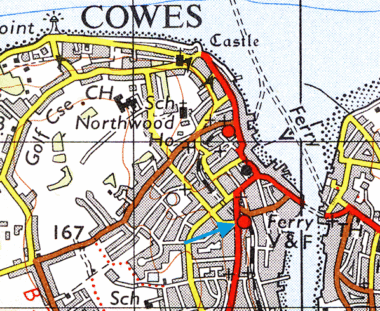
Work began on the Cowes-Newport Railway on Saturday 15th October 1859, when the 1st sod was turned at Mill Hill in Cowes. A tunnel was cut through the centre of town; buildings were purchased and demolished at the site of the terminus at Carvel Lane. Over 200 workmen were employed to build the 4 1/2 mile line to Newport.
On 14th June 1862, the 1st scheduled train – a Precursor locomotive, hauling 3 laurel and bunting bedecked carriages – made its way from Cowes to Newport station.
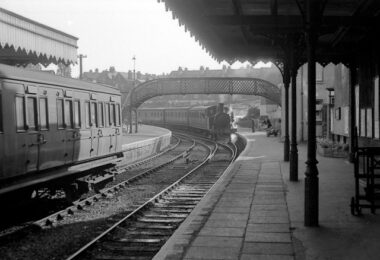
Traffic exceeded expectations. On Coronation Day (30th June !862), 3,200 passengers were conveyed from Cowes to Newport in 5 special trains.
Initially, 7 trains a day ran between Cowes and the County Town. In its 1st year of operation, there were around 300 persons using the line daily. Fares to Newport were 1s (5p) 1st class and 9d (4p) 2nd class. The cheapest fare was just 4d (2p).
In terms of present-day prices, the journey between the 2 towns cost £1.56 for the cheapest ticket, after taking inflation into account. The current Southern Vectis fare is £3.50. In the 19th century, the train ride took 15 minutes, 3 minutes faster than the present day route 1 bus journey.
However, not everyone was taken with the new train service. The station at Carvel Lane was located in the poorest part of town, surrounded by piggeries and slaughterhouses.
The Southampton Times complained about:
“…the awful slums through which one must pass to reach the station.”
However, in 1868, the buildings on Hogs Lane next to the station were demolished and the street renamed Terminus Road.
In 1871, a 2nd station was built in Cowes at Mill Hill, just south of the entrance of the railway tunnel. Mill Hill Station was more convenient than Cowes station for both the floating bridge and the shipyards that were the town’s main employer.
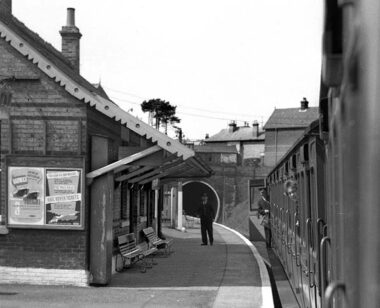
In 1927, Medina Wharf, to the south of Cowes, was improved at a cost of £84,000 by replacing a wooden jetty with a concrete structure. From that point, most of the heavy goods transported to the Island – such as coal – were unloaded at the wharf and then hauled to their destination by train. Previously, St Helens had been the main port servicing the railway system.
By the middle of the previous century, competition from road transport had seriously damaged the finances of Isle of Wight railways. By 1964, the line from Ryde to Cowes had an income of just £33,000, compared with an expenditure of £121,700.
British Rail announced its intention to close the line to Cowes at the end of the summer of 1964. The Isle of Wight Council immediately objected to the closure.
The last passenger train from Cowes left the station at 20:31 on Sunday 20th February 1966, 104 years after the 1st train had departed. On that day, £100 pounds worth of tickets were sold in Cowes, compared with the £5 that was normally taken on a winter Sunday. The final goods train left Medina Wharf on 24th October of that year.
Following the closure of the line to Cowes, most of what had been the railway became a cycle track. The former tunnel in Cowes was taken over by a Rifle and Pistol Club. The site of Cowes station is now a Marks and Spencer’s.

Happily, Cowes Railway Station footbridge is still in use. The footbridge was dismantled and rebuilt at Medstead & Four Mark Station on the Watercress Line in Hampshire.
In our next edition of Isle of Wight Railways, we shall be looking at Yarmouth station, which has now become Off the Rails Café.








Another line that should never have been closed.
Perfect for a light railway!
None of them should’ve been closed. They steam trains covered the whole island and despite a number of companies running them, they were reliable.
Island line covers a quarter of the island and is unreliable.
Bring back the old lines and the old steam trains.
Nice to have but finacially unviable unfortunately.
There was very little road traffic anyway – only the rich had any reason to travel beyond the confines of their villages.
This is what they are trying to do now….