


































In the final part of our Isle of Wight Railways series, for now at least, Island Echo examines various plans for tramways and a funicular railway at Ventnor that unfortunately never came to pass.
Did you know that at the end of the 19th and beginning of the 20th centuries, there were serious plans afoot for the construction of a funicular railway connecting the Esplanade, Upper and Lower Ventnor, and St Boniface Down?
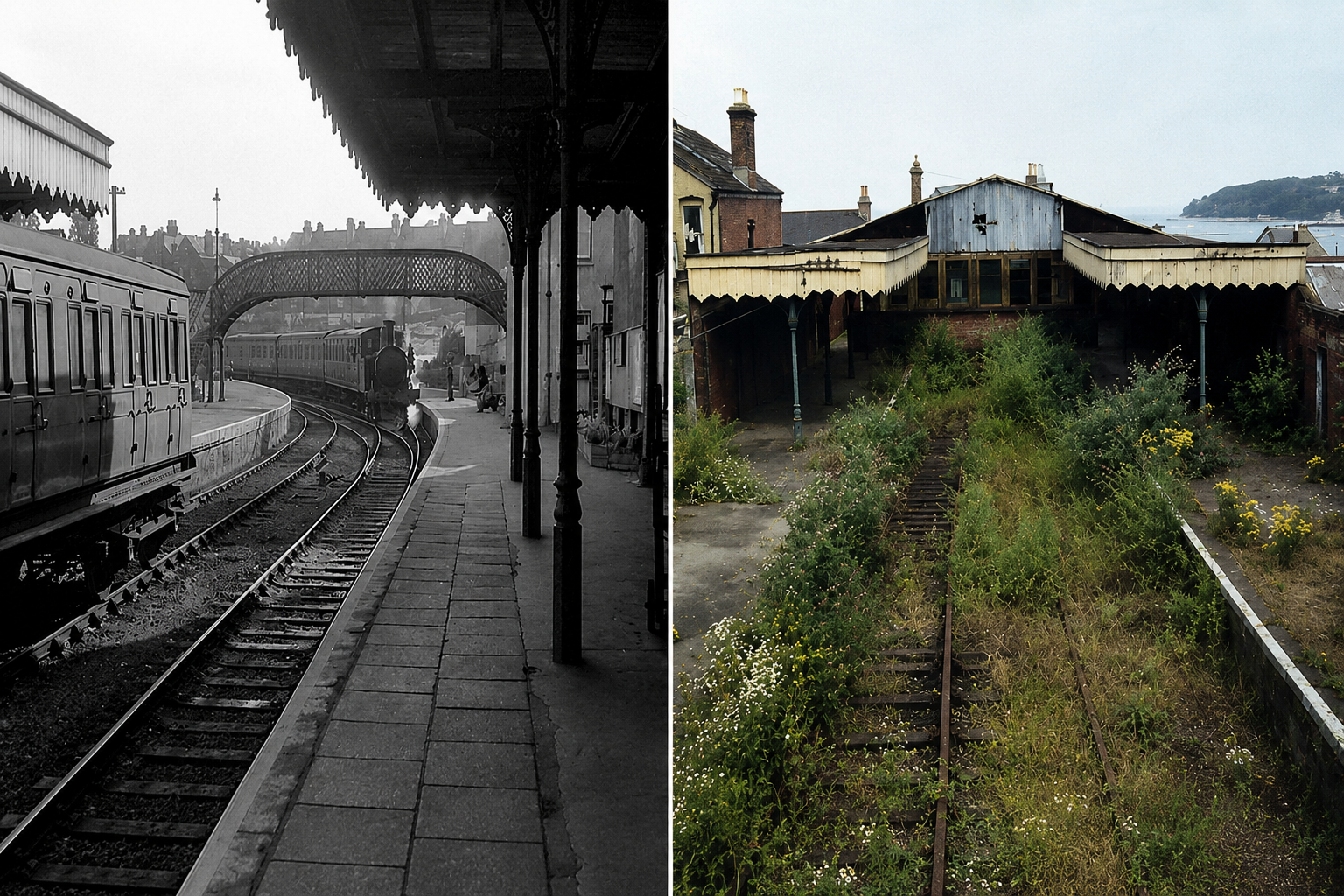
Ventnor Railway Station – set in a disused quarry high above the town centre – was never a convenient destination for travellers to and from the seaside resort, not because of distance but more due to Ventnor’s formidably steep gradients. For this reason, numerous proposals were made to connect the railway station to the seafront by means of either trams or a funicular railway.


Access to the railway station – 294ft above sea level – was not a great problem for the rich, who could be transported to and from the train terminus by horse-drawn carriage. 19th-century Ventnor hotel proprietors – from the Royal Marine, Crab & Lobster and Queen’s Hotel – also ran horse buses to the inconveniently located station.
Plans for a Ventnor tramway predated the opening of the railway in 1866. A Ventnor Tramway Company was founded in 1863, which – in 1865 – put a Bill before Parliament for the construction of a 2-mile steam-powered street tramway between the proposed station, Bonchurch, and the Esplanade. The Bill was thrown out.
A further attempt was made to build a Ventnor tramway by the Isle of Wight Railway Company in 1880 when a 2nd Ventnor Tramway Company was formed, however, it did not survive the death of the IWR chairman Joseph Bravo the following year.
In 1889, there was a proposal for a ‘Ventnor Lift’ between the station and the Esplanade Hotel. This was to be a funicular railway powered by an oil-fired steam engine working an endless belt. Nothing came of the idea.
In 1891, engineer John Blakely proposed a Ventnor Incline from the shore to the station to the Town Board at a cost of £10,000. The local authority favoured an extension to the top of St Boniface Down, but the scheme fell through when met with a negative response from the landowner.


In 1897, the Ventnor Inclined (Light) Railway Company was formed with the support of the Isle of Wight Railway Company and the Urban District Council, again for a line between the Esplanade and the summit of St Boniface Down at a total cost of £13,874 (around £1.5million pounds in current values). In 1899, the Board of Trade approved the scheme from the bottom of the town as far as the railway station (but not to the top of St Boniface Down as the landowner had not agreed terms). However, in 1903, these powers lapsed with nothing completed.
The best-known attempt to connect St Boniface Down with Ventnor Railway station and the town centre came in 1908 when Fritz Behr – an engineer resident in Ventnor – was commissioned to prepare plans at a cost of £250 (£38,000 in today’s values). Behr was an accomplished railway engineer, who was known as ‘the father of the monorail’. He had already designed the Listowel and Ballybunion railways in Ireland as well as a cliff railway at Treport (similar to that proposed for Ventnor).
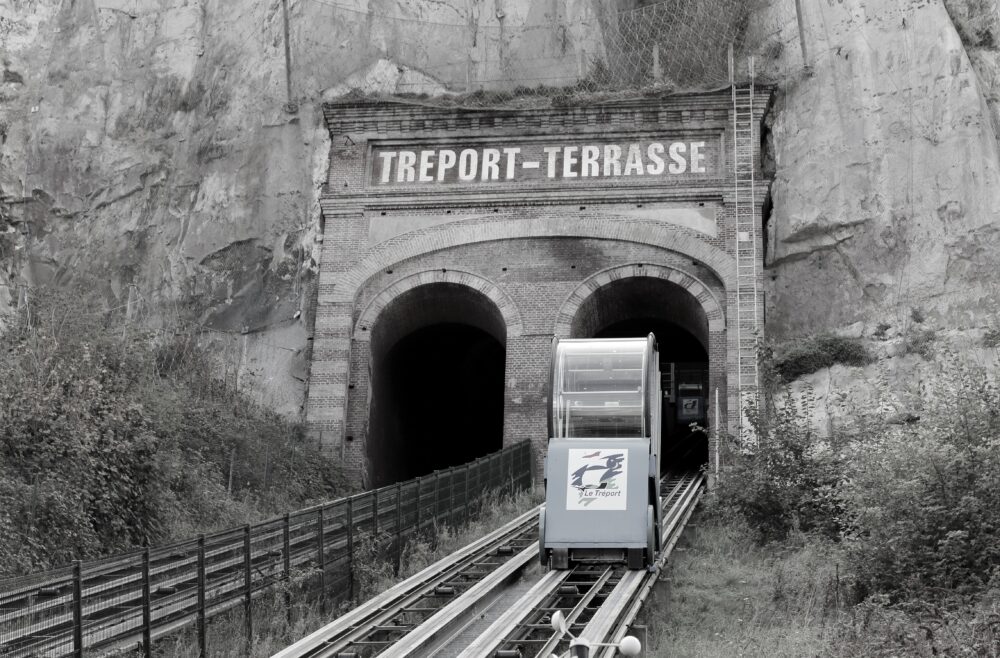
Behr’s Funicular Railway was to have been powered by electricity on a continuous belt system. The rail cars were to carry 46 passengers in 4 compartments. A price of a ticket from the shore to the very top of St Boniface Down was estimated at 7d (3p), with rail cars running to the top of the downs at half-hour intervals. The estimated cost of the scheme was put at just under £20,000 (close to £2million in today’s values). A public meeting at Ventnor Town Hall approved the undertaking.
However, plans to build Behr’s Funicular Railway came to nothing – the council could not agree terms with the local landowners. In 1910, the scheme was abandoned.
The final serious attempt to connect Ventnor Railway Station to the town centre and shore was made by Southern Railway, which took over the Isle of Wight lines in 1923. Previous plans were brought up to date, and the 1925 Southern Railways Act authorised the compulsory purchase of properties between the station and Beach Hotel. Properties were bought along the route for substantial sums.
However, again, nothing came of the plans, which were abandoned in 1927. The reason given was because, by then, a motor bus was running between the station and the town.
There have been no further plans for funicular railways or trams to run between Upper or Lower Ventnor – or to the top of St Boniface Down – since 1927.
Was it unfortunate that a funicular railway was never built to the top of St Boniface, or would it have spoiled the natural beauty of the hills above the town? Please let us know in the comments.







You only have to look at the success of the Lynton & Lynmouth railway to see that it would have been a great thing to have done and visitors would still be coming to the town just to ride the railway.
Yes it would have spoilt the down. But as with the Divil’s Dyke (near Brighton) it would be long gone with little trace of it.
Depends on what you mean by “spoiled”.
It would have meant more people travelling up there and possibly even housing but it would have been insignificant compared to the huge radar masts that were erected up there and the spinning dishes that followed.
Thank you Island Echo for these interesting local articles.
More local history please.
Only been on one in this country which is the West Hill Cliff Ride in Hastings. Think it’s fabulous, goes through a tunnel also. There’s an East Hill one also.
Ventnor definitely missed a trick.
There is a working funicular railway between Lynton and Lynmouth in Devon.
There was also (briefly) one called the Clifton Rocks Railway that ran through the cliff face between Clifton and the Avon Gorge right next to the suspension bridge in Bristol. This one only ran for a few years because of local snobbery – The residents of the expensive Clifton area objected to working class people from the Gorge coming through.
The tunnels still exist though and were used as a wartime backup studio by the BBC and would have helped to keep the service going in case of invasion.
The same can be said about re-building Shanklin Pier after the Great Storm.
There was a lot of talk about it, but no action.
The Island seems good at talking, but nothing ever gets done.
How about building it now.
Also whilst at it, start work on the Undercliff and re-open the
Undercliff Road.
So much can be done on this Island.
Where does all the money go.
All those 20p and 40p toilet fees, all those 24/7 overnight parking fees,
yet alone the extorninate council tax rates and additional garden waste charges.
The Listowel and Ballybunion railway was one of those clever but ill-thought-out ideas, with the problem of getting the passengers to distribute themselves evenly on each side of the rail to stop the train tipping over. It looked great, but was not an unqualified success. (And it was developed by the French engineer Chalres Latigue.)
Very interesting and shame it never happened.
I see the council back then were just as bad at making a decision as they are know
Even when Ventnor station was in use and few had cars the railway was an inconvenient and unpopular way to get to Ventnor.
But the clown, Seely, thinks re-opening it would be viable.
Not in the summer it wasn’t.