
















































 In the 4th part of Secret Isle of Wight, we examine the tragic life of Princess Elizabeth, who was incarcerated in Carisbrooke Castle and is buried at Newport Minster.
Elizabeth was the 2nd daughter of King Charles I and Henrietta Maria of France and was born on 28th December 1635 at St James’s Palace in London.
Elizabeth was a very bright child, who learned to read and write Hebrew, Greek, Italian, Latin and French. She was known as ‘Temperance’ by her family due to her sweet and kind nature. When she was 11, the French ambassador described the princess as a ‘budding young beauty’, who had ‘grace, dignity, intelligence, and sensibility’.


On the outbreak of the Civil War in 1642, the Royal family were divided. The Queen and her eldest daughter Princess Mary fled for the safety of Holland. Elizabeth was refused permission to join her father at court and – from the age of 6 – became a prisoner.
In 1648, Parliament removed Elizabeth’s household. The 12-year-old princess penned a letter of appeal against the decision.
Elizabeth wrote:
“My Lords, I account myself very miserable that I must have my servants taken from me and strangers put to me. You promised me that you would have a care for me; and I hope you will show it in preventing so great a grief as this would be to me.”
1n 1649, Elizabeth’s father, King Charles I, was captured and sentenced to death. Elizabeth then wrote a long letter to parliament, requesting permission to join her sister Mary in Holland. However, this request was refused until after her father’s execution.

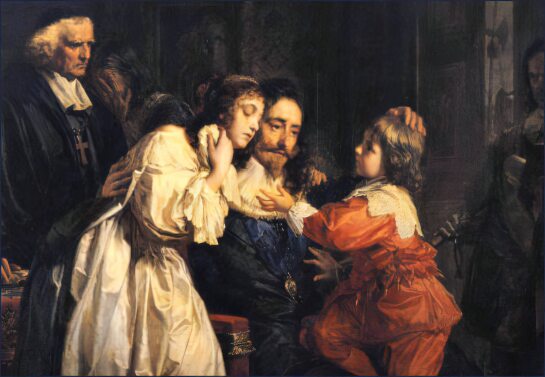
On 29th January 1649, an emotional final meeting took place between the 13-year-old Elizabeth and her father. Charles I told her not to ‘grieve and torment herself for him’ and asked her to keep her faith in the Protestant religion. Elizabeth was sobbing so hard that her father asked her if she would be able to remember everything he told her. She promised never to forget and said she would record it in writing. Her accounts of the meeting were found after her death a year-and-a-half later.
Elizabeth wrote:
“He bid us tell my mother that his thoughts had never strayed from her and that his love would be the same to the last. Withal, he commanded me and my brother to be obedient to her; and bid me send his blessing to the rest of my brothers and sisters, with communications to all his friends. Then, taking my brother Gloucester on his knee, he said, ‘Sweetheart, now they will cut off thy father’s head.’
“And he desired me not to grieve for him, for he should die a martyr, and that he doubted not the Lord would settle his throne upon his son, and that we all should be happier than we could have expected to have been if he had lived.”
Charles’ son did indeed become King 10 years after his father’s execution.
Following the beheading of Charles I, Parliament refused Elizabeth permission to go to Holland to join her sister Princess Mary. Elizabeth was taken to Carisbrooke Castle – where her father had been imprisoned – as a hostage.
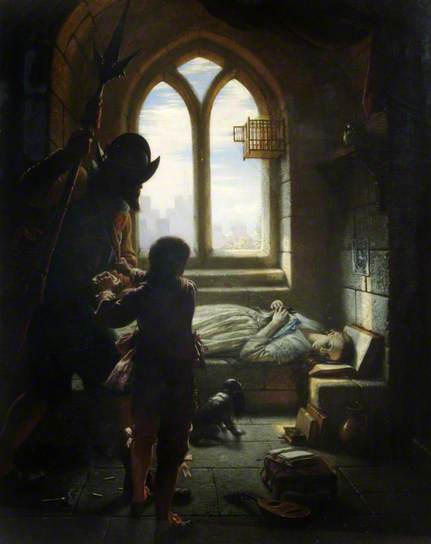
This move caused her death. Elizabeth had complained that her health would not permit her to travel; she caught a cold, which quickly developed into pneumonia. On 8th September 1650, Elizabeth was found dead with her head on the Bible her father had given her. She was just 14 years old.
3 days after Elizabeth’s death, permission for the princess to join her sister Mary in the Netherlands arrived on the Isle of Wight.
Princess Elizabeth was buried at St. Thomas’s Church, Newport. Her grave was unmarked except for her carved initials, ‘E.S.’ (Elizabeth Stuart).
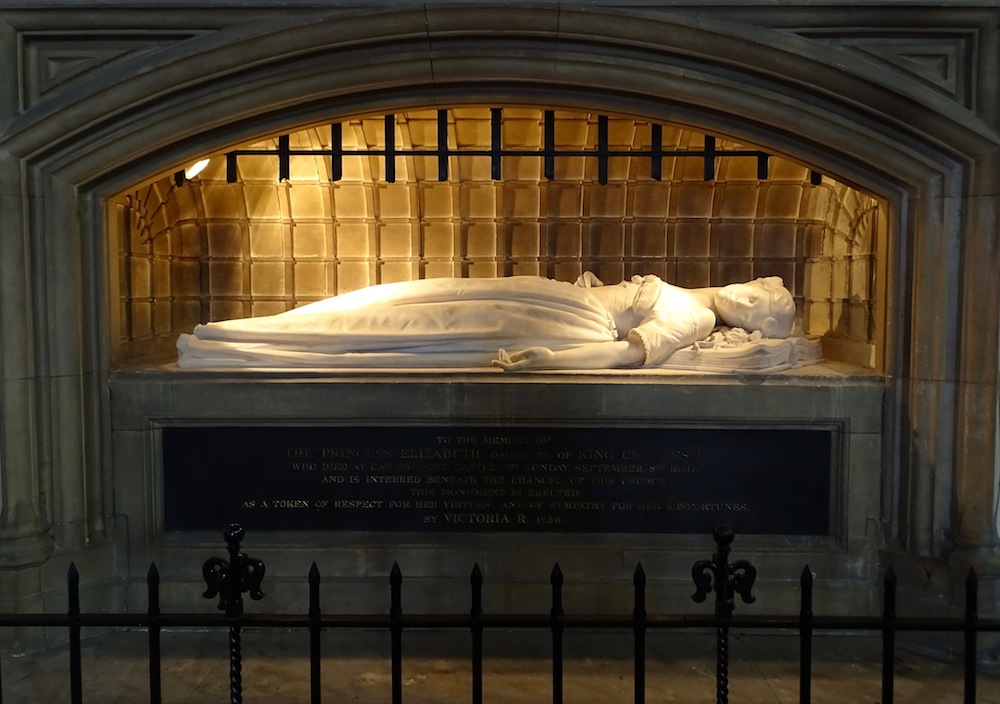
On moving to the Isle of Wight, Queen Victoria commanded that a suitable monument be erected to Elizabeth’s memory. In 1856, she commissioned a white marble sculpture to mark her grave. This depicted Elizabeth as a beautiful young woman, lying with her cheek on a Bible, open to words from the Gospel of Matthew:
“Come unto Me, all ye that labour and are heavy laden, and I will give you rest.”
Above the sculpture is a grating – indicating that she was a prisoner – but the bars are broken to show that the prisoner has now escaped to ‘a greater rest’. The plaque marking the sculpture reads:
“To the memory of Princess Elizabeth, daughter of King Charles I, who died at Carisbrooke Castle on 8 September 1650, and is interred beneath the chancel of this church, this monument is erected as a token of respect for her virtues and sympathy for her misfortunes, by Victoria R., 1856.”
The tragic story of Princess Elizabeth imprisonment and death in Carisbrooke Castle is told in Secret Isle of Wight by Andy Bull.
Secret Isle of Wight can be purchased at Waterstones and all good local retailers and can also be bought directly from Amberley at https://www.amberley-books.com/secret-isle-of-wight.html.











What a great story, and another Royal connected to the Island. And can I just say a big thank you to Andy Bull for researching all this stuff, and the Island Echo for publishing it.
Thanks echo very interesting article again
Time to do the same to the rest of them. They have been subjecting and feeding of the British people too long. Stop reading the ‘official’ story and read the real one in the songs of the people.
St George’s Hill, Weybridge, Surrey. Look at it’s history, command land stolen from the people.