











































In the 2nd edition of Isle of Wight Piers, Island Echo examines the 4 piers that have been built at Ryde: the Promenade pier, the Tramway pier, the Railway pier and the long-gone Victoria pier.
Ryde is the most commonly used gateway to the Isle of Wight. However, up until the early 19th century – before the 1st pier was built – landing at Ryde was massively inconvenient for visitors to the Island. The shallow coastal waters went a mile out to sea, making it impossible for any sizeable vessel to approach except at high tide.
The final stage of the journey for passengers would be either to be carried piggyback or to be conveyed to the shore in a horse-drawn cart. However, the carts often got stuck in the sand.


The famous 18th-century novelist Henry Fielding – who wrote Tom Jones – depicted Ryde as follows:
“Between the sea and the shore at low water there is an impassable gulf of mud and sand, which can neither be traversed by walking or swimming so that for near one half of the 24 hours Ryde is inaccessible by friend or foe … “
He described his being taken from ship to shore in the following words:
“I was hoisted into a small boat and rowed as close to shore as possible, taken up by two sailors who waded with me through the mud and placed in a chair on the shore.”

Ryde Promenade Pier
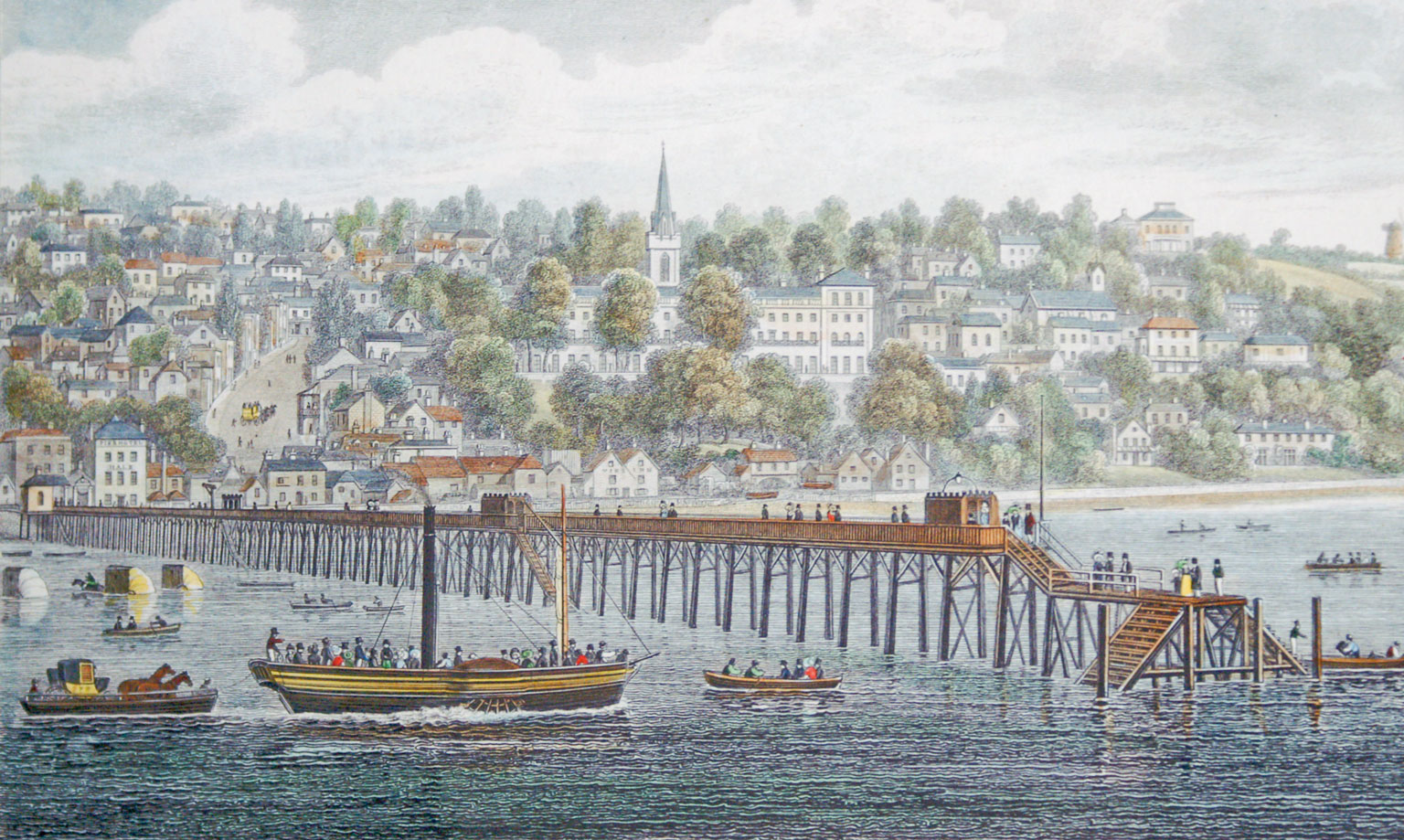
In 1812, Ryde’s prosperous estate owners and businessmen formed Ryde Pier Company. In July of that year, Parliament passed the Act for the construction of a 1,600 ft pier. This was 1 of the earliest large piers to be built anywhere in the world.
The pier was completed (to a length of 1,740 ft) in 1814. It was constructed earlier than the now more famous Brighton Pier. Ryde then became one of Britain’s most fashionable resorts and the Isle of Wight’s busiest passenger terminus.
From 1825, the Portsmouth and Ryde Steam Packet Company operated 2 paddle steamers – Union and Arrow – between Ryde and Portsmouth, with 4 sailings daily. The cheapest fare was 1s – nearly £6 in today’s values. If only Wightlink charged £6…
In 1827, the pier head was enlarged to provide berthing for 2 steamers simultaneously. The pier was extended twice – in 1824 and 1833 – to reach a length of 2,250ft: almost half-a-mile.
Fares for Islanders visiting Portsmouth were often very cheap. For example, on Coronation Day 1848, it was possible to cross the Solent for just 6d (2 1/2p) or less than £4 after taking inflation into account.
In 1895, a pavilion was constructed at the Pier Head at a cost of £5,358. This included 2 reading and refreshment rooms, a concert hall for 700 people and a sun lounge on the top floor.
Ryde Pier then went from strength to strength. At the turn of the century, Islanders were able to take a day trip from Ryde to Cherbourg, France. Arguably, cross-Solent transport infrastructure was superior a century ago to what it is today.
In the 1950s, the pier was hard-pressed to deal with weekend crowds that flocked to the Isle of Wight. Queues for the ferries would stretch halfway down the pier.
Ryde – the last paddle steamer to operate the route to Portsmouth – was withdrawn from service in 1969. Sadly, she now lies – in an appalling state of disrepair at Island Harbour on the banks of the River Medina.
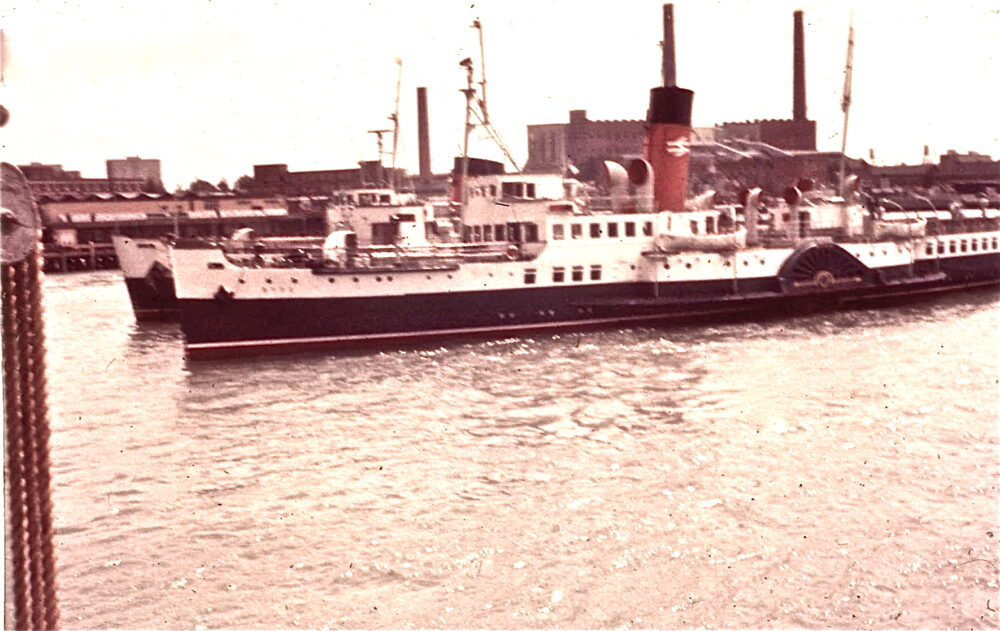
Ryde Pier was famed for entertainment in the postwar years. There was a ballroom, rollerskating rink, restaurant, cafeteria, slot machines, the Seagull Bar, the Porpoise Bar, and the First and Last Pub all located on the Pier Head. In the 1960s, famous bands such as ‘Dave Dee, Dozy, Beaky, Mick and Titch’ and ‘Amen Corner’ played at the Seagull Ballroom.
Sadly, the pavilion at the end of the pier was demolished in 1971.
Tramway Pier
Running alongside the Promenade Pier is the Tramway Pier. This was originally built for horse-drawn trams in 1864. The tramway was electrified in 1885. Fares were then 2p (1st class) and 1p (2nd class).
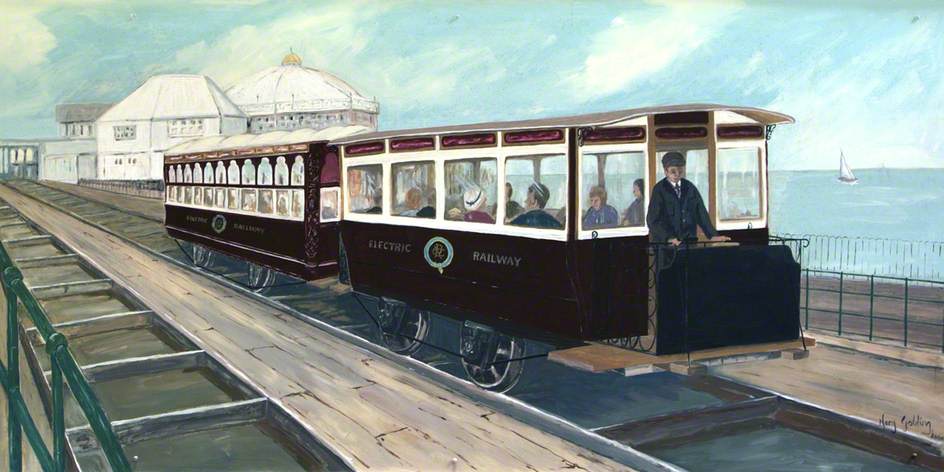
Trams continued to run between the Esplanade and Ryde Pier Head right up until 1969. A former tramcar can be seen in the Isle of Wight Steam Railway museum in Havenstreet today.
The former tramway is currently being converted into a pedestrian walkway between the Esplanade and the Pier Head as part of a multi-million pound investment in the area.
Railway Pier
In 1880, a railway pier was constructed alongside the tramway pier. The whole project – which connected the Pier Head with Ryde St John’s Road station – was completed at a cost of £250,000. The railway pier was electrified in 1967 and – until recent modernisation – was operated with former London Underground trains.

Victoria Pier
Between 1864 and the 1st World War, there was a 2nd pier at Ryde – 500 yards east of the Promenade Pier. This was built for a rival ferry company that operated a service between Ryde and Stokes Bay in Gosport. A shortage of funds resulted in Victoria Pier being shorter than the Promenade Pier at just 970 ft in length.
The insufficient length of the pier resulted in ferry services being unable to berth at low tide. Victoria Pier also suffered serious gale damage and as a result services to the mainland were discontinued in 1875.
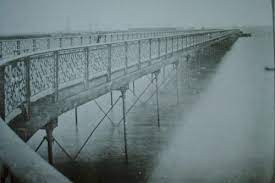
Victoria Pier was then used as a bathing station. Hot and Cold Ozone baths were constructed at the pier head, with tickets for the baths costing 6d (2 1/2p). The bathing facilities were initially very popular but then fell into disuse at the turn of the 20th century.
The pier was bought by Ryde Town Council for £1,000 in 1914, and an Act of Parliament allowed its demolition in 1914. All remaining traces were washed away in 1924.
So next time you take a walk up Ryde Pier, look down and you will see it is actually 3 separate piers…








This is very interesting and please can we have more articles like this on local history?
Thank you.
Poor Calbourne in a very sorry state. Fotunately now kept in superb order at the Isle of WIght Steam Railway.
6d (in proper money) equals 2½ of the new pennies – not 5p
Otherwise, another excellent article.
Indeed.
I thought the pier pavilion was demolished because of a fire in the ballroom.
Can anyone shed any light on the reason for the pavilion’s demise?
Does anyone know why the shelter is no longer accessible? Also, I’m sure there was more than one. I remember sitting in the shelter fishing with my two brothers; I hated fishing-so boring. I was, and still am, more interested in steam trains, both real and model (OO gauge).
I have memories of travelling up the pier on the trams. The seating was open wooded, which, wearing shorts, would leave imprints on the back of my legs as if I had been smacked with a cane.
Just as a minor point, all of the trains since electrification have been ex London Underground, including the ‘new’ ones.