










































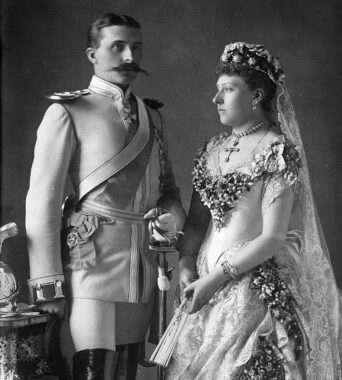
Princess Beatrice – the youngest child of Queen Victoria – married the dashing Prince Henry of Battenberg at Whippingham Church on 23rd July 1885.
Beatrice was known to the royal family as ‘Baby’. As her elder sisters married and left their mother, the Queen came to rely on her company. Victoria was so determined her youngest daughter would not marry that she refused to ever discuss the possibility.
Despite the Queen being set against Beatrice marrying, a number of possible suitors were suggested to Beatrice before she married Henry. One of these was Napoléon Eugéne, son and heir of the exiled Emperor Napoleon III of France and his wife, Empress Eugénie.


Napoleon III had moved his family to England in 1870. After the Emperor’s death in 1873, Queen Victoria and his wife Empress Eugénie became close friends. Newspapers at the time reported the rumoured imminent engagement of Beatrice to Prince Eugéne.
These rumours ended with the death of Eugéne in the Anglo-Zulu War on June 1, 1879.
Queen Victoria wrote in her diary:
“Dear Beatrice, crying very much as I did too, gave me the telegram … It was dawning and little sleep did I get … Beatrice is so distressed; everyone quite stunned.”
Prince Henry’s brother Louis was another potential suitor. Queen Victoria invited him to dinner but sat between him and Beatrice to prevent the pair from becoming too friendly. Beatrice was told by the Queen to ignore Louis to discourage him.

Louis married Princess Victoria of Hesse instead. While attending Louis’s wedding at Darmstadt, Beatrice fell in love with Prince Henry…
After returning from Darmstadt, Beatrice told her mother she intended to marry him. The Queen is said to have reacted with deafening silence and a refusal to talk to her daughter for 7 months, communicating by writing instead.
Pressure by the Princess of Wales and the Crown Princess of Prussia persuaded the Queen to start talking to Beatrice again. Victoria agreed to the marriage on condition that Henry lived permanently with Beatrice and the Queen in East Cowes.
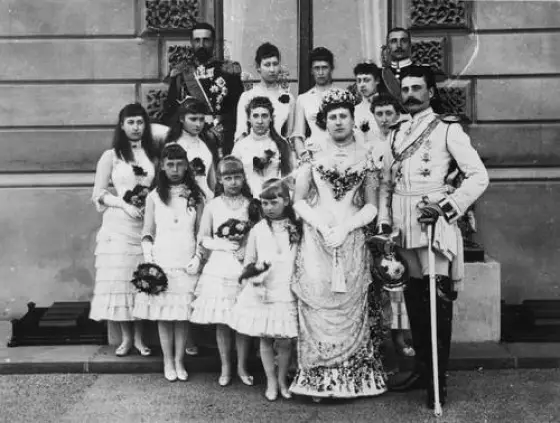
After their marriage, the newlyweds honeymooned at Quarr Abbey House, on the Island. Queen Victoria sat stoney-faced throughout the ceremony, then burst into floods of tears on their departure.
After their honeymoon, Beatrice and her husband returned to the Queen’s side. Victoria made it clear that she could not cope on her own and that the couple would not be permitted to travel without her.
Their marriage was a happy one and was blessed with 4 children – Alexander, Victoria Eugenie, Leopold and Maurice – born between 1886 and 1891. Her daughter Victoria Eugenie – regarded as a beauty – married Alfonso XIII of Spain in 1906.
In 1889, Queen Victoria made Prince Henry Governor of the Isle of Wight, but he grew restless under the thumb of his strict mother-in-law at Osborne. When he escaped on a trip to Corsica, the Queen sent a warship to take him home.
In 1895, Prince Henry persuaded the Queen to let him travel to West Africa to fight in the Ashanti War. However, he caught malaria while in Africa, and tragically died in January 1896 on the return journey.
After the death of her husband, Beatrice succeeded Henry as Governor of the Isle of Wight. She remained the queen’s companion and unofficial secretary, living at Osborne Cottage before moving to Carisbrooke Castle.
Princess Beatrice died in 1944 at the age of 87 and is buried beside her husband at Whippingham Church.
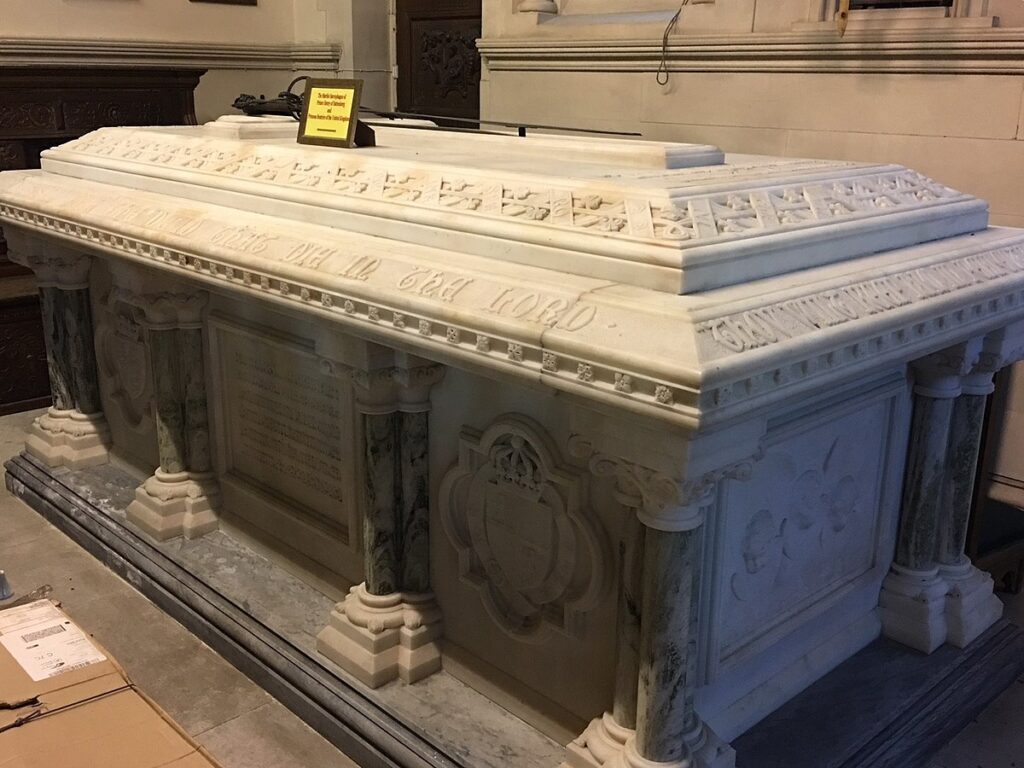
Further details of the life of Princess Beatrice may be found here.







“When he escaped on a trip to Corsica, the Queen sent a warship to take him home”
Now I wonder why Queen Elizabeth II didn’t do that when Harry fled the country?
Another fascinating article full of facts I never knew …. never too late to learn, though