

































The Isle of Wight has long been celebrated for its rich maritime heritage, but few realise the Island’s crucial role in 2 of the most extraordinary feats in ocean rowing history.
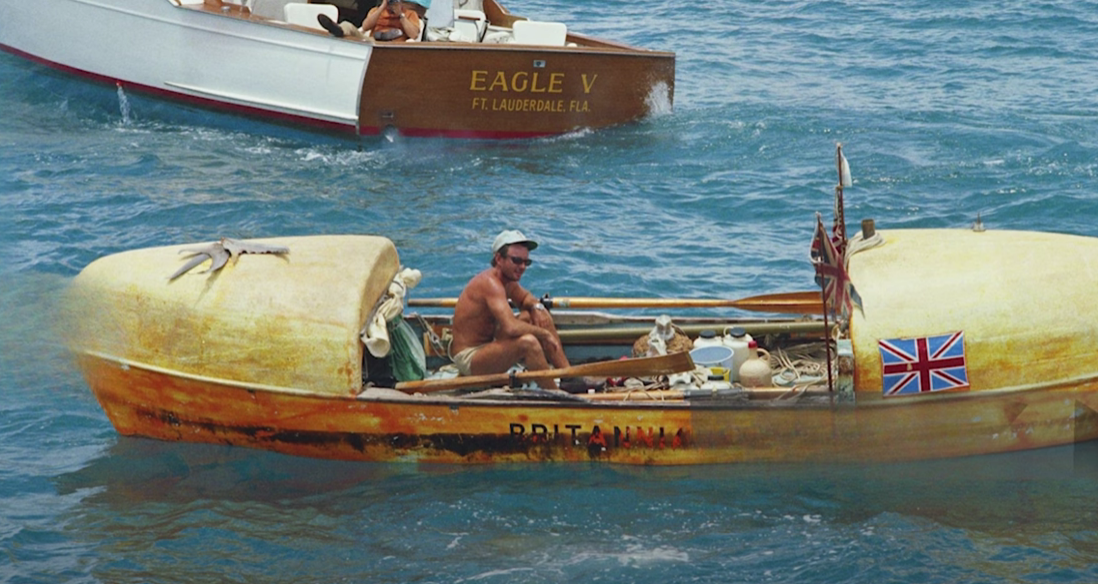
At the heart of this story are two vessels: Britannia and Britannia II. These remarkable boats were designed, built, and crafted by Island hands – the legendary Uffa Fox from East Cowes and the historic Clare Lallow’s boatyard in Cowes. They carried adventurer John Fairfax across the Atlantic and Pacific Oceans in record-breaking solo and duo crossings, setting standards for ocean rowing vessels that remain influential today.
John Fairfax was no ordinary adventurer. Born in 1937 in Rome to a British father and a Bulgarian mother, Fairfax led a colourful and daring life long before his ocean exploits. He had smuggled contraband through Central America and survived the South American jungle, embodying a fearless spirit drawn to extremes.


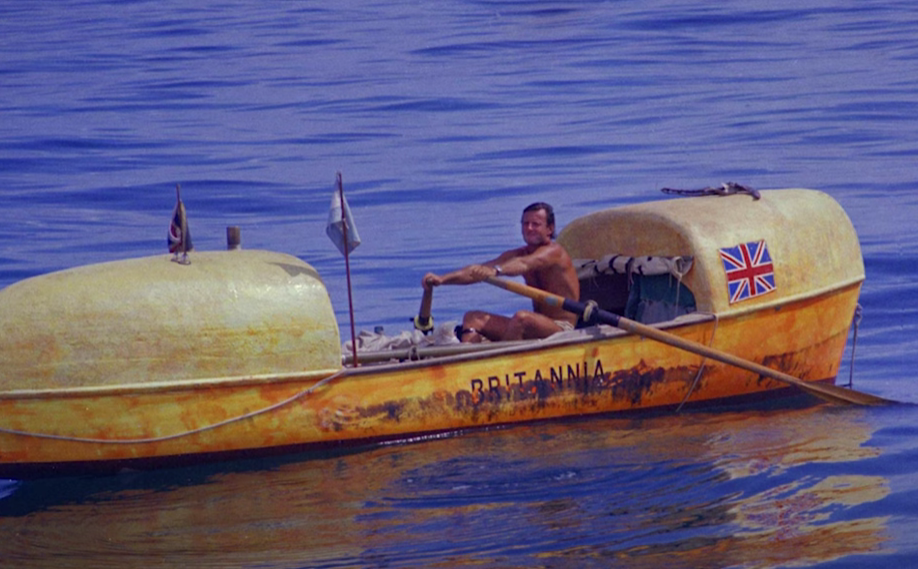
His dream to row an ocean had been sparked 15 years earlier by an article in Reader’s Digest about 2 Norwegians who’d rowed across the Atlantic in 1896. However, no one had attempted the feat solo.
In the Summer of 1966, Fairfax arrived in London to find financial backers for his ambitious plan. He was determined and disciplined, training daily with a gruelling routine of running, swimming, weightlifting, and rowing on the Serpentine in Hyde Park.
When asked why, Fairfax said:
“Because almost anybody with a little bit of know-how can sail. I’m after a battle with nature, primitive and raw.”
Finding sponsors wasn’t easy. After a year without success, Fairfax placed a personal ad in The Times. Among the responses were a student wanting to help build the boat, a secretary named Sylvia Cook eager to assist in her spare time, and a family who sent a cheque for £1 – which Fairfax treasured so much he had it framed.

Eventually, financial backing came from businessman Martin Cowling, setting the stage for a boat to match Fairfax’s daring. Enter Uffa Fox.
Fox was already renowned as one of the 20th century’s most innovative naval architects, and his Cowes workshop was a beacon of maritime design. For this challenge, he created Britannia – a 22ft rowing boat unlike any other. Built with self-righting and self-bailing capabilities and a partially enclosed deck, it was designed to protect its lone occupant from the Atlantic’s brutal conditions.
This was more than just a vessel; it was a lifeline, meticulously engineered to survive the vast 3,600-nautical-mile crossing from the Canary Islands to Florida. The boat’s strength and stability were vital – and entirely owed to the craftsmanship and expertise found only on the Isle of Wight.
On 20th January 1969, Fairfax set off from San Agustin, his course carefully plotted to use prevailing north-easterly trade winds while accepting he’d be swept south by currents. His log reveals the sheer struggle against relentless headwinds and how every mile lost meant brutal extra effort.
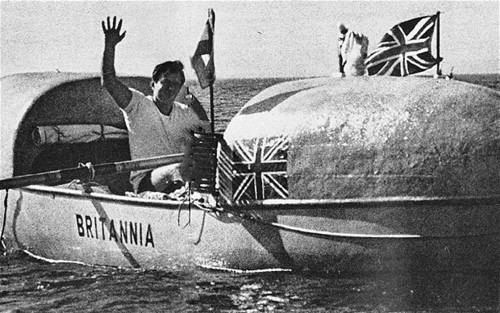
For 180 days, Britannia was Fairfax’s sole companion. The boat withstood storms and enormous waves, a testament to Fox’s genius and the skill of Island boatbuilders. It carried Fairfax across the ocean – unassisted and undefeated.
The day he landed in Florida, 19th July 1969, was the same day Apollo 11 prepared to land on the Moon. The astronauts sent a message congratulating Fairfax – an explorer who’d conquered the ocean with just a pair of oars and a well-built boat.
But the story didn’t end there…
After this historic Atlantic crossing, Fairfax set his sights on the even more daunting Pacific Ocean. This time, he wouldn’t row alone. Sylvia Cook, the secretary who had once offered to help from London, joined him for the next epic adventure.
To take on the Pacific’s staggering 8,000 miles, Fairfax returned to the Island and Uffa Fox for a new vessel. Britannia II was born – designed again by Fox but this time built locally at Clare Lallow’s boatyard in Cowes, which had been building boats since 1867.
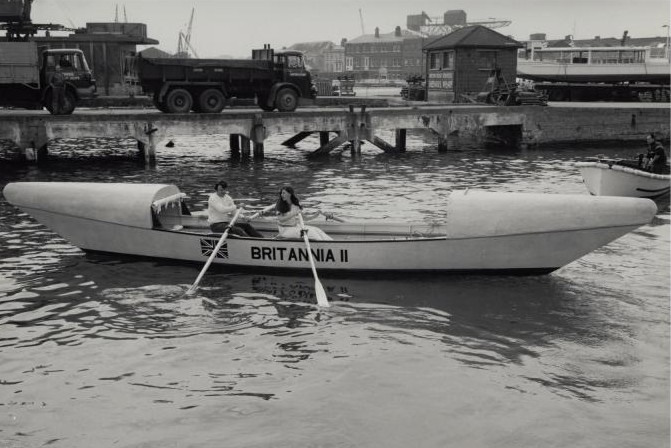
Britannia II was bigger, stronger, and more self-sufficient, perfectly crafted to endure nearly a full year at sea. Fairfax and Cook braved shark attacks, fierce storms, and even a cyclone, but the boat held firm, just as it had been built to do.
Their arrival at Hayman Island in Australia in April 1972 marked the first successful row across the Pacific Ocean — and Cook became the first woman to row any ocean.
Both Britannia and Britannia II laid the foundation for modern ocean rowing craft. While today’s vessels boast GPS and carbon-fibre hulls, the principles of design – safety, seaworthiness, and resilience – remain rooted in Uffa Fox’s Island innovations and Clare Lallow’s exceptional craftsmanship.
John Fairfax’s incredible journeys were philosophical acts of defiance against modern comfort, tributes to human endurance – but they were also quiet celebrations of Isle of Wight maritime excellence.
The boats that carried Fairfax – crafted by Island hands – remain examples of the Island’s historic role in pushing the boundaries of ocean exploration and human endurance.






Have the boats survived?
In a museum somewhere?
Britannia can be seen at the Classic Boat Museum, Thetis Rd, Cowes. Open Tuesday and Friday until the end of October. There is a collection of 60 other boats on display, well worth a visit for only £5.
Interesting article, where are the boats now?
So who built the first “Britannia”?
Uffa Fox built the first one.
As a very humble rower. Wow!