

























































Across the United Kingdom, attitudes toward waste are changing. Once regarded simply as a problem to be buried, burnt, or sent elsewhere, waste is now viewed as part of a circular economy that prioritises reuse, recycling, and resource recovery. In busy urban areas, managing waste efficiently is one of the biggest environmental challenges. London, as one of the world’s largest and most dynamic cities, demonstrates this clearly—here, services like rubbish collection London have become essential for keeping the capital clean and managing its growing waste responsibly. Meanwhile, smaller communities like the Isle of Wight are pioneering innovative local approaches to sustainability. Together, these two very different settings reveal what effective, responsible waste management can look like in practice.
The Challenge of Urban Waste: Lessons from London
London, home to nearly ten million people, produces over seven million tonnes of waste annually. The city’s density, diversity, and economic activity make waste management a complex logistical challenge. With countless households, businesses, and construction projects operating simultaneously, coordinating the collection, sorting, and recycling of materials is no small feat.
The capital’s efforts have evolved significantly in recent years. Local councils have been working with environmental agencies and private operators to promote recycling and reduce landfill dependency. Initiatives such as the London Environment Strategy set ambitious goals to make the capital a zero-waste city by 2050, focusing on waste reduction at the source and on educating residents about sustainable consumption.


However, despite strong policy frameworks and technological progress, challenges remain. Contamination in recycling streams continues to lower the efficiency of materials recovery, while disparities in waste management services between boroughs lead to inconsistent results. The sheer scale of urban living also means that convenience often outweighs sustainability in daily decision-making. Nevertheless, London’s infrastructure and access to innovation create an opportunity to set national examples in urban waste reduction.
Island Innovation: A Model from the Isle of Wight
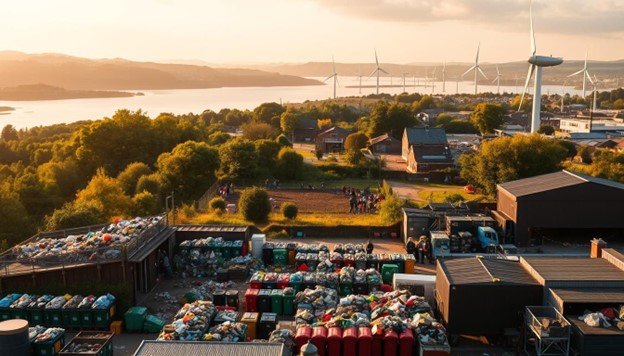
Just off England’s south coast, the Isle of Wight presents a contrasting yet equally instructive example. With a population of around 140,000 and limited land area, the island cannot rely on exporting its waste problems elsewhere. Instead, it has had to innovate locally. The Isle of Wight’s approach demonstrates how smaller communities can take decisive, community-driven action toward sustainability.
One of the island’s most notable achievements is its investment in advanced waste-to-energy technology. The Isle of Wight’s Energy-from-Waste (EfW) facility converts non-recyclable waste into electricity, supplying renewable energy to local homes and businesses. This process significantly reduces landfill use and provides a tangible benefit to the community.
In addition, the island’s recycling infrastructure is remarkably comprehensive for its size. Households are provided with clear guidance and multiple bins for separating materials, while educational campaigns run through schools and local media reinforce a culture of environmental responsibility. Community groups also play an active role, organising beach clean-ups and repair cafés to reduce litter and extend the life cycle of everyday items.
What Connects London and the Isle of Wight
At first glance, the two places could not be more different—one a sprawling metropolis, the other a tranquil island. Yet both demonstrate that effective waste management depends on three shared principles: innovation, participation, and accountability.

Innovation
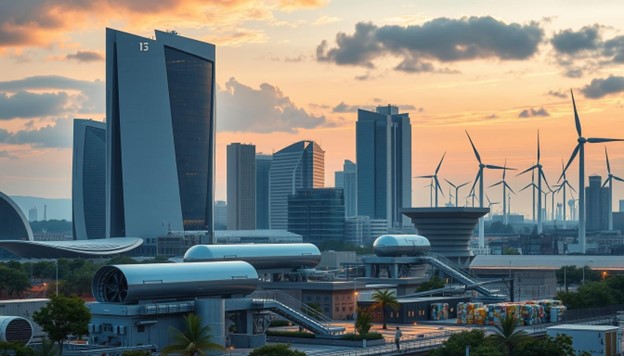
Both regions are leveraging technology to handle waste more intelligently. London’s use of digital mapping and sensor-based waste bins, for example, helps optimise collection routes and reduce emissions from collection vehicles. The Isle of Wight’s energy recovery system showcases how smaller regions can adopt circular economy principles by turning waste into a resource.
Participation
No waste management strategy succeeds without the public’s involvement. London’s recycling rates rise where boroughs actively engage with residents through awareness campaigns and accessible recycling facilities. On the Isle of Wight, smaller community size encourages direct involvement—people know their waste impacts the environment they see daily. This sense of ownership can inspire stronger, longer-lasting behavioural change.
Accountability
Transparency about where waste goes and how it’s processed builds trust. When councils and waste contractors publish clear data about recycling rates and landfill diversion, communities can measure progress and hold institutions accountable. Both London and the Isle of Wight have taken steps toward open reporting, though there is always room for improvement.
The Broader Lessons for the UK
The comparison highlights a crucial insight: sustainable waste management must adapt to local conditions while aligning with national goals. For larger cities, the focus should be on systems integration—connecting transportation, energy, and waste networks to operate more efficiently. For smaller communities, resilience and self-sufficiency are key—developing solutions that minimise reliance on external disposal or processing facilities.
Moreover, policy consistency across regions is essential. When recycling standards, bin colours, and accepted materials differ between councils, it confuses residents and undermines participation. A more unified national recycling framework could streamline processes and reduce contamination.
Education also remains at the heart of progress. Many people still misunderstand what can and cannot be recycled, leading to avoidable waste and increased processing costs. Schools, local councils, and media campaigns should continue to highlight not only how to recycle but why it matters—connecting individual actions to the broader environmental impact.
Toward a Circular Future
Ultimately, both London and the Isle of Wight show that responsible waste management is not merely about disposal—it is about design, prevention, and renewal. Every step, from product manufacturing to consumer use and final treatment, must be viewed as part of a continuous cycle. The goal is not just to manage waste, but to eliminate the concept of waste altogether.
London’s vast resources and infrastructure offer opportunities for large-scale innovation, while the Isle of Wight’s localised systems exemplify community resilience. Together, they illustrate how both urban and rural regions can complement one another’s progress. As the UK moves toward a greener future, these two examples remind us that sustainability is not defined by size, but by commitment—and that every household, business, and council has a role to play in closing the loop.