
































































The 2026 FIFA World Cup has become the clearest demonstration yet that cryptocurrency can support a mainstream consumer product rather than remain confined to trading and speculation. Across 104 matches involving 48 teams, prediction markets have turned football outcomes into continuously traded contracts, drawing billions of dollars in volume and introducing a wider audience to stablecoins, digital wallets, and real-time market pricing.
The tournament arrived as interest in crypto sports betting was already expanding, but the World Cup pushed the model into a different category. Instead of using crypto only to deposit at an online sportsbook, users could buy and sell positions tied to match results, tournament winners, and other measurable events. Prices changed as new information reached the market, making the betting experience resemble financial trading as much as conventional gambling.
That distinction helped the World Cup become crypto’s biggest sporting stage. Prediction markets did not simply add blockchain payments to an existing sportsbook model. They used crypto infrastructure to create liquid, global markets that responded to every injury update, tactical change, result, and shift in public sentiment.


World Cup Prediction Markets Surpassed $50 Billion
The scale of the breakthrough became clear in June, the opening month of the tournament. Kalshi, Polymarket, and Rothera collectively helped push monthly prediction-market activity beyond $50 billion, with sports contracts accounting for the majority of the surge.
Kalshi generated approximately $31 billion in notional trading volume during the month, more than 70% above its May total. World Cup-specific contracts reportedly accounted for more than $22 billion of activity by mid-July, showing that the increase was closely tied to football rather than a broader rise across every event category.
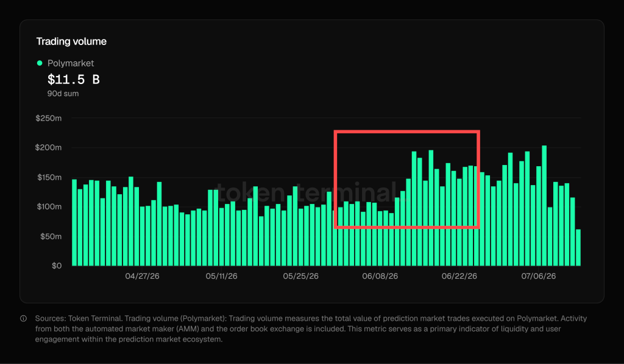
Polymarket’s international exchange recorded a monthly high of roughly $10.8 billion, while its regulated U.S. platform added around $3.5 billion. Rothera, the Robinhood and Susquehanna-backed entrant that launched in June, processed another $2 billion during its first month.
These figures placed prediction markets in direct competition with the traditional betting industry for attention during the world’s biggest football tournament. The comparison is not exact because notional prediction-market volume includes contracts that can change hands multiple times, while sportsbook handle measures wagers placed with operators. Even so, the numbers showed that event-contract trading had reached a scale that could no longer be treated as a niche crypto experiment.
Polymarket Turned Football Odds Into Tradable Prices
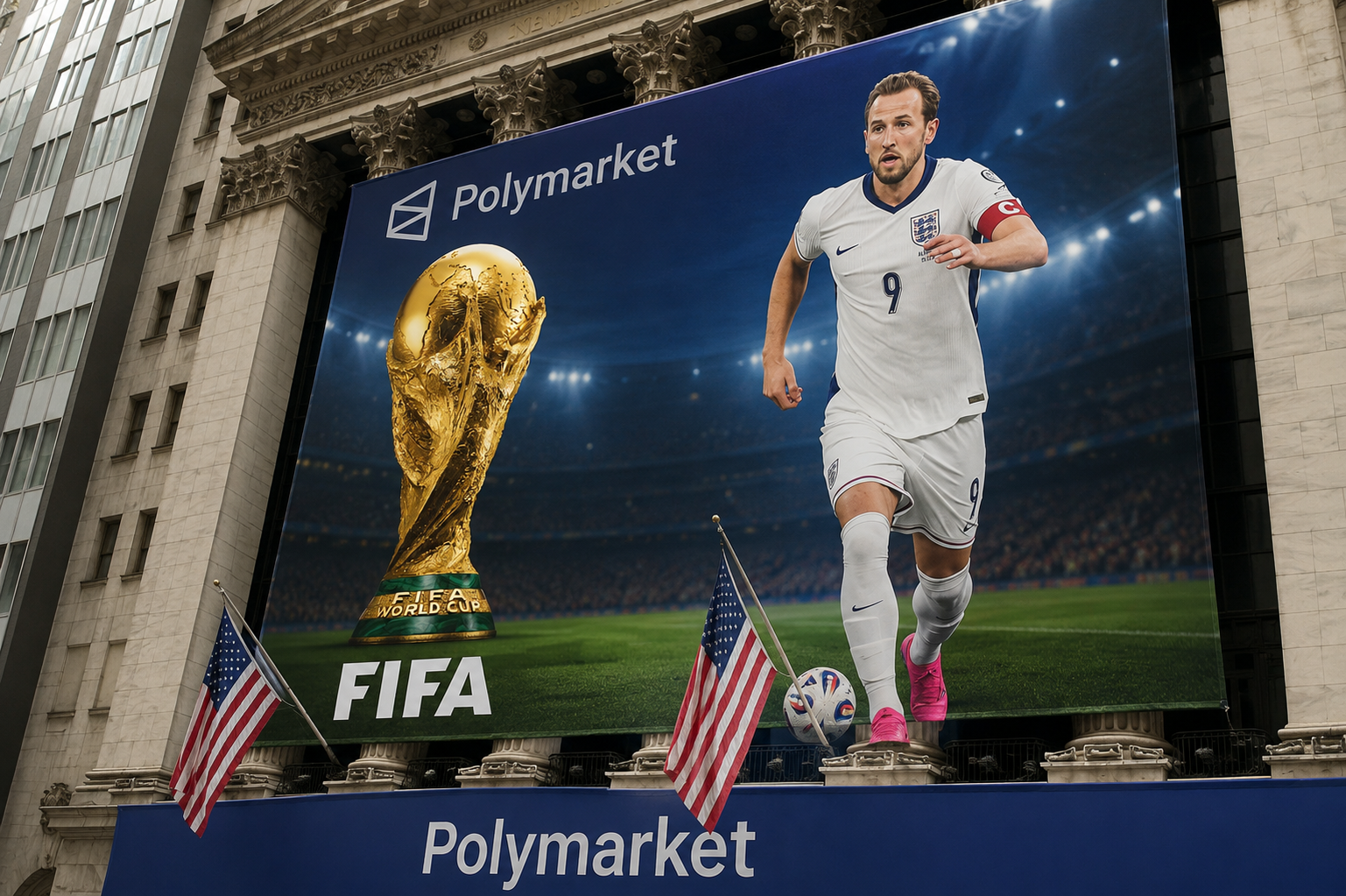
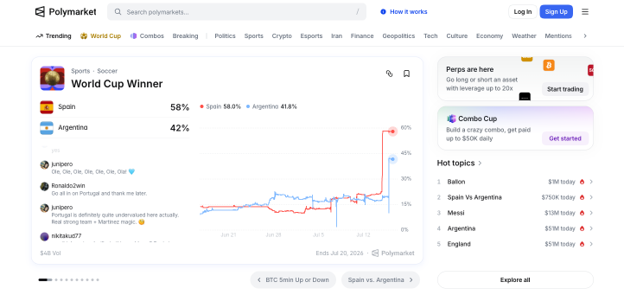
The growth of Polymarket illustrates why prediction markets became so closely associated with crypto during the tournament. Its World Cup section allowed users to trade contracts covering individual fixtures and the eventual champion, with contract prices functioning as implied probabilities.

A contract trading at $0.65 effectively signals that the market assigns a 65% probability to the outcome. If the event occurs, winning shares settle at $1. If it does not, they settle at zero. Unlike a fixed sportsbook wager, the position can usually be sold before settlement, allowing traders to lock in gains, limit losses, or react to changing information.
That format created an active secondary market around the tournament. As teams advanced, suffered injuries, or produced unexpected performances, contract prices moved to reflect the new outlook. Polymarket’s World Cup winner market alone had recorded more than $4.2 billion in trading volume by July 14.
The appeal extended beyond experienced crypto traders. Football fans could interpret the prices without understanding complex blockchain mechanics, while more sophisticated participants could compare odds across Polymarket, Kalshi, and conventional sportsbooks to identify pricing differences.
Crypto Became the Settlement Layer Behind the Markets
The World Cup’s crypto connection was not limited to branding. On international prediction platforms, stablecoins became the financial infrastructure supporting deposits, trades, and settlement.
USDC was particularly useful because it allowed users to transact on-chain without exposing their betting balance to the volatility of Bitcoin or Ethereum. A trader could enter a position worth $100, exit it later, and keep the proceeds in a dollar-pegged asset rather than worrying that the payment currency itself might move sharply during the match.
This gave prediction markets several practical advantages. Funds could move between wallets and supported platforms without relying entirely on bank opening hours or cross-border payment networks. Settlement records were visible on-chain, while smart contracts could automate parts of the payout process after a market was resolved.
The technology remained largely invisible to casual users, which may be one reason adoption accelerated. Participants did not need to think about blockchain architecture every time they traded a match. They interacted with probabilities and football outcomes, while crypto operated in the background as the payment and settlement rail.
Match Narratives Became Live Financial Markets
Football has always produced debates over form, tactics, injuries, and individual players. Prediction markets converted those arguments into prices that changed in real time.
The England versus Norway matchup offered a useful example. England entered as the stronger side in the betting market, but Norway’s reliance on Erling Haaland created a clear source of uncertainty. The England and Norway betting outlook showed how a heavily favored team could still face a meaningful risk from one elite player capable of changing the match with a single chance.
On a prediction market, that uncertainty is continuously repriced. News about Haaland’s fitness, England’s starting lineup, weather conditions, or tactical approach could immediately change the market’s implied probability. Traders who believed the adjustment was too large or too small could take the opposite side.
This is one of the key differences between prediction markets and static pre-match analysis. An article or tip provides a view at a particular moment. A liquid market shows how thousands of participants are collectively updating that view as circumstances change.
Prediction Markets Reached New Users
The World Cup also changed who was using these platforms. Traditional sportsbook apps often experience a spike at the beginning of a major competition before engagement fades. Prediction-market usage reportedly followed a different path, building throughout the tournament as users became more familiar with event contracts.
Kalshi and Polymarket accounted for a substantial share of betting-app downloads during June, according to data cited by CoinDesk. Kalshi also reported strong growth among first-time and female users, suggesting the tournament introduced prediction markets to audiences that had not previously used conventional sports betting products.
Several factors may explain that appeal. Prediction-market interfaces often present a simple question and a percentage rather than a complex betting slip. Users can follow a position as the implied probability changes, and they do not necessarily have to wait until the final whistle to exit.
The broader range of markets may also encourage retention. Once the World Cup ends, the same users can trade contracts tied to elections, economic data, entertainment, technology, and cryptocurrency. The football tournament acts as the entry point, but the product is designed around events far beyond sports.
Wall Street Began Treating Prediction Markets Seriously
The rise in liquidity attracted more than retail bettors. Institutional trading firms began exploring prediction markets as a new derivatives category, applying strategies such as arbitrage and cross-platform pricing.
When the same World Cup outcome trades at different implied probabilities across Polymarket, Kalshi, and major sportsbooks, professional traders can buy the cheaper position and hedge through another venue. As more capital pursues those discrepancies, prices tend to converge.
That process improves market efficiency. Prediction platforms were previously criticized for low liquidity and prices that could be moved by relatively small trades. World Cup volumes made their odds more credible and harder for individual participants to distort.
The arrival of institutional firms also indicated that prediction markets were becoming part of the wider trading ecosystem. What began as a crypto-native product was increasingly being evaluated using the same tools applied to futures, options, and other financial contracts.
Regulation Remains the Biggest Divide
The World Cup highlighted the growth of prediction markets, but it also exposed the sector’s fragmented regulatory structure.
Polymarket’s regulated U.S. operation differs substantially from its international platform. The U.S. product uses identity verification and conventional financial intermediaries, while the global platform supports crypto wallets and USDC settlement but remains restricted in certain jurisdictions.
This creates a complicated user experience. Two markets may appear similar while operating under different rules, payment systems, and consumer protections. Prediction contracts may also be treated as financial derivatives in one country and as gambling products in another.
Regulatory scrutiny is likely to increase after the tournament because the industry is no longer too small to ignore. Billions of dollars are moving through contracts tied to sporting outcomes, and platforms are competing directly with licensed sportsbooks for users and advertising exposure.
The central issue will be whether regulators treat prediction markets as a distinct financial product or attempt to apply existing gambling rules. The answer will shape which platforms can operate, how they accept deposits, and whether crypto settlement remains central to the model.
The World Cup Gave Crypto a Mainstream Use Case
The 2026 World Cup did not make cryptocurrency relevant because teams launched fan tokens or athletes promoted digital assets. Its impact was more practical.
Crypto supported markets that millions of people could understand immediately. Users were not being asked to speculate on an abstract blockchain project. They were using stablecoins and digital wallets to express a view on whether a team would win a match or lift the trophy.
That simplicity turned prediction markets into one of crypto’s clearest consumer applications. The blockchain operated behind the product, while football supplied the attention, emotion, and constant flow of new information.
The longer-term test will come after the final. If World Cup users continue trading political, economic, entertainment, and crypto events, the tournament may be remembered as the moment prediction markets moved decisively into the mainstream. Even if activity falls from June’s record levels, the sector has already demonstrated that crypto infrastructure can support a global market during one of the most closely watched events in sport.