














































Newspapers throughout the United Kingdom reported on the rescue of 19 sailors from the American ship Bainbridge at Atherfield on 8th October 1832.
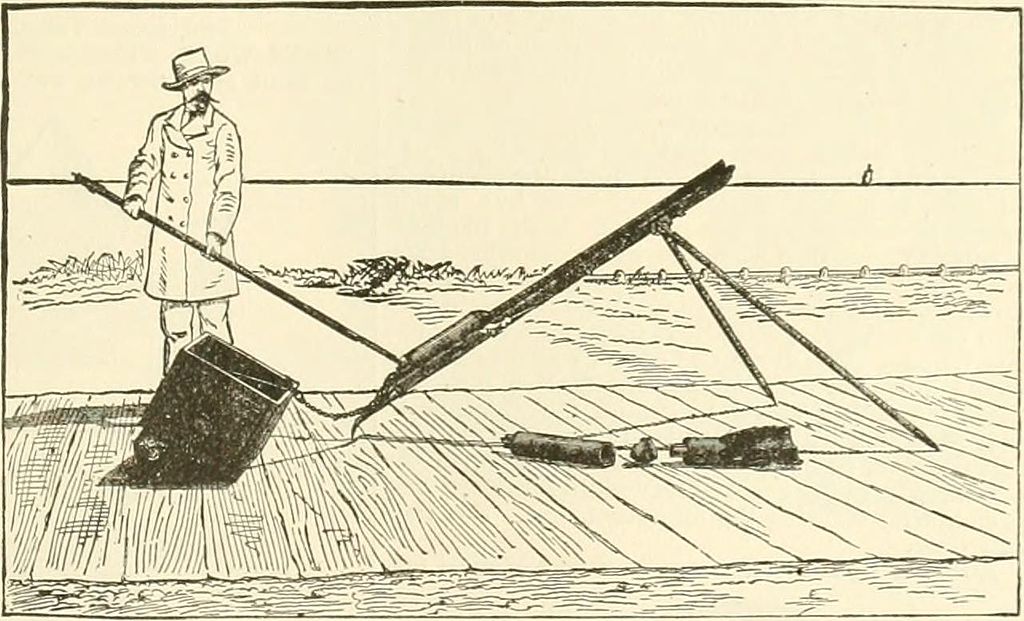
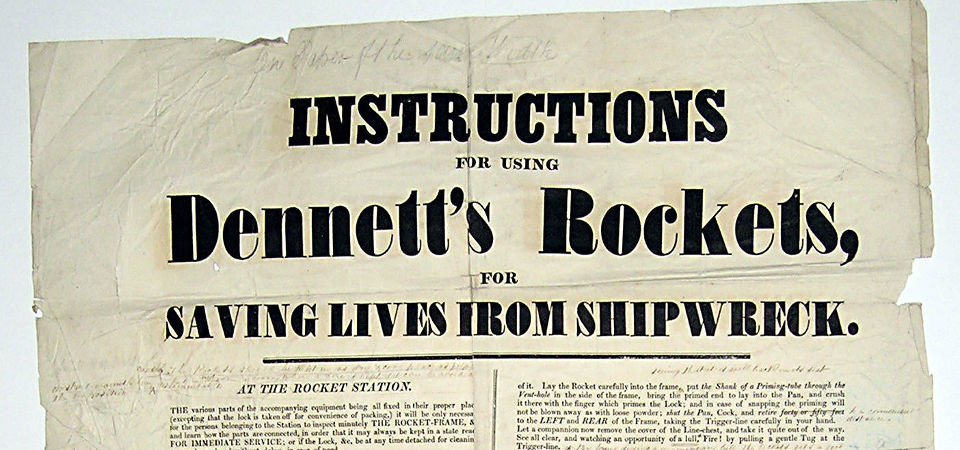
This date is important in the history of lifesaving at sea as this was the 1st time Dennett’s rocket had successfully been used to rescue sailors from a stricken vessel and safely carry them ashore.
Dennett’s rocket was invented by John Dennett from Gunville near Newport.


On the night in question, the Bainbridge – carrying a cargo of rum – was seen to have come to grief off Atherfield at first light.
For 7 hours, numerous attempts were made to save the crew but to no avail. Captain Manby’s gun – an earlier version of Dennett’s rocket – was fired 4 times to try to get a line to the ship, but each time failed to reach its target.
Then, a man named Grimes discharged Dennett’s rocket which succeeded in reaching the Bainbridge and rescue the lives of those on board.
After his rescue, the captain of the Bainbridge wrote:

“We hereby certify that the Bainbridge, from Halifax for London, was wrecked during the heavy gale, on the night of the 7th -8th inst, on Atherfield Rocks, at the back of the isle of Wight; that four attempts were made with Captain Manby’s apparatus to throw a line over the ship, without success, owing principally to the great distance she lay from shore.
“A Rocket of Mr Dennett’s invention was then fired, and at once carried the line to its destination in the most complete manner, although the position of the ship was most unfavourable for such a manoeuvre, as she lay end on, with her stern towards the shore.
“The communication thus established, a strong rope was hauled onboard, and a boat drawn through the surf, by which the crew, nineteen in number, were in two trips safely landed upon the beach. The superiority of the rocket was most evident to all, and the proof is in the result.
That they come into general operation upon similar occasions, we heartily wish, and we give our most hearty thanks, (as is most due,) to Mr Dennett, for his exertions in the cause of humanity.”
From 1832, Dennett’s rocket became the primary method of carrying shipwrecked sailors to land. 3 rocket stations were set up on the southern coast of the Isle of Wight at Freshwater, Atherfield and St Lawrence. As late as 1890, it was used in the rescue of 36 crew of the Irex – driven ashore in Scratchells Bay – when all were hauled to the top of the 400 foot cliff with the help of Dennett’s apparatus.
John Dennett was born on 25th September 1780 into a well-established Island family based near Carisbrooke. It is thought he developed his interest in rockets during the Napoleonic wars.
Dennett won several honours from foreign sovereigns for his lifesaving invention. He had an interest in antiquities, was a member of the British Archaeological Association, and wrote about the prehistoric barrows of the Isle of Wight. Shortly before his death in 1852, he was appointed custodian of Carisbrooke Castle.








A very intresting article.
You can find out about his daughter Emma Dennet who was a painter, poet and naturalist and is buried in Carisbrooke here https://www.youtube.com/watch?v=x1pwRrnwbzs