







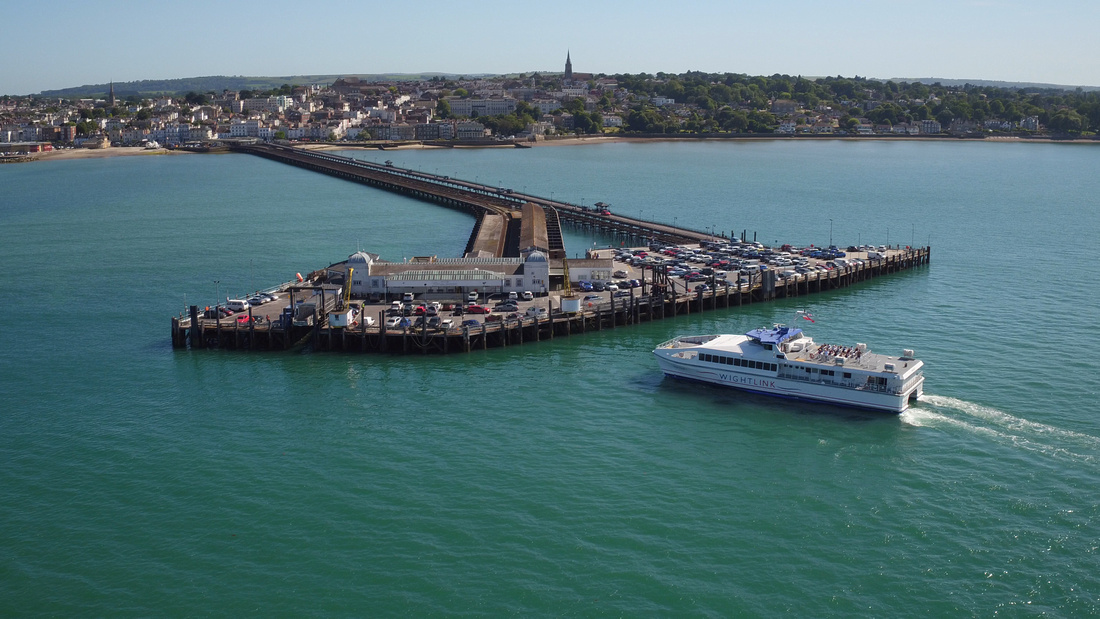

















































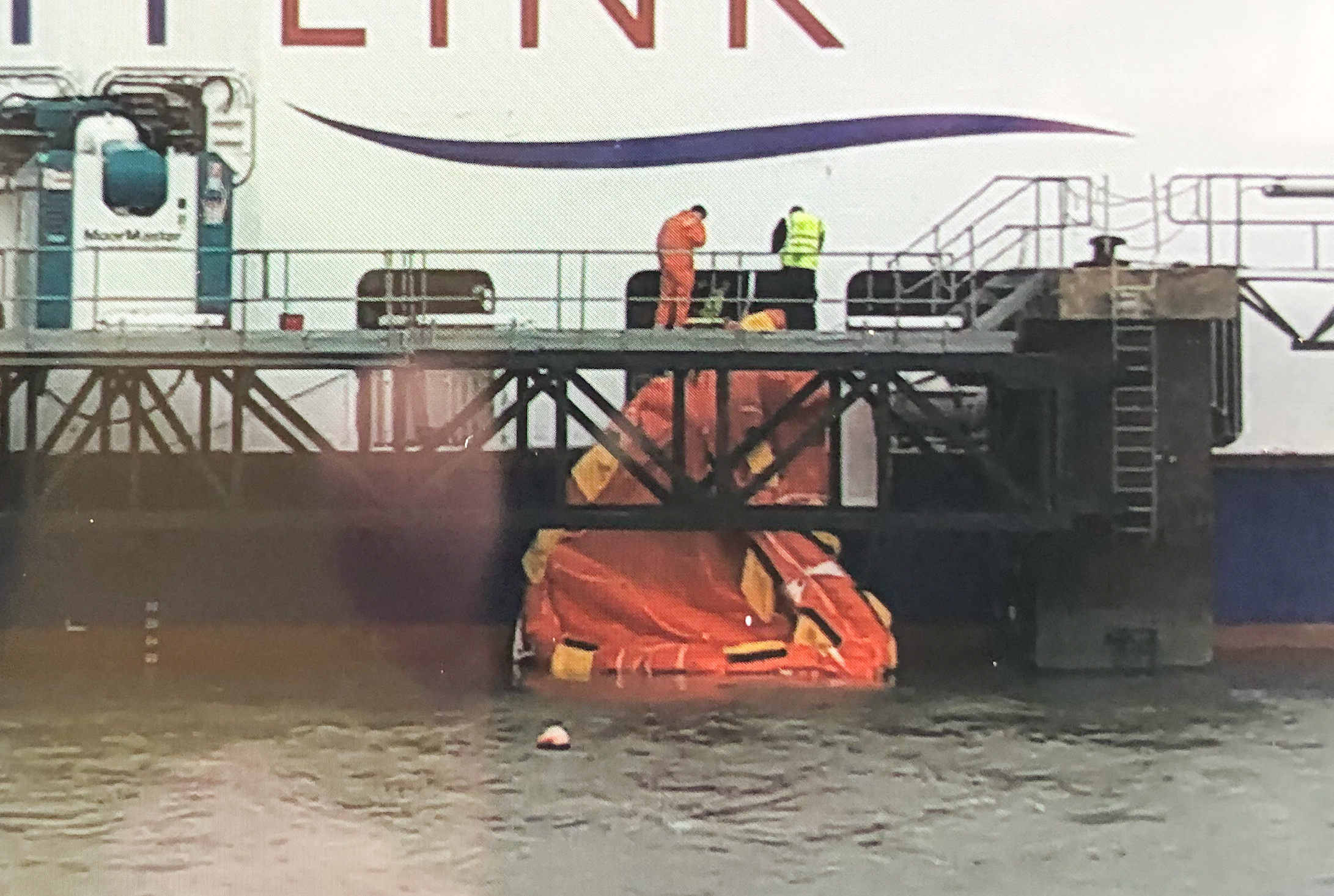

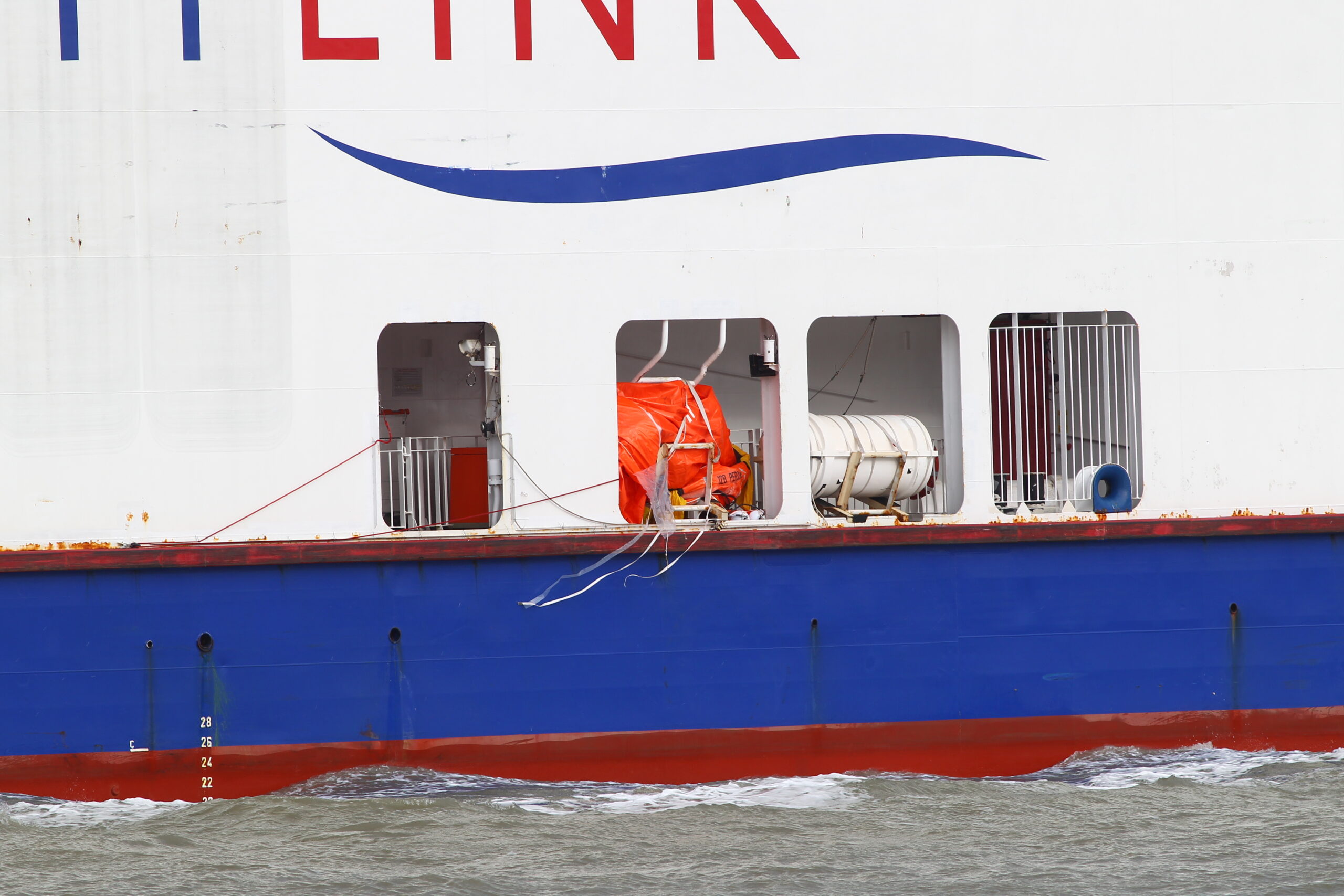
A life raft has unexpectedly deployed on Wightlink’s car ferry St Clare, leading to delays on the operator’s Fishbourne to Portsmouth service this morning (Friday).
The inflatable safety devices are only supposed to deploy when manually activated or dropped into the sea, but for reasons currently unknown the life raft – situated on car deck level – inflated whilst docked.
The incident occurred at the Fishbourne terminal shortly before 09:40.


Wightlink staff have managed to deflate the lift raft and haul it back on board with the St Clare now proceeding to Portsmouth, albeit behind scheduled.

No one is thought to have been injured.
The 09:00 sailing from Portsmouth has only just docked as the vessel was forced to wait in the Solent for St Clare to depart, which could cause some knock-on delays to the timetable as the day progresses.
Wightlink has been approached for a statement.

UPDATE @ 12:00 – A spokesperson for Wightlink has said:
“When Wightlink’s 08:00 sailing from Portsmouth arrived at Fishbourne this morning, one of St Clare’s liferafts partially inflated accidentally.
“The ship’s crew recovered the liferaft and stowed it again. St Clare departed to Portsmouth at 10:09.
“As very few people are crossing the Solent at present, due to Covid restrictions, customers travelling on the route today will be able to complete their journey without undue delay”.







Cold likely caused condensation to form over the sensor, which, then triggered the self inflate as it would have done if it had been immersed into the sea water.
The device which triggers it is based on pressure, usually needs to be about 4m underwater for it to activate.
What is it a submarine or life raft? Maybe the pressure sensor had a fault or got bashed by something?
don’t think as deep as 4m – 4inches??
Yes, most likely cause. Our bathroom fan has a humidistat and runs when the cold air is met by warmer due to condensate forming upon it.
Nope – those liferafts can only inflate under three scenarios
one – if someone pulls the rope that is attached to the side of it and triggers the release of the gas canister inside the raft.
two, if the boat is underwater to a certain depth whereby the release unit cuts the rope and then the raft floats to the surface. The pull on the rope is done by the boat sinking further and the canister floating upwards. – these release units are based on pressure and not a bit of water touching them. (hydrostatic release unit, activated at depths between 1.5m and 4 metres)
or three — there is an auto release on the bridge – but that would push the liferaft into the water first.
this is most likely someone yanking that rope.
Unlikely that this was caused by the painter being yanked out by someone as you would have to pull about 20m of rope out of the liferaft before it would release the CO2 inside. Most common reason is that one of the crew accidently blasted the HRU with a pressure washer when cleaning.. Who knows though.
Not likely choff – those HRU are exposed to the elements and get hit by waves throughout the journey.
whose to say the crew member thought he had hold of a throwing line in preparation for berthing and was pulling it together to get ready to throw to the shore.
I’ve seen this happen with pressure washers on more than one occasion.
The life rafts on st Clair are almost midships and long way from the mooring stations.
no you haven’t – the HRU just cuts the cord that holds the liferaft in the cradle, so that it is free to float away from a sinking vessel.
You’re missing the point.
no choff – the HRU merely cuts the rope that holds the liferaft in place, so that it can float free – the action of the boat sinking and the raft floating up pulls the painter out of the raft container and then is inflated as the weak link attached to the boat snaps.
the HRU does not activate the inflating mechanism on its own – so no, a pressure washer will not do it.
Thank you for you accurate description of how an HRU works, I’m fully aware of how a HRU and liferaft release system works also. You are absolutely right for a simple float free system, however, St Clair’s life rafts are on a rolling cradle so once the HRU is activates and severs the rope securing the liferaft to the cradle it will roll overboard and once all the painter is pulled out it will activate the CO2 release and inflate the life raft.
Exactly what no name said
A more simple explanation.
A pressure washer will not directly cause a liferaft to inflate. That is impossible. Only pulling the painter all the way out to 20m will do that.
A pressure washer can, as whitnessed by Choff activate an HRU as it simulates 1.5m – 4.0m of water pressure on the device.
If on a ship that has a rolling cradle liferaft system like St Clair the HRU is activated it will roll into the sea by gravity.
Once the liferaft is in the sea and especially if the ship is making way the 20m painter will eventually be pulled from the life raft and cause it to inflate.
Sorry but post by no name is not a clear & accurate explanation of how a Hydrostatic release Unit HRU is supposed to work with liferafts. There is a pull cord built into liferafts that activates the inflation mechanism. The free end of that cord is secured to a fixing on the vessel. A HRU is not attached to that pull cord but is, instead, installed into part of the securing system for the flieraft in addition to a manual release mechanism. In the case of a need to abandon ship, the mechanical release system would be used and then the inflation cord pulled either by hand or as a result of the liferaft pulling on it. An HRU only gets activated if the vessel sinks with the liferaft still secured. Increasing water pressure below the surface activates a release mechanism allowing the liferaft to rise to the surface. As the raft floats upwards, it automatically inflates when the pull cord pulls tight. A full and clear explanation can be found at casualnavigation.com/how-does-a-hydrostatic-release-unit-hru-work/
ivor biggun – yours is also not quite correct
the free end of the cord is not attached the vessel – the free end is attached to a weak link. As the life raft floats to the surface and the vessel sinks further, the weak link snaps allowing the liferaft to continue to float to the surface – without it, the free end of the cord, if attached directly to the boat, would remain attached and drag the liferaft down with the boat
What does this bit of rope do?
Hardly breaking news!
It is when it totally buggers up your day!! I missed out on a lot of work because I couldn’t get to work when I was supposed to. Fixed Link is the only answer!!