


































 In this edition of Made on the Isle of Wight we examine the giant Princess flying boat which was designed to carry over 100 passengers across the Atlantic in luxury.
3 Princesses were completed in the Columbine Yard in East Cowes but sadly the Princesses were destined not to make a single commercial flight.
The Princess flying boats were developed to serve as a bigger and better successor to pre-war commercial flying boats, such as the Short Empire. They were built for the transatlantic route to fly passengers between Southampton and New York City in both space and comfort.


Before World War II, British airline Imperial Airways had successfully used large long-range passenger flying boats to create a network of long-distance routes. Passengers were transported in first class accommodation, resembling a luxury cruise. However, operations of these flying boats was disrupted by wartime when many were requisitioned for service with the RAF.
Flying boats had been preferred for long-distance flights in the pre-war era, as they were not limited by runway length. Furthermore, at that time most airfields were still grass-surfaced. For services to far-flung parts of the British Empire, the ability to land and take-off from water was a distinct advantage, as many distant lands had no airport facilities at all.

The British Air Ministry wanted to revive the flying boat routes after the war. They approached 2 British flying boat manufacturers – Saunders-Roe and Shorts – requesting that the 2 firms collaborate to create new flying boat: the Short Shetland. 2 were completed.
Saunders Roe, however, aimed to create a far grander, larger and revolutionary all-metal flying boat, the Princess – which was to be the largest ever built. Its performance criteria included a weight of 140 tons, a 214-foot wingspan, a height of 55ft 9 inches and a length of 148ft.
It would be capable of cruising at an altitude of 37,000ft, have a maximum range of 5,190 miles, and be outfitted with luxurious state-of-the-art accommodation for 104 passengers. Its cockpit was designed to carry a pair of pilots, 2 flight engineers, a navigator, and a radio operator.
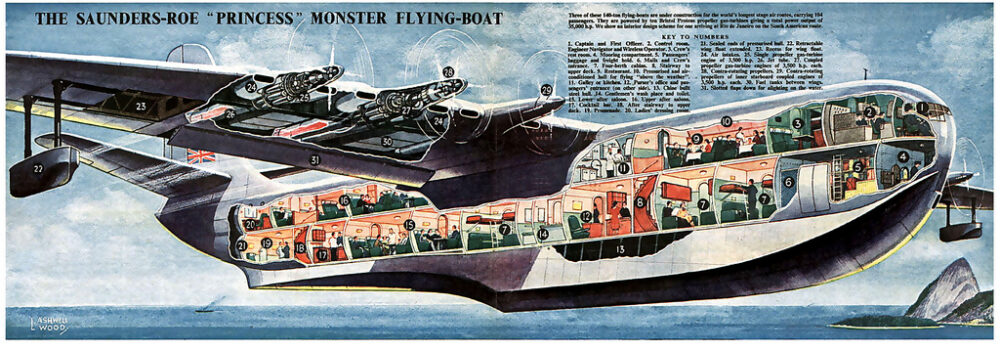
In May 1946, the British Ministry of Supply ordered the production of 3 SR.45 (Princess) flying boats. It was believed this would lead to a contract for the aircraft from British flag carrier British Overseas Airways Corporation (BOAC). Work on the Princesses began almost immediately after the order was received.
However, in 1951, BOAC re-evaluated its needs and decided the airline had no need for the Princess, or any new large flying boat. It planned to terminate its existing flying boat services in 1950 and focus on its land-based routes using the jet-powered De Havilland Comet instead.
The airline saw that runway and airport improvements had added to the advantages of land-based aircraft, which did not have to carry the additional weight of the boat hulls needed for seaplanes. Furthermore, seaplanes were subject to corrosion caused by seawater.
The era of the large flying boat had ended even before the 1st Princess was even finished.
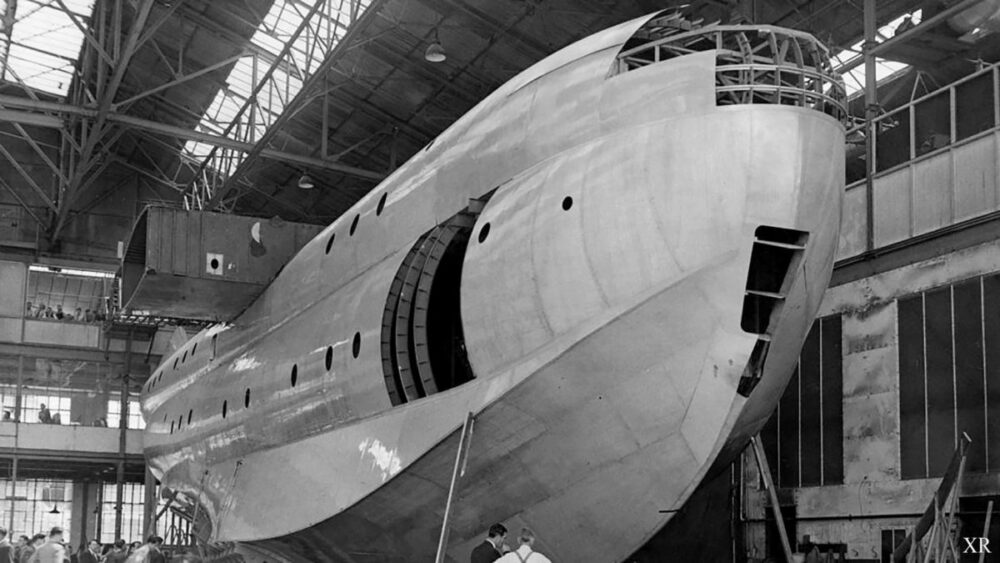
In late 1951, it was announced that construction of the 3 Princesses would continue, with the intention of using them as transport aircraft for the RAF. A new company – Princess Air Transport Co Ltd – was formed to find new uses for the giant flying boats under construction, with 75% of the share capital held by Saunders-Roe.
On 22nd August 1952, the 1st Princess flying boat – G-ALUN – conducted its maiden flight, piloted by Geoffrey Tyson. The initial flight lasted for 35 minutes, in which the flying boat performed a complete circumnavigation of the Isle of Wight. It went on to perform a total of 47 test flights, including 2 public appearances at the Farnborough Airshow.
Sadly, it was the only Princess ever to fly. All 3 aircraft were placed into storage – 1 at Cowes and 2 at Calshot Spit. It was hoped that work on the flying boats would be restarted when a buyer was found.
Offers were made for the Princesses. In 1954, Aquila Airways were willing to pay a price of £1million each for the stored Princesses, but this offer was rejected. In 1958, information on the Princess was shared with the United States Navy, who wanted to convert the 3 stored aircraft to nuclear power. A delegation from Saro was dispatched to the US to discuss the sale of the preserved flying boats, but this interest was not sustained.
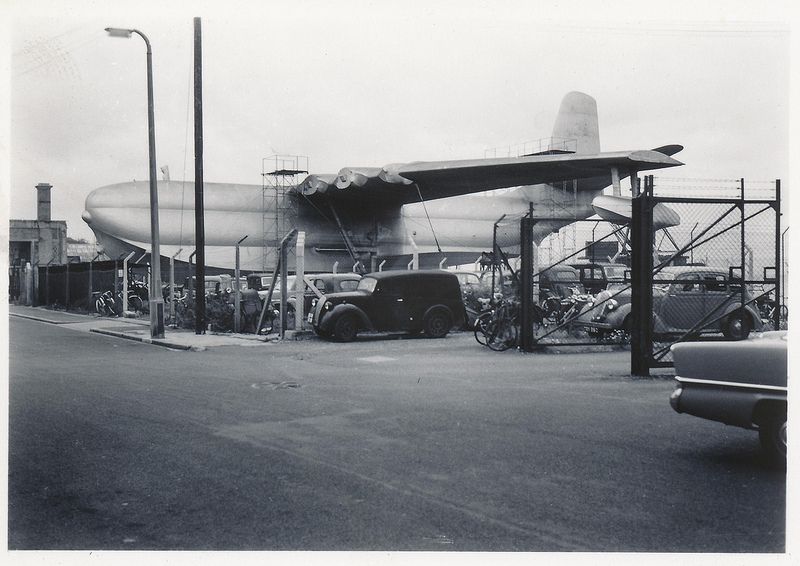
Finally, in 1964, the 3 Princesses were bought by Aero Spacelines, who planned to use them as heavy-duty freight aircraft to transport Saturn V rocket components for NASA. However, when the cocooning was removed, it was found that they were badly corroded, as the contract for maintenance of the stored aircraft had lapsed and the airframes had deteriorated.
All 3 Princesses were broken up by 1967. They were the last aircraft to be made in the famous Saunders Roe works.
In the next edition of Made on the Isle of Wight, we shall look at the famous Islander aircraft – made in Bembridge by Britten-Norman.









Well that was a bit of a fail wasn’t it?
the Wight Aviation Museum at Sandown Airport has a display about the Princess……pay us a visit later this year when we reopen.
These articles are brillient!
Well done Island Echo.
More please!
My Dad, who did a lot of the drawings for the Princess, said that they couldn’t get the right engines for the craft and the ones fitted were underpowered. I actually visited the wooden mockup of the interior of the craft in East Cowes. He took us down to the sea front at East Cowes because the plane was supposed to be taking off for a test flight. Unfortunately all it did was taxi up and down a few times.
Its a pity one could not have been saved
Proper IW that, real islanders, no overners, all locals in proper industry!
Really impressive looking craft, such a shame we have lost the ability to create such on the Island. Thank you Echo for providing such even if the only thing to look forward to is the past now.
Mally, Some of us are old and WISE enough to know how lovely it was without diversity and enrichment.
Imo not coincidence that overcrowding, poverty, and the vilest of crimes occur since.
If not most strange it happens ever where certain types settle en-masse
Hmm, that proper that it didn’t even take off.
They were not the last aircraft to be made at the Columbine yard. The SR53 Interceptor came next which was test flown from Boscombe Down, That was followed by three SR 177 Interceptors which were sadly cancelled before completion.