











































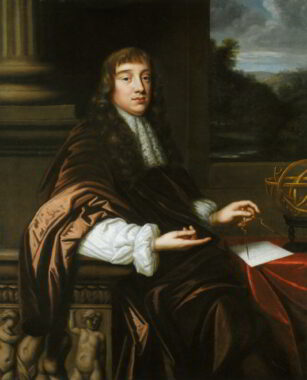
Robert Hooke – 1 of Britain’s greatest scientists, natural philosophers and architects – was born in Freshwater on 18th July 1635.
He was the son of an Anglican curate. He grew up in the area known now as Hooke Hill. He 1st showed his genius as a child when he constructed a working version of a clock from wood on having seen a brass clock.
Robert Hooke’s father died when he was 13 and he was left with an inheritance of 40 pounds. He used this money to buy himself apprenticeships and scholarships, to get himself off the Island and enrol himself 1st in Westminster School in London and then at the University of Oxford.


While still in his early 20s, Hooke had proposed the famous law of elasticity that bears the name ‘Hooke’s Law’ and with which many schoolchildren today begin their study of physics.
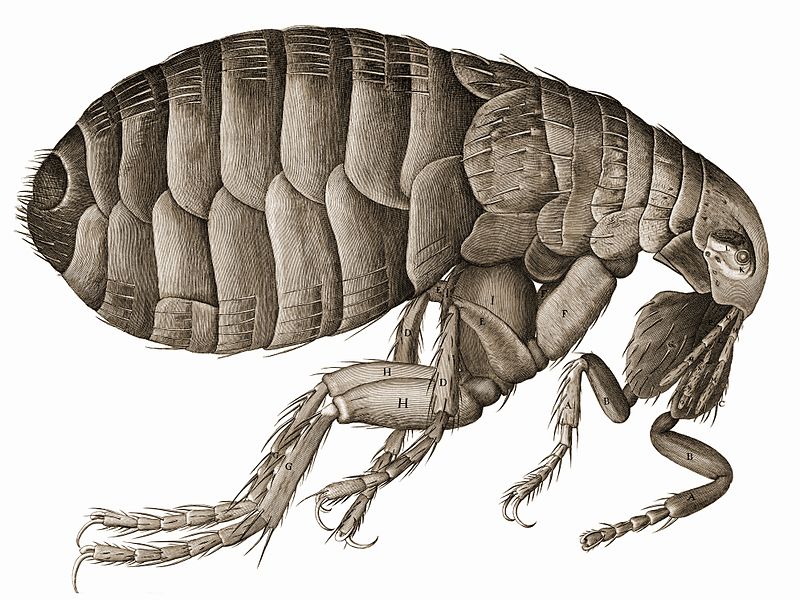
Robert Hooke was the 1st person to discover microorganisms in 1665, using a compound microscope that he had built himself. His findings were published in his 1665 book Micrographia, in which he coined the term “cell”.
In Micrographia, Hooke was also the 1st scientist to report on patterns of refracted light, which are known today as ‘Newton’s Rings’.
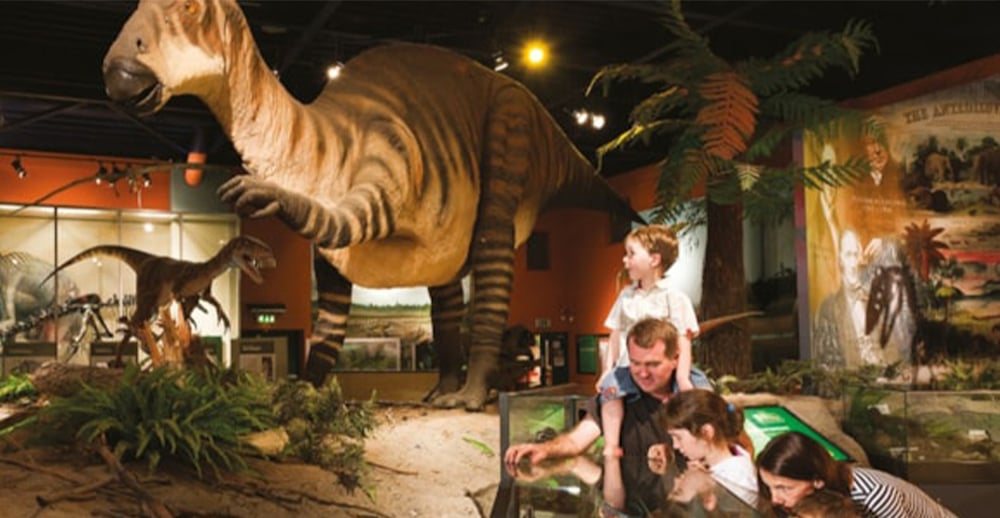
The same year in which he published Micrographia, Hooke made his final visit to the Island to attend to the death of his mother. At this time, he used the opportunity to study the numerous fossils found in the Back of the Wight.
He hypothesised the extinction of species, and argued that fossils atop hills and mountains had become elevated by geological processes. By observing fossils, Hooke had developed the Theory of Evolution some 200 years before Darwin.

In 1673, Hooke built the earliest Gregorian telescope, which he used to observe the rotations of the planets Mars and Jupiter. He proved through experimentation that gravity follows an inverse square law and hypothesised this relation in planetary motion. This principle was later formalised by Isaac Newton in his law of universal gravitation.
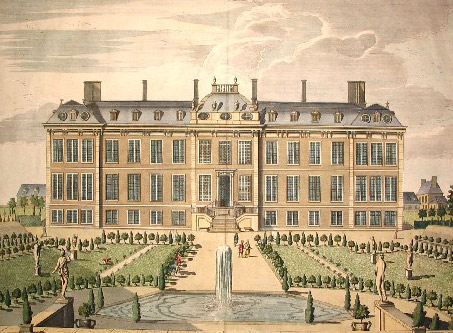
Hooke was not only an authority in the field of science. After the great fire devastated London in 1666, he was put in charge of surveying the city for its reconstruction. He was also the architect of many new buildings, contributing to the design of the Royal Greenwich Observatory and the dome of St. Paul’s Cathedral. He was also responsible for the construction of Montagu House (now the British Museum).
The Isle of wight Scientist was fascinated by mechanics, and it is thanks to him that the famous watch and clockmaker Thomas Tompion created the world’s 1st pocket watch.
History has failed to do justice to the genius of Hooke. However, today he is recognized as one of the most important experimental scientists of all time.
Hooke the polymath was an expert in biology, medicine, physics, engineering, horology (the science of measuring time), microscopy, navigation, astronomy and architecture. The breadth and depth of his knowledge has led to his being referred to as ‘the English Leonardo da Vinci’.
Much of his obscurity is said to be due to his bitter disputes with rival scientist Isaac Newton, who is said to have denigrated the achievements of Hooke when he became President of the Royal Society. Both had attempted to claim credit for the theory of gravity and corpuscular theory of light.
Today, not even a portrait of Hooke has been preserved despite his having been in the forefront of the first golden age of science. According to scientific legend, Newton sent for the only portrait of Hooke and ordered it destroyed.







Robert Hooke also invented the universal joint, known by engineers as a Hooke Joint.
Lovely Bloke really miss him, use to enjoy hearing him discuss topics down the Red Lion over a tlaggen of Ale. Good Ol’ Hookey
What an amazing achievement all that work started at such a young age wish I had half his intelligents
Lol. Love island echo comments!
Why is this not taught in our Island schools?
Newton disputed many of Hooke’s “achievements”. Hooke was renowned for stealing credit for the discoveries of others. Also a thoroughly nasty man.
This was all a very long time ago. Depends on whose account you want to believe.
I believe the genius who was Isaac Newton rather than the dabbler and scoundrel who was Hooke. He was a thoroughly bad lot. Hooke actually kept records in his diaries of how he sexually abused his 12-year-old niece as well as several maids and other staff. His first biographer, Richard Waller, states that Hooke was “in person, but despicable” and “melancholy, mistrustful, and jealous”.
He also helped co-write Peter Pan, I believe the baddy in the book was his creation.
I believe he made something ocular for Samuel Pepys. He is mentioned in Pepys Diaries.