































































 Following significant pressures on the health and care system across the Island over and post the bank holiday weekend and difficulties in discharging patients from St Mary’s Hospital, the Isle of Wight NHS Trust say it has been necessary to postpone some routine in-patient and day case surgery today (Thursday).
The postponement has been necessary to create capacity at St Mary’s to care for patients who need immediate care. All patients affected by these postponements have been advised and will be rescheduled as soon as possible.
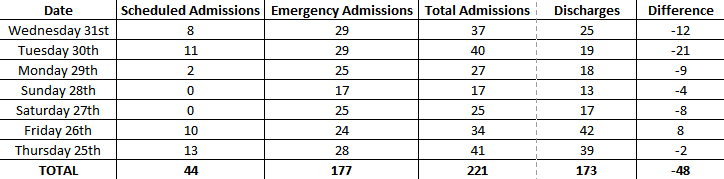
To achieve a consistent flow of patients through St Mary’s Hospital the aim is to discharge 50 people per day subject to their medical care and an assessment that they are safe to discharge being complete. Over the last few days, due to limited places on the Island and the understandable desire of patients, and families, to be discharged to a place of their choice, the level of discharges achieved has been well below the 50 required.


Shaun Stacey, Chief Operating Officer at Isle of Wight NHS Trust, commented:
“The difficulties in discharging patients from hospital has meant that we have had to create additional capacity to cope with the number of patients we are currently caring for. We can only create additional capacity by releasing the space and staff we use for surgery and that means that we have had to regrettably postpone some patient surgery. We only do that as a last resort but the current difficulties we find ourselves in mean that we have no choice.
“I have spoken personally with a number of patients this morning whose surgery we have had to postpone and I share their frustration with this position. As the figures demonstrate we have had significantly more admissions than discharges over the last 7 days. I want to apologise to every patient whose surgery we have had to postpone.”
Shaun continued:

“We recognise that patients, supported by their families, want to be discharged to a location that they feel comfortable with, whether that is the patient’s own home, to stay with a relative or to a nursing or residential care home. We would encourage patients and families to plan for discharge as soon as they are admitted to hospital. Sometimes we will need patients to move, when they are medically fit for discharge, to interim locations in the community to free up beds for those who are ill and need to be in a hospital bed.”
The Emergency Department and Beacon Health Centre at St. Mary’s Hospital have been under significant pressure, especially following the Bank Holiday weekend. There were over 200 attendances at the Emergency Department on Tuesday 30th August and over 160 on Wednesday 31st August.
St Mary’s Hospital is appealing for Islanders to call the Island based NHS 111 telephone number if they feel they need urgent medical help before making a visit to the Beacon Centre.
Dr Mark Pugh, Medical Director at Isle of Wight NHS commented:
“We really need people to think about whether they need to attend the Beacon Centre. If you think you should we would ask you to phone NHS 111 first and they may well be able to offer you alternative treatment options like seeing your GP, a pharmacist. On the other hand, if it’s an emergency, the NHS 111 service can send out an ambulance directly to you if that’s what’s required.”
When you call 111 the call is answered by a highly trained call handler, supported by nurses and paramedics based at St Mary’s Hospital. They will assess the symptoms and put the caller directly in touch with the people who can help; for example, an out-of -hours doctor, a district nurse, an emergency dentist — or it may be something as simple as a 24 hour pharmacy.
999 is for emergencies and life-threatening situations only and the Emergency Department (A&E) is for serious, life-threatening injuries and illnesses that need urgent medical attention.
It is vitally important for those who have been unwell with vomiting and/or diarrhoea recently, especially if they have had these symptoms in the past 48 hours, not to come to the hospital unless it is an emergency. Good hygiene is important during outbreaks of diarrhoea and vomiting as it is highly contagious. Keeping hydrated and drinking plenty of fluids is very important, particularly for the elderly and the very young that are most at risk. If the symptoms persist, telephone NHS 111.
Further details of symptoms are available on the NHS Choices website www.nhs.uk.