























































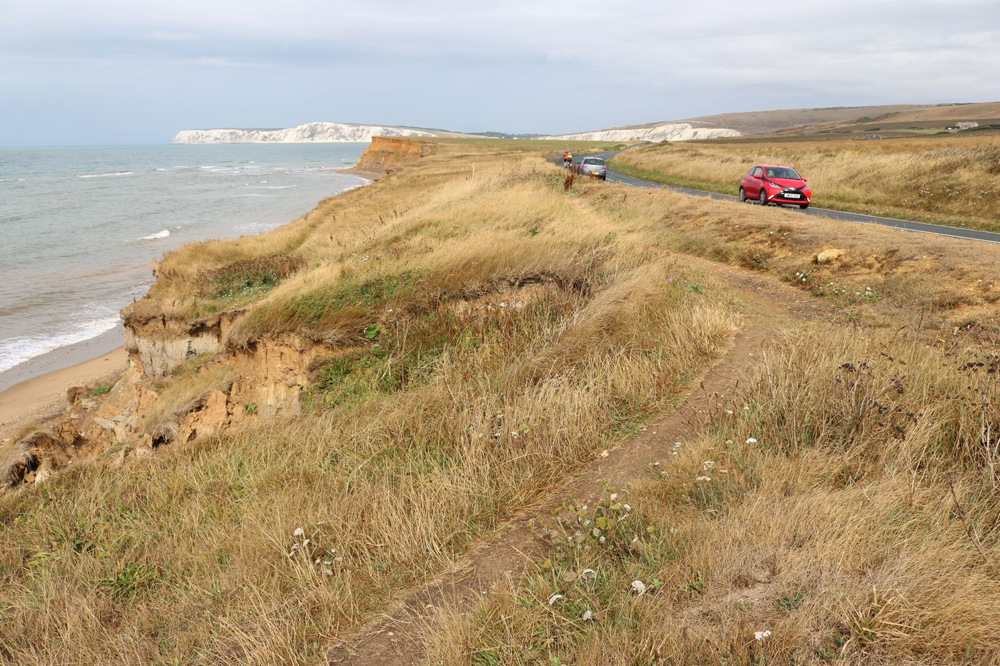

Plans for an engineering scheme to prolong the life of an erosion-threatened section of the Military Road at Brook have been submitted by Island Roads.
The proposal, submitted to the Isle of Wight Council, seeks to protect a 25-metre section of the Military Road that, due to ongoing erosion, is now just metres from the cliff edge.
The solution proposed by Island Roads would not only extend the life of the section, it would do so in a way that is visually unobtrusive, give due regard to environmental considerations and which would allow natural erosion processes to continue. As such, an Environmental Statement has been submitted as part of the planning process.


In simple terms, the plan is to install piles under the south side of the carriageway to isolate the road from ongoing coastal erosion. The piles would be buried so would not initially be seen from either ground level or from the beach/sea below. It is anticipated that it would be between 5 and 10 years before the piles becomes visible from the beach as a result of erosion.
Island Roads believes the solution is compatible with various environmental designations that protect the location; an Area of Outstanding Natural Beauty, a Site of Special Scientific Interest and a Special Area of Conservation. At the same time, the scheme will extend the life of the road therefore preserving this important transport link for residents and visitors, between the south and west of the island.
The site is one of many defined in the Highways PFI contract as needing an engineering solution to protect the carriageway at geologically vulnerable locations. Such schemes already delivered include Bouldnor Road at Yarmouth and at Newport Road (The Graben) in Ventnor.
Steve Ashman, Island Roads service director said:
“The challenge of the Brook scheme has been to devise an engineering solution that prolongs the life of this important section of the Island’s infrastructure but does so in a way that respects the unique environmental and geological characteristics of the site.
Article continues below this advertisement “We have looked at several solutions and the advantages and disadvantages of each, and we believe the current project is the best option in terms of protecting the section in a fully sustainable way.”

It is hoped that, subject to planning permission being granted, work on the 8-week project could begin in October, outside the main holiday season.











Yet the tarmac that Island roads have laid less than a month ago, to Elmsworth farm at Porchfield, has a massive crack several feet long already, and inches deep.
All Island roads do is lay a very thick layer of tarmac over the old crumbling, subsiding damaged surface, rather than take the effective but costly option of digging out to subsoil level and stabilising such first as we were told would be the case when the contract was given.
Then, because the thick added layer means the carriageway is raised so much higher there is a nasty drop to the verge or soil which is then filled with a lose grey fine chipping material.
This loose material is then displaced easily by heavy rain, any vehicle driving on it and consequently the then higher tarmac ‘edge’ of the carriageway then has no ‘support’ and so crumbles and cracks away as vehicles drive on the edge of such.
Tar-mac is NOT concrete and has no strength on its own, and we were initially promised roads would be repaired by sorting out the underlying issues, not burying such, giving enough time until the contract expires before the old issues, only now deeper and more costly to remedy are ‘surprisingly discovered’
To ‘trust’ them to repair the military road seems a little over optimistic.
Very well put miss primmer ,and what a wealth of knowledge you have I am very impressed.
Well that’s military road closed for months if not years and will there be traffic lights like St Mary’s and they will most probably do the work when TT is scheduled
Island Roads cant even handle simple jobs like resurfacing pavements and roads the quality of their work is some of the worst ive ever seen . There are other Civil Engineering companies on the Island more suited for this kind of work why not use them ?
Give Island roads a break, we moved here 7 years ago and the roads on the island were the worst I’ve ever experienced, you had to pay more attention on pot holes than driving.
I think for the time they have been looking after the roads they have done as amazing job.
All the haters out there need to put a sock in it and get a life.
But the most used road on the Island.The section from North Fairlee to Coppins Bridge is in an appalling state. Never mind the pavements sort out the roads.
The principal trouble is the Island geology. I once saw a hole being dug in the road in Cornwall, about 2ft down it was solid granite, which is why their roads don’t subside as ours do.
Whist Cornwall has granite, it also has a radioactive gas which leaches up from the decaying granite beds.
So I guess they don’t need street lighting either if the roads glow.
My issue though is that WHEN the contracts were being discussed the talk was that the contractor would SORT the underlying issues of our roads. They mentioned that they were ‘just cart tracks which had merely been tar-mac’d over every year with no solid bases to many which were over clay etc.
Island roads just add more topping on such roads giving them more time before they fail, but fail they will. But so long as the cheques are cashed and no small print ensuring remedial work has to be carried out after a short time span, ONLY the council tax payer cares.
I understand the dilemma in regard to complying with AONB and other associated principles, however the Military Road is a vital road link on the Island that also serves to avoid traffic congregating in other more central areas. This plan is a sticky plaster approach. Planning should be looking at re-routing endangered parts of the road slightly further inland which would then be safe for the next 80-100 years, not 5-10. Would also mean this work could be conducted without closing the existing route.
How about just move the road and buy a section of land next to it? Simple and straight forward. If the owner does not sell then a compulsory order can be sought. Will last much longer than piles and will most likely be cheaper, quicker and more environmentally appeasing as in 5 to 10 years the piles will become visible and in possibly 20 years the road will be back to square one again with the piles most likely staying there rising away.