

































































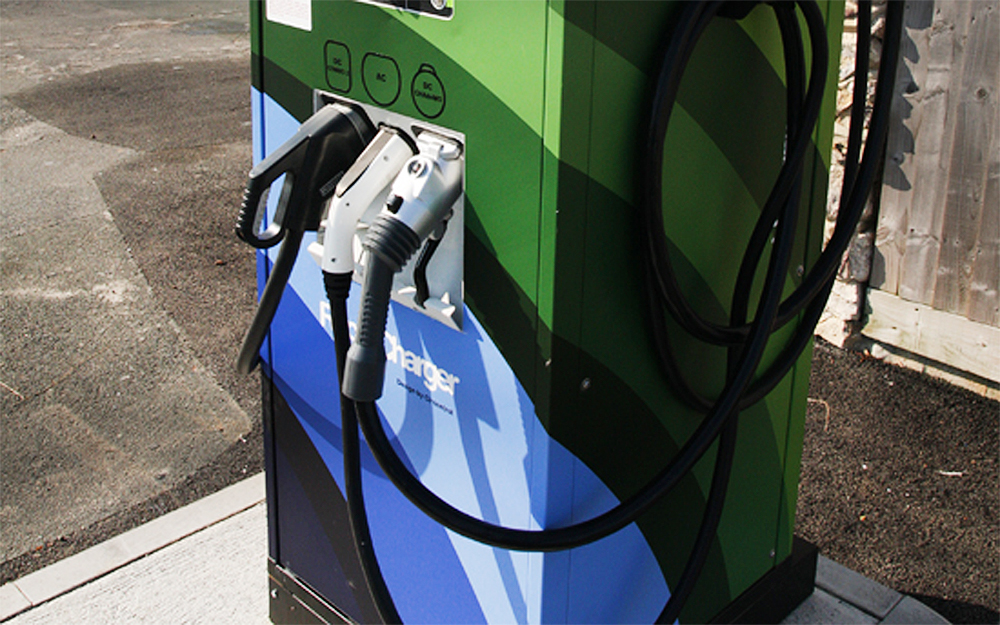

 Scottish and Southern Electricity Networks (SSEN) is calling for the Government to work with industry to roll out the world’s most extensive electric vehicle (EV) charging network by 2025.
SSEN argues that world-leading public access to EV charge points will accelerate a green economic recovery and empower the Isle of Wight to make the switch to EVs.
After significant reductions in electricity emissions over the last decade, transport is now the biggest single emitter of carbon and it is estimated that if the UK is to meet its net zero target, there will be an 11,000% increase in EV ownership across southern England.

SSEN has today published Accelerating a Green Recovery, setting out 10 proposals to support the UK’s transition to EVs.
Among the proposals is the call for the universal provision of charge points, and to secure this through electricity networks working with local authorities on ‘area-wide tenders’. This will support a cost-effective transition to a system that provides access to EV charging capability to communities without access to off-street parking and in locations where local businesses are reliant on footfall like town centres and seasonal tourist areas.

A successful area-wide tender process for a network of public EV charge points in the Netherlands in January 2020 led to 20,000 public EV charge points being contracted across an area covering 3.2 million people. In comparison, as of June 2020 the UK had just 32,000 public EV charge points for a population of 66.8m people.
In England, 81% of owner occupier households have access to off-street parking and will be able to access low cost EV charging with time of use tariffs at home, this only includes 50% of the private-rented sector and just 25% of local authority housing.

SSEN Distribution says the UK Government should replicate the Dutch model to accelerate the provision of EV charging infrastructure in a fair and cost-effective way.
Colin Nicol, SSEN’s Managing Director said:
“SSEN stands ready to support and accelerate the green recovery. Delivering charge points in communities across the UK will support green jobs and spread investment.”
“Local authorities should be empowered on this journey. We want to unlock and enable the communities we serve realise their net zero ambitions. Local Area Energy Plans, will allow targeted investment, avoiding unnecessary cost and disruption in the transition to net zero.”
“Universal access to EV charge points is critical to a fair transition. With the right policies the UK could have the world’s most extensive EV charging network by 2025, and ensure no one is left behind.”
Analysis for the Committee on Climate Change found strategically planning and investing in the UK’s electricity networks could avoid £34bn of unnecessary expenditure between now and 2035.
Other proposals in the Accelerating a Green Recovery plan bringing forward the ban on the sale of new diesel and petrol cars, allowing revenue from Clean Air Zones to go toward EV infrastructure and giving communities greater say in their energy future.
Standardisation of charging, allowing any EVs to be plugged into any charge point and no multiple of fiddly accounts, cards or apps being needed is also key to get more people out of petrol and diesel cars into EVs.
SSEN’s Accelerating a Green Recovery EV plan is available to view at www.ssen.co.uk/EV.












As with solar panels, those rich easily able to afford the new hi tech products and who can thus, ‘get in’ early, benefit the most, as they will get cheap tariffs, yet by the time the plebs are ‘electrified’ the charges will go up, and any ‘incentive’ as with solar panels, will be long gone.
Governments just want more people in debt by forcing them to change every car in the land, thus gaining from new business and loans.
Little to do with climate change, mostly to do with, making their business party supporters richer. The former, just ‘used’ as an excuse to force people to scrap decent cars and spend what many haven’t got to spend.
why arent ssen being honest – more electricity consumption is more profits for them.
It’s greener to keep old cars going than building new ones .not getting rid of my 30 year old landrover for any one .
I just can not afford an all electric car, unable to have my own charge point, terraced house. So not for me.
Will have to go hybrid if i can afford one of them ! ! ! which i can’t.
Back to the drawing board for me then.
Wonders how many more on the Island can not afford hybrid or full electric?
80%, 90% 95%