



































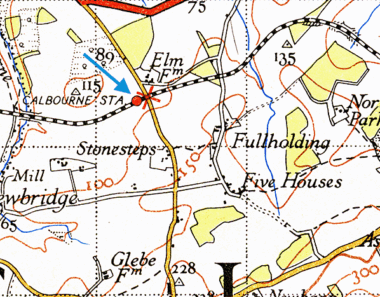
 Calbourne & Shalfleet Railway Station had a tranquil, rural West Wight existence until closure, when mysterious happenings occurred halfway along Elm Lane… The official name ‘Calbourne & Shalfleet’ caused disputes between the 2 villages as the sign on the platform merely said ‘Calbourne’, but jealous residents of the village to the north sometimes chalked ‘Shalfleet’ underneath. The station was a hefty mile walk from both the villages it served. In the absence of motorised transport, it was better than nothing, but it could never compete with the bus. Calbourne & Shalfleet was small – so small that there was no separate accommodation for passengers – who were at one time forced to use the station master’s living room in inclement weather. When the Southern Railway took over from the Freshwater, Yarmouth and Newport Railway, the former company’s station in Newport was closed and its ticket office relocated at Calbourne & Shalfleet. Next to the station was a level crossing at Elm Lane with a signals box next to this. Calbourne & Shalfleet first opened to passenger traffic on 20th July 1889. An detailed account of life there has been recorded by Mrs Katie Buckett, whose parents were stationmaster and mistress for 41 years, up until the end of World War II.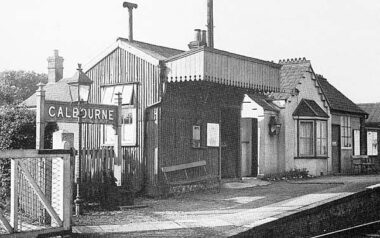
“The rent was low for the bungalow containing 2 bedrooms, a living room with a cooking range, coal fired, a scullery with a sink and copper, but we did have water laid on by tap and water cisterns in the loos. “There were only 2 houses with that luxury in the village, the Manor House and the Vicarage, so we were very lucky.”
Livestock were often a problem for the stationmaster’s family:


“Tuesday was market day, and cattle trucks were shunted on to the back of the first train in the morning, which was the school train too. “Sometimes, it was like a cowboy film: animals seldom go where you want them to, so often they dodged down the platform on to the track, with farmers, guard and my father chasing them. “Quite often, one would escape into a field, and my sisters and I were very late for school along with the other pupils, but we had a good excuse.”
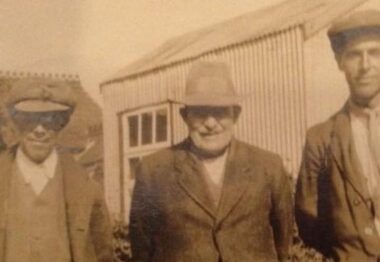
“On Saturdays, 2 trains were run to Newport at a cheap fare for marketing (6d – 2 1/2p). “These trains were crowded, and some of the male passengers were ‘pretty’ (drunk) by the time they came back on the last train. “Often, my mother had to assist the butler from Westover House (who was a regular on Saturday nights) into our living room, away from aggressive passengers from another village, and keep him there until the all clear.”
Mrs Buckett had mainly happy memories of being a ‘railway child’:
“I can look back to those days with warmth on life at a wayside Island station in the days of steam. “We had so much with wild flowers, mushrooms, blackberries and so on, even if the fireman of the engines stoked up in the station and the black soot landed on our snowy white sheets and clothes.”
Article continues below this advertisement

The last train from Calbourne & Shalfleet Railway Station left on 20th September 1953. A contemporary newspaper reported:
“After one of the busiest passenger-carrying days in its 64 years in operation, the 12-mile-long Newport-Freshwater line closed with the last train leaving the crowd-packed West Wight terminus at 21:31. “When it left Newport at 20:50 on its last outward journey, it carried about 50 passengers – which was about 41 more than usual for a Sunday night. “5 ‘Militia Men’ in colourful uniforms prepared to give the train service full military honours at its ‘funeral’. “The ‘Militia’ – with a black draped Union Jack – performed their first ceremony, which ended with the sounding of the Last Post as the train was about to leave Freshwater, and repeated it on the platforms at Yarmouth, Ningwood, and Calbourne, the other stops.”
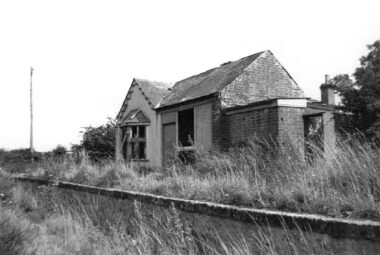
“The wind moans through the roughly boarded windows, the floors creak, plaster peels from the decaying walls, and there are holes in the ceiling. “A shock has awaited curious villagers who have ventured into the buildings after hearing about strange activities. “A devil-mask, painted boldly in red, white, and black, grins in the entrance.”
A dozen startling murals – featuring skeletons, ghosts, coffins, and gallows – had been painted inside the dilapidated station. 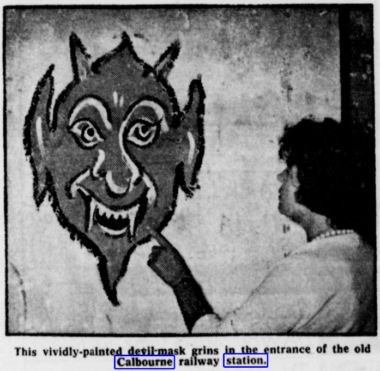
“I saw some figures moving in the shadows. One was clearly a man with a beard. It seems as if the paintings were done by these beatnik folk. “This business is certainly causing some talk with many of the locals. We are all trying to puzzle out the mystery.”
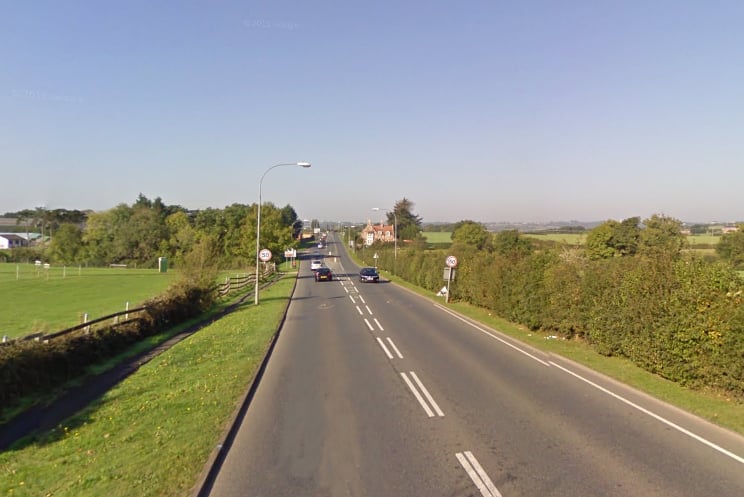
The Portsmouth Evening News could find no explanation for the bizarre happenings. Unfortunately, Calbourne & Shalfleet Railway Station no longer exists, having been replaced by a modern bungalow. The former crossing keeper’s cottage at nearby Pound Lane (below) survived into recent times but has now apparently been demolished.