



































There will be no more teacher strikes when the new school year gets underway in September as a 6.5% pay rise has been agreed upon by the unions.
After months of disruption to children’s learning, it has been agreed that industrial action is to end.
Members of the National Education Union (NEU), NASUWT and the National Association of Head Teachers (NAHT) have voted to accept a 6.5% offer from the Government – the highest pay award in over 30 years. This adds almost £2,000 onto the salary of someone on £30,000 per annum.


Peter Shreeve, Assistant District Secretary of the National Education Union, has said:
“Isle of Wight members and others have voted clearly and in great numbers over recent months. They worked hard to change the Government’s position on pay and funding. Indeed, the action was key in securing the highest pay award for over thirty years. Moreover, members secured extra funding for schools.
“The re-ballot for strike action comfortably passed Government’s highly restrictive thresholds. Turnout for electronic ballots was also strong, suggesting it is time for Government to end the practice of mail-only ballots”.
Although there will be no strikes when the kids go back to school at the start of September, Peter says there are still challenges that remain:
“Despite the end to next term’s action, major challenges still remain unsolved – staff recruitment and retention, as well as an overwhelming workload.
Article continues below this advertisement “Less than 3 weeks ago, the Parliamentary Education committee learned of 2,300 teacher vacancies in November 2022 – the highest number since 2010 and significantly more than the previous year. Research suggests this increase indicates that teacher leaving rates have likely increased this year. That only 59% of the target for recruiting trainees for Initial Teacher Training was achieved in 2022/23 made the situation worse.
“July 2023 figures show teacher recruitment for 2023/24 just below target in the primary sector, but missing the secondary school recruitment target in almost all subjects and by 48 percent overall. Thus, there will still be dramatic trainee shortages in almost all secondary subjects particularly in key areas such as Business Studies, Physics, MFL (languages) and computing.
“All these vacancies need to be filled. It remains the view of the NEU that school and college funding is far from adequate.
“In a 13 July statement, Education Secretary, Gillian Keegan said she would convene a workload reduction taskforce to explore how to “minimise workload for teachers and leaders”. The aim to reduce working hours by five hours per week. Every teacher has their fingers crossed.
“By supporting education communities to attract and keep staff, better ensures every child gets the attention and support they deserve. The campaign for a better-funded education system will not go away.”








It’s almost like the money you lost whilst on strike has paid for your pay rise.
You old fart terry you pay for the rise and there time off
You don’t get paid when on strike.
Add to that the pension contributions that aren’t put in , which is three times what the employee puts in.
Then they have lost the increase in wages.
Which will take another year to recupe pushing them further into a below inflation pay.
You must work in public education.
You old fart Terry,you pay for the rise and thier time off.
After months of disruption to children’s learning, it has been agreed that industrial action is to end.
only because it is the summer holidays and they don’t want to “work” on strike action when they are dossing for six weeks.
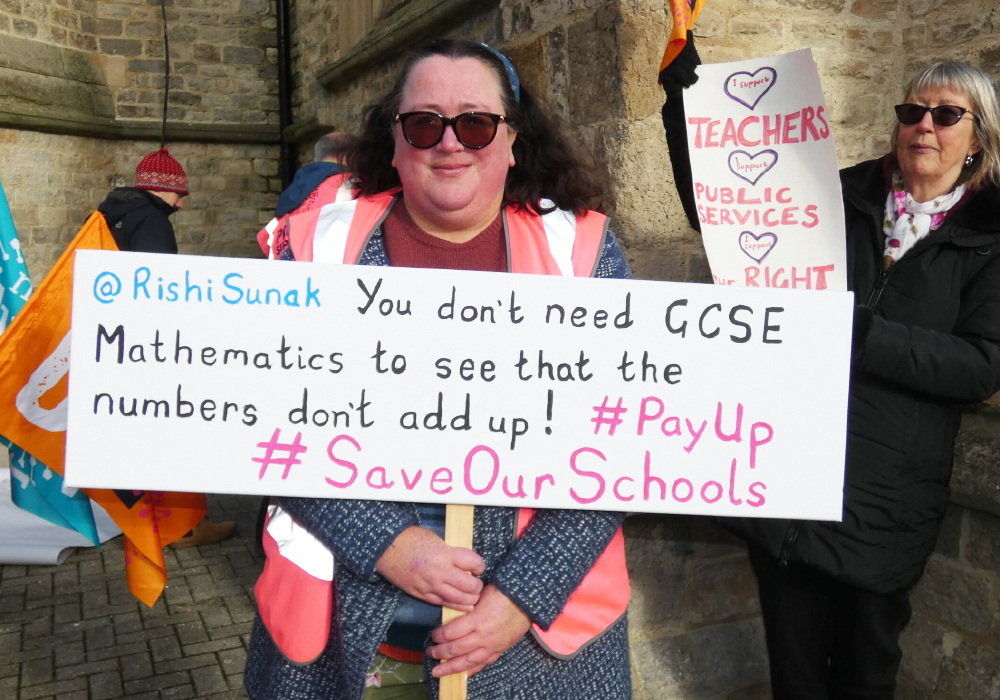
I love the photo, someone should tell her you don’t need a gcse in mathematics to realise you took a pay cut, once you factor in the payless days of strike and the rate of inflation.