



































This bank holiday Monday, Island Echo takes a brief look at the often neglected culinary traditions of the Isle of Wight.
Did you know that some claim the doughnut was invented on the Isle of Wight? Or that the local cheese was said to have been as hard as a grindstone? Or that the Battenberg cake is connected with 2 Isle of Wight governors?
If not, then read on …


The Isle of Wight was traditionally rural and its dialect – recorded by WH Long in his Isle of Wight dictionary – reflects the work, habits and food of its agricultural workers.
The 1st drink of of the day was Lebb’n O’clock: beer drank at 11:00 during hay and harvest time. Lunch was known as nuncheon – a combination of noon and the archaic word shench, meaning drink. Nammet or ‘nammit’ was a meal of bread and cheese and a pint of strong beer taken at 3 or 4 in the afternoon, carried to work in a traditional nammet basket.
Those toiling in the fields would also have rot gut and swizzle (small beers) taken to them in puncheons (small kegs). The Isle of Wight ale was believed to cure ills such as tissick – a hacking cough.
The folk belief that ale could cure ailments led to the rhyme oft quoted by locals in bygone times:
“Strong beer cures the gout, the colic, and the tissick,
and it is for all men the very best of physic”Article continues below this advertisement

Isle of Wight hard cheese
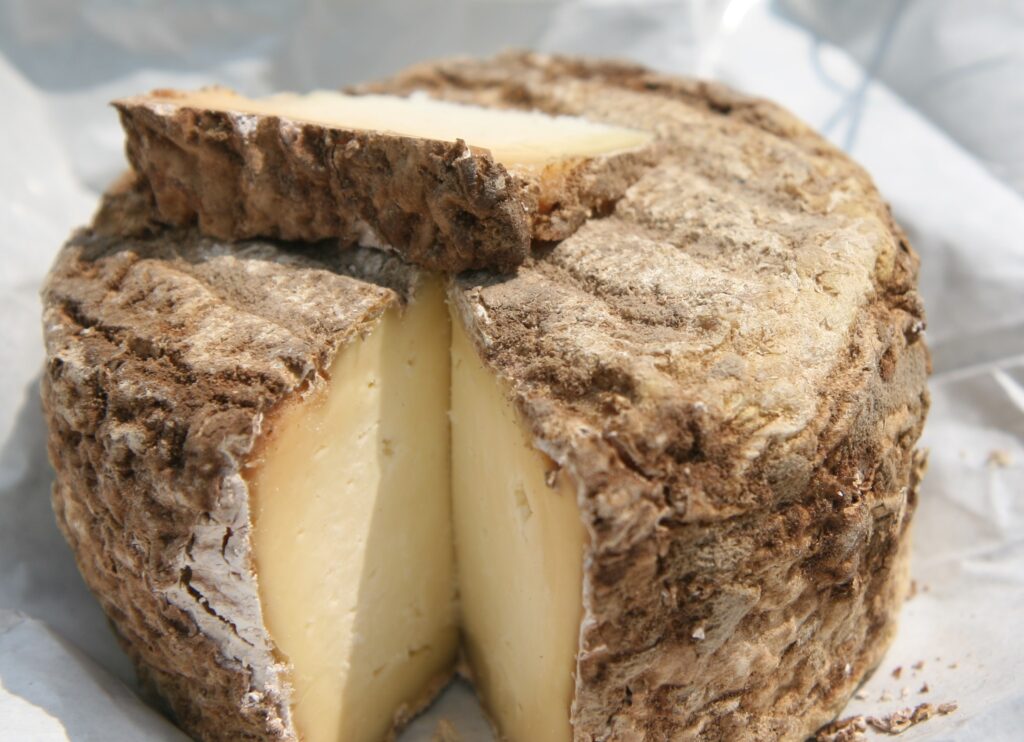
Isle of Wight hard cheese never had the best of reputations. It was so hard that it was named locally either as ‘Wight rock’or ‘chockdog’ (choke dog).
Island farmers concentrated on the production of cream and butter; this left only skimmed milk to make the cheese, which soon became dry and hard.
An Isle of Wight farm worker described this cheese in 1790 in the following way:
“It can scarcely be cut by a hatchet or saw; it is to be masticated only by the finest teeth and digested only by the strongest stomachs.”
There are various legends associated with this hardest of cheeses.
One of the most popular claims that during a French raid of the Island, the defenders ran short of bullets to fire at the invaders. They therefore resorted to taking out their lunches, cutting their cheese into pellets, ramming them down the barrels of their guns and firing them at the enemy.
Another yarn is that when Isle of Wight cheese and mill-stones were stored in the hold of a ship, rats preferred chewing the stones and that whenever a storm threatened, it was the cheese – rather than mill-stones – that was thrown overboard to lighten the cargo.
Isle of Wight doughnuts
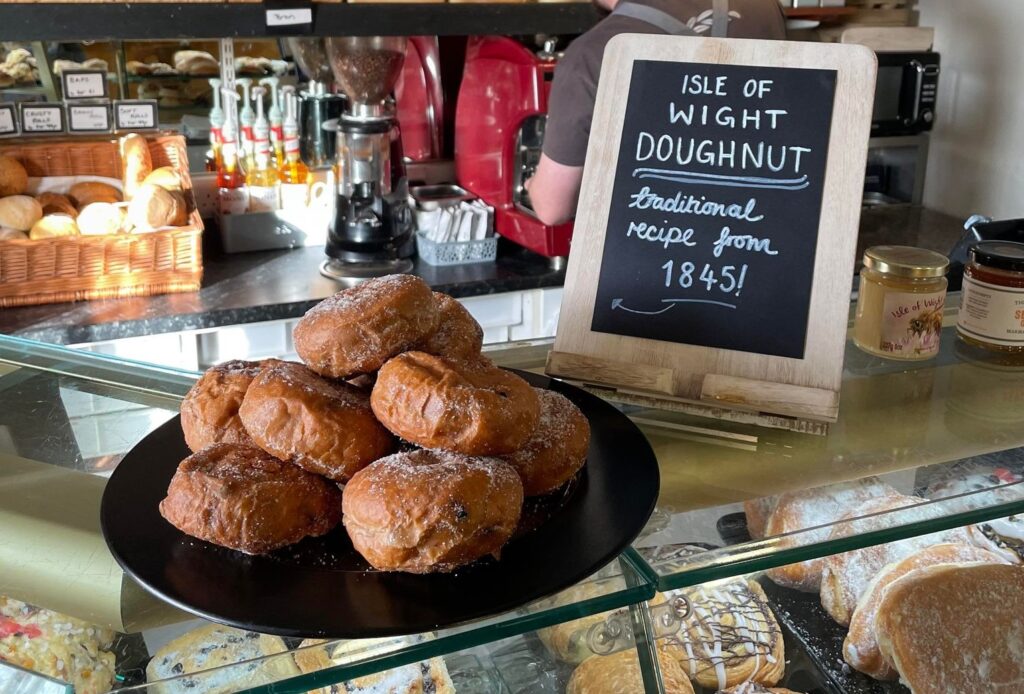
Thankfully, our native doughnuts have a more wholesome reputation than the indigestible cheese. Some even say that the doughnut was invented here on the Island …
Our claim to have invented the doughnut rests on 2 pieces of 19th century evidence: the publication of the ‘Isle of Wight Doughnut’ recipe in 1845 and a paragraph in the book The Queen’s Isle, in which the author states that “…doughnuts are peculiar to the Island…”.
This is backed up by a letter from a George Millman to his fiance in Ventnor in the 1870s in which he asks:
“What are these Doenuts dear? Are they good to eat? Or are they nuts made of iron with a sort of screw inside?”
The Isle of Wight may have been the 1st place in Britain to develop something called a ‘doughnut,’ However, American food writers claim their ‘donuts’ were introduced by Dutch settlers, who 1st introduced their oliebollen to the United States in the 17th century, before the doughnut was recorded here.
Most likely, the local and Dutch versions of the doughnut (or donut) developed independently.
The Isle of Wight doughnut is very different to an American donut, with a plum in its centre rather than jam.
The original name for a doughnut on the Island was ‘bird’s nest’, and the word ‘doughnut’ was 1st used in the mid-19th century.
The local Grace’s bakery have made Isle of Wight doughnuts using the original 1845 recipe.
The Battenberg cake
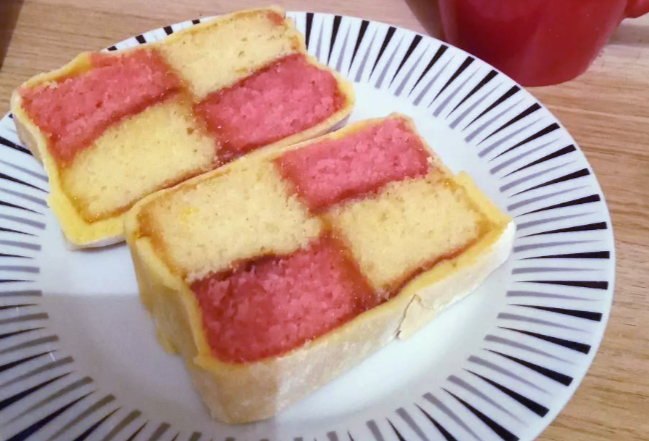
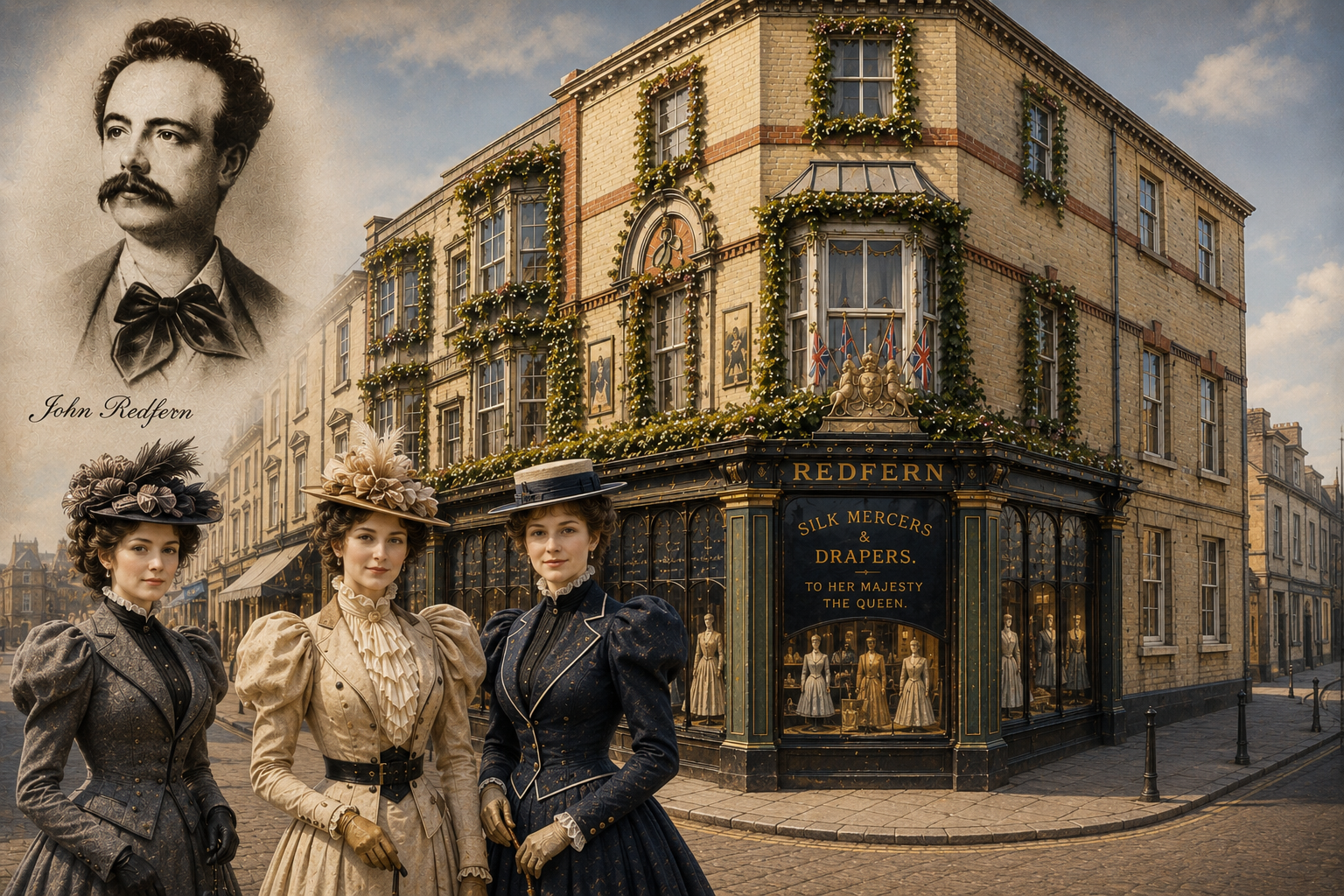
2 Isle of Wight governors have been Battenbergs. The 1st was Princess Beatrice – youngest daughter of Queen Victoria – who married Prince Henry of Battenberg. The 2nd was Earl Mountbatten, who changed his name during World War I to make it sound less Teutonic.
1 theory about the Battenberg cake is that it was 1st baked to celebrate the marriage of Earl Mountbatten’s parents in 1884. A 2nd claim (made during the British version of Bake Off) is that the 4 squares represent the 4 Battenberg brothers: Prince Louis, Prince Alexander, Prince Henry (who married Princess Beatrice) and Prince Franz Joseph.
However, the 2nd claim is untrue: the original cake had more than 4 panels. The simplification to 4 panels began when industrial bakers such as Lyons began baking Battenbergs, as these were easier to make on production lines.
Coneys
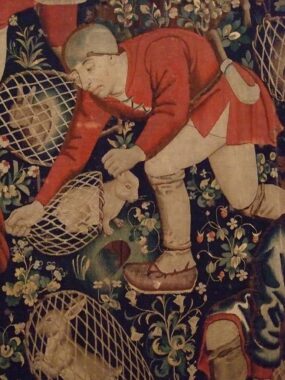 Coneys – as rabbits were formerly known – were the poor man’s food for Islanders from the Middle Ages onwards.
Rabbits are not native to the Isle of Wight: they were introduced by the Normans in the 12th Century. At that time, there were no foxes – the rabbit’s natural enemy – here. Soon, the Island became overrun with coneys.
The poor welcomed the rabbit as a plentiful supply of food. A coneyman (rabbit hunter) became a popular trade. Isle of Wight coneymen were said to have taken the meat as far as London and its markets.
Rabbits were far less common on North Island due to the widespread presence of foxes. The fox was 1st introduced to the Island in 1845 for the ‘sport’ of hunting.
Isle of Wight fishermen were said have had a unique method of catching coneys using a crab and a candle. The candle was fixed to the shell of a crab and lit; the crab was then thrust down a rabbit burrow. The rabbits – alarmed at the sight of the approaching light – would run out of their burrow and into the fishermen’s nets.








Interesting article. Makes a change to have a bit of light relief & not the usual doom & gloom.
The crab and candle story sounds like a wind up.