













































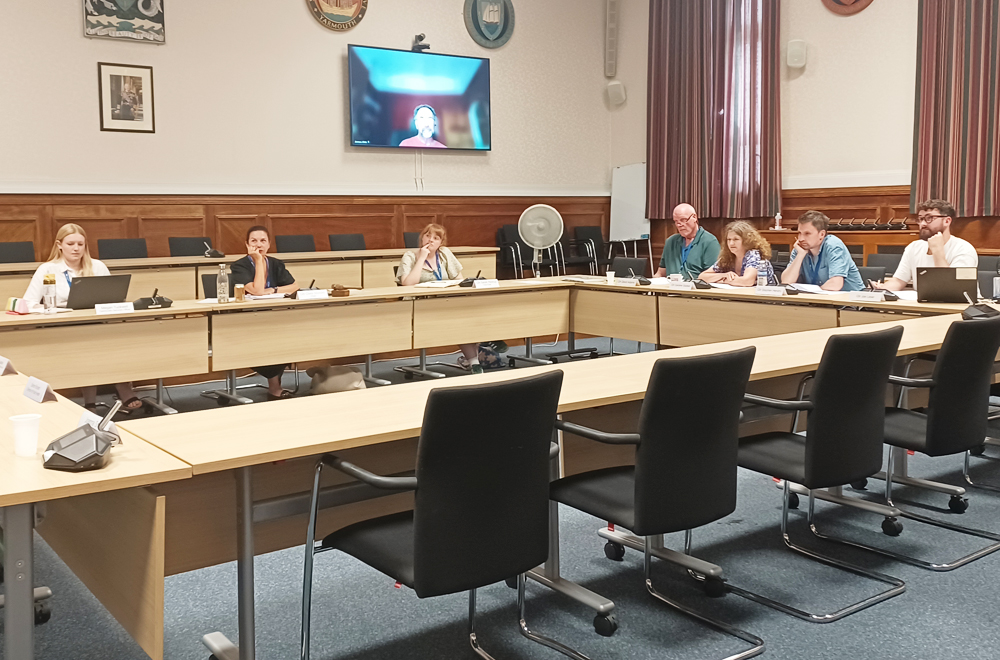

Concerns over ‘huge’ and ‘drastic’ cuts to NHS running costs were raised at an Isle of Wight Council committee meeting last week.
Councillors Clare Mosdell and Joe Lever voiced disquiet over far-reaching NHS changes, which will see local integrated care boards make 50% reductions in running and programme costs.
A summary of the Model Integrated Care Board (ICB) Blueprint – a document setting out the future roles and functions of ICBs – was presented to committee members.


In a document published prior to Thursday’s meeting, NHS Hampshire and Isle of Wight said:
“2025/26 is a year of significant change in the way we work as an organisation to deliver a more efficient public service for our population. This is all the more important in light of the decision for ICBs to reduce running and programme costs by 50 per cent by quarter three of this year.
“This is in addition to the proposed changes taking place at a national level that will see NHS England come together with the Department of Health and Social Care and regions having new responsibilities.
“We are currently working at pace to evolve and strengthen how we work as an organisation and across the wider system in response to all these changes taking place across the public sector.”
Infection prevention and control, Emergency Preparedness, Resilience and Response (EPRR) and local workforce development and training are among the functions the Blueprint advises should be transferred over time.

Meanwhile, population health management, health inequalities and inclusion expertise and epidemiological capability are the areas the Blueprint suggests should be grown and invested in.
Addressing NHS Hampshire and Isle of Wight representatives, Cllr Mosdell, chair of the adult social care, public health and housing needs committee, said:
“This is a drastic, huge saving being made across health services.
“Every year that I’ve done this I’ve just seen more and more savings having to be made – so a huge 50 per cent cut in your running and programming costs just seems an impossible task.
“I know that you’re saying that it’s not to affect services, but we’ve already got the outcry of what is happening to our Isle of Wight hospice and I’m probably not as convinced and positive as you are coming across.”
James Roach, director of primary care for NHS Hampshire and Isle of Wight, said:
“This is challenging, we absolutely recognise the impact on local services, but we are operating within a national programme with a national expectation and a national target in relation to running cost reductions.”
Cllr Lever, a Green Party member of the committee, said:
“There are some pretty big things being transferred, which makes me nervous about what will happen to those functions – SEND, primary care operations, medicines optimisation – they don’t feel like small things to be transferring.
“It’s hard for me to understand whether this is going to be a good thing in the long run with the looming 50 per cent savings.”
Ros Hartley, director of policy, innovation and partnership at NHS Hampshire and Isle of Wight, said:
“This is about running costs and not the service costs. Some of the services we are looking at, where we transfer to and what the risks of that are and how we mitigate them, some of them are about doing things more efficiently and doing them at scale.
“We’re looking at things we can do better – I don’t want to shy away from the challenge of this because the challenge is big.”
ICBs are responsible for planning health services for their local population, with the Island falling under NHS Hampshire and Isle of Wight.










What they need to do is reduce the head count, why have you got clinics at the hospital that see 10 maybe 12 patients a time and have four or five nursing staff, the last one I attended had nothing to do other than make the patients a hot drink.
So true.
The NHS is overstaffed, half of the workforce are not
required.
The NHS could save billions of pounds in salaries.
But like all Government run organisations, bad
management.
It is surprising how many civil servants are still
shirking from home since the pandemic
The Government should take a leaf out of
Morrisons stores and order their shirkers
back to work.
The only real workers in the country are those
Self employed or those working for private companies.
Working for the public sector is one big permanent holiday.
Extortionate wages and pensions and unlimited sick pay!
I think the article could have made it clearer that this is a reduction in the cost of managing the organisation of the services,.. not a 50% reduction in funding for the services provided….
it has often been said about the NHS, that there are “too many chiefs, not enough Indians”,.. it seems this reduction is trying to address that.
whilst there will, undoubtedly, be some effect on services,.. this appears to be about reducing the (considered to be) top-heavy management of the NHS,.. not about reducing services.
The comments from the council members suggest that perhaps they don’t understand this distinction.
Dont get rid of the few people that answer the phone, there are not enough of them.