








































 In the 2nd of our series Made on the Isle of Wight, we examine the history of submarine construction and design in both East and West Cowes.
We have all heard of the giant hovercraft and flying boats made by Saunders Roe in East Cowes, but did you know that the same company also built a prototype of a giant cargo carrying submarine to transport bulky goods under the polar ice cap? Were you also aware that 2 World War I submarines were built at J.S. White’s in Cowes?
During the Great War of 1914-18, Britain’s maritime trade was badly disrupted by the activities of German U-boats, threatening our food supply and hindering the transport of vital raw materials needed for the war effort. The Admiralty, therefore, commissioned British shipyards to build a series of submarines to take on the U-boats and keep Britain’s sea lanes open.


The 1st of the submarines built by J.S. White’s was the E32, launched on 16th August 1916. The E-class of submarines formed the backbone of Britain’s submarine fleet during the 1914-18 war. Altogether 56 were built across the UK.
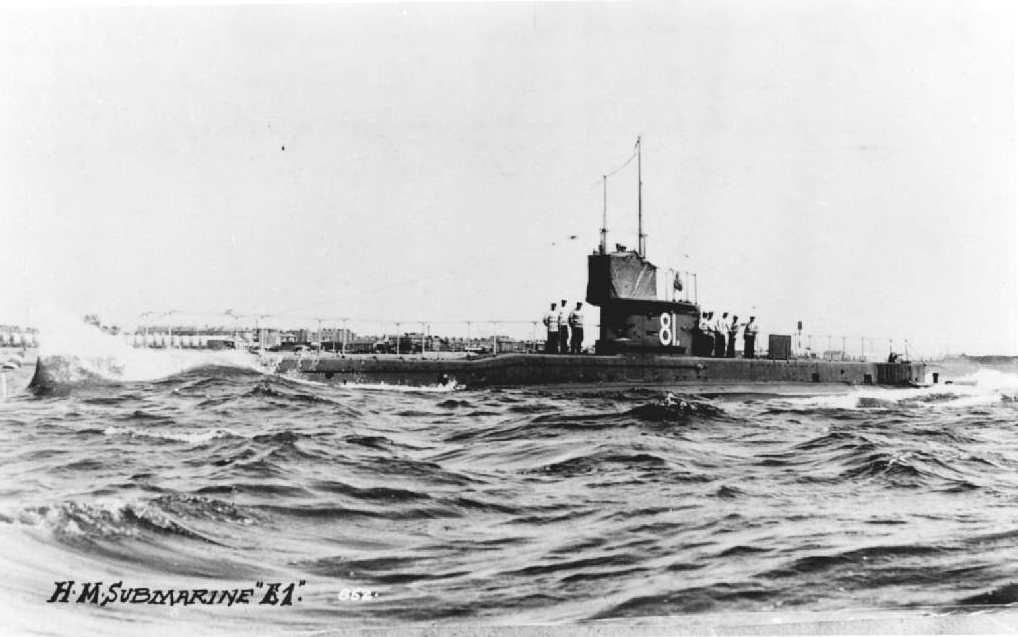
HMS E32 – built at Cowes – was 180ft long and had a crew of 3 officers and 28 men. She was armed with a 12-pounder QF gun and carried 10 torpedoes. The submarine could travel at a speed of 16 knots (18mph), with a submerged speed of 10 knots (12 mph). She could reach a depth of 200ft and stay submerged for 5 hours. The E32 had a range of 3,255 miles.
HMS E32 was used for anti-U-boat patrols off the coast of Ireland. She saw her 1st action on 8th March 1917 when her crew spotted a U-boat in the Atlantic and gave chase.
On 5th April of the same year, the merchant ship Benheather was torpedoed by the German submarine U-46, but did not sink. HMS E32 lay in wait by the stricken vessel, hoping to sink the enemy craft when it returned for the kill. On the U-boat’s return, the British submarine dispatched 3 torpedoes in its direction, forcing it to make a hasty retreat.
HMS E32 only served the Royal Navy for 6 years and was sold in Sunderland in 1922.


A 2nd submarine – HMS F2 – was launched at the J. S. White yard on 7th July 1917. The F-class was the replacement for the E-class. The Admiralty ordered 10 F-class submarines but only 3 were built – 1 of which was built on the Island.
The F-class submarines were employed in coastal defence. After the war, HMS F2 was used as a training vessel in Campbelltown, Scotland. She was also sold in 1922.
The Isle of Wight continued to build naval vessels after the Great War ended in 1918 and throughout the Second World War. But not submarines.
However, over 40 years after the last submarine had been launched on the Island, Saunders Roe in East Cowes were commissioned to design a revolutionary new type of submarine: a giant nuclear-powered bulk cargo carrier to travel under the polar ice cap and transport iron ore from the north of Canada to the UK.
In March 1959, the UK firm Saunders-Roe Ltd. completed its preliminary design study for Mitchell Engineering. The submarine was to be 604ft long and capable of carrying around 28,000 tons of pelletized iron ore.
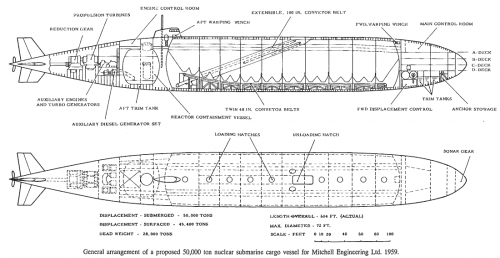
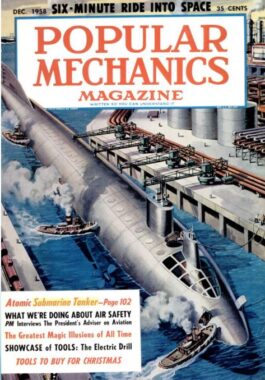
An even larger oil tanker version of such a cargo submarine – also to be designed by Saunders Roe – was described in the December 1958 issue of Popular Mechanics. This was to be 800ft long (for comparison, the Hindenburg zeppelin was 803.7ft long), carry 80,000 tons of oil, have a maximum speed of 40 to 50 knots, and require a crew of 12.

Model tests of the hull shapes were made in the 600ft test tank at the Saunders-Roe works in Whippingham (now GKN Osborne). Sadly, neither version of the bulk cargo carrying submarine was ever built.
An even stranger idea than a giant submarine transporting goods under the polar ice cap was that of a submersible aircraft – also to be designed by Saunders Row in East Cowes. But that story will be for a future edition of Made on the Isle of Wight…








Absolutely fascinating article.
“Made on the Isle of Wight” …. who knew? We didn’t. Local history – Thank you Island Echo.
There is a book called made on the Isle of Wight available in Newport book shops or Amazon also available second hand are the Two volumes of Saunders Roe books published in 1980 by Raymond Wheeler
“built a prototype of a giant cargo carrying submarine” ? A bit of ‘journalistic licence’ there I fear
Echo has had some great Island stories and info.
Shame this council never had a local company build the ‘sometimes’ floating bridge.
As always the UK has the skills, but has bought in cheaper from other countries and just relied upon unskilled low paid jobs but then have to subsidise the workers and the non workers by paying their rent, c.tax etc, thus making such workers contribute little or nothing but take more out than they pay in.
Hence the poverty now, and the ‘attraction’ to the rest of the world to come and live off the few workers who do earn enough to pay into the system.
Now though those taking outs needs cannot be met by those ‘paying in’.
Stem the flow and look after our own.
Quite amazing what used to be built over here. Not these days though… Just look at the Floating Bridge ! Why was that not tendered out for an Island company to build ? Imagine the prestige it would give the Island, and the tourists.. plus would have been a lot cheaper.
I would like to know, why are there not any sea planes on this Island ? Capable of landing on the sea, or sands.. Bush pilot types, or bigger. Commercial types to fly people to mainland and back ? Imagine, low tide at Ryde… plane lands, could walk out, board and fly off.. Only reason I can think of this not happening, council would earn NOTHING from it..
So interesting.please contact Wight Aviation Museum if article or information about made on isle of wight
A very interesting item, hopefully there will be many more