






































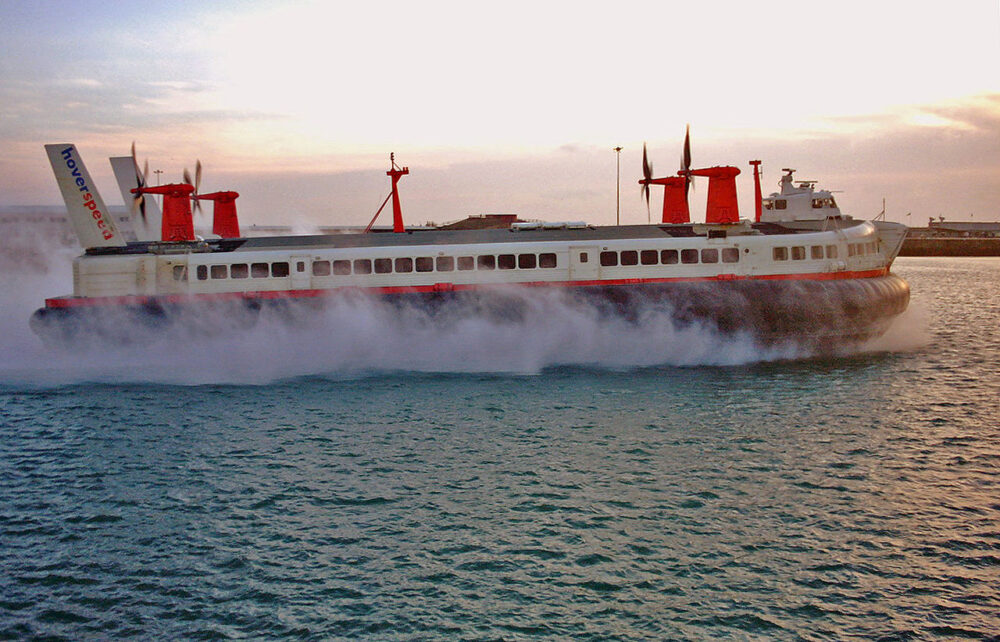
The Saunders-Roe Nautical 4 hovercraft – more commonly known as the SR.N4 – provided a cross-Channel service between 1968 and 2000 and even featured in the James Bond film Diamonds are Forever. But did you know that it was built in East Cowes?
It was the largest civilian hovercraft to have ever been put into service ‒ 4 times larger than any hovercraft previously built.
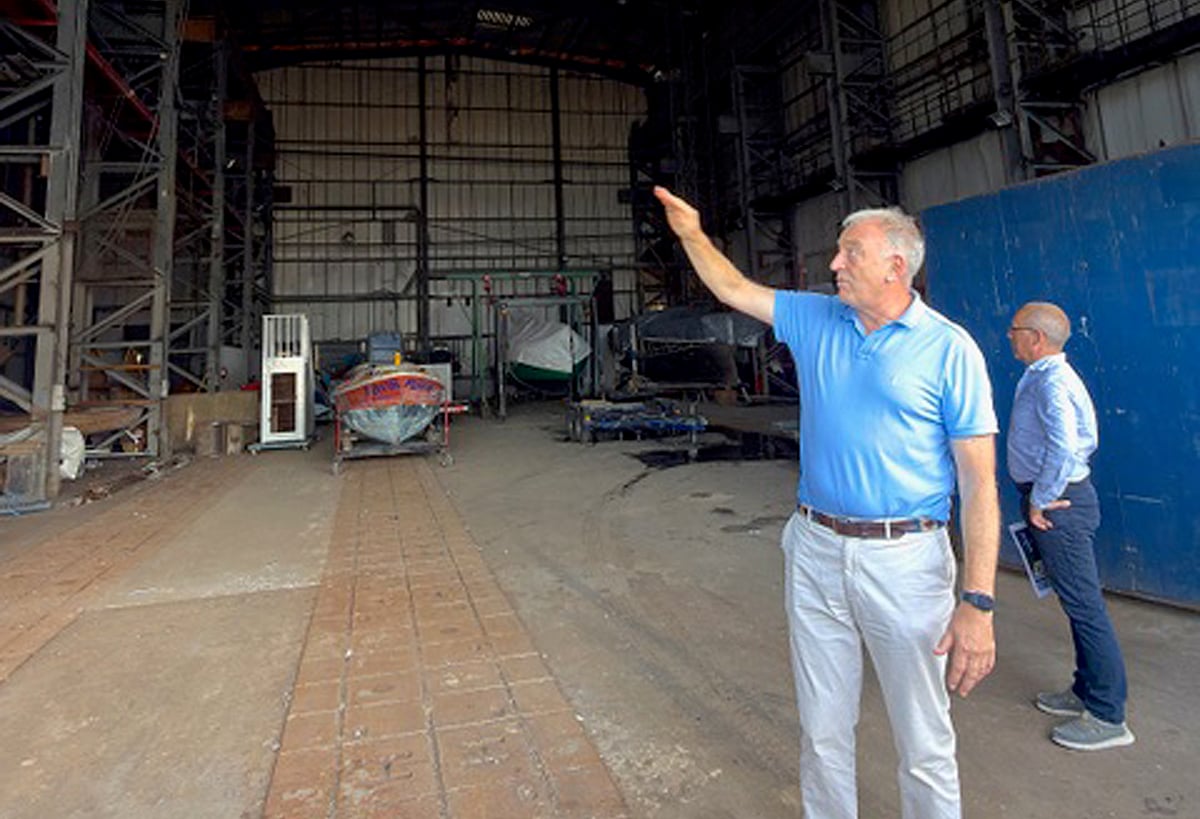
Saunders-Roe began work on the SR.N4 in 1965 in the Columbine Yard in East Cowes (where the giant Princess flying boats were also constructed). By the time that the craft’s first trials took place in early 1968, Saunders-Roe had merged with Vickers Supermarine to form the British Hovercraft Corporation.


The 1st completed SR.N4 – 001 – was officially presented to the press in October 1967. Its maiden flight was on 4th October 1967.
In August 1968, the first SR.N4 ‒ Princess Margaret ‒ entered commercial service between Dover and Boulogne. Later craft also traversed the Ramsgate to Calais route.
Power for the giant hovercraft was provided by 4 Rolls-Royce engines attached to a propulsion propeller (then, the world’s largest propeller). The 1st version (Mk I) was designed to carry 254 passengers besides a 4-lane automobile bay, which held up to 30 cars.
The SR.N4 Mk I was 131ft long, weighed 193t and was capable of 96mph. The craft consumed 1,000 gallons of fuel per hour at a cruise speed of 58mph and had an approximate range of 150 miles. The SR.N4 could operate up to a Force 8 wind on the Beaufort scale and in 3.5m swell seas.
The SRN4s operated regular services across the English Channel between 1968 and 2000. In response to operator demands, stretched versions of the SRN4 were developed, culminating in the Mk III variant, which had almost double the capacity for carrying both cars and passengers as the Mk I.

The work to convert the SR.N4 from Mk I to Mk III cost around £5million for each craft. The improvements allowed them to withstand winds of up to 58mph.
The journey time from Dover to Boulogne was roughly 35 minutes, with 6 trips per day at peak times. The fastest-ever crossing of the English Channel by a commercial car-carrying hovercraft was 22 minutes, achieved on 14th September 1995, by the SR.N4 Mk.III Princess Anne.

The 2 main commercial operators (Hoverlloyd and Seaspeed) merged in 1981 to form Hoverspeed, which operated a total of 6 SR.N4s. 1986 was the peak year for Hoverspeed when it carried over 3million passengers from England to France.
The last of the craft was withdrawn from service in October 2000, and Hoverspeed itself ceased operations in November 2005. The end of duty-free travel and the newly-built Channel Tunnel had made the cross-Channel hovercraft service uneconomic.
The SR.N4 had a good safety record. Most mishaps involving the craft were benign and resulted in little more than the craft being towed back to shore. In 1978, the GH-2007 Princess Anne lost much of her air-cushion skirt in heavy seas some 7 miles off Dover. Then, in March 1985, 4 passengers tragically lost their lives when Princess Margaret crashed into a pier at the entrance of Dover Harbour from Calais in Force 6 to 7 heavy seas.
After Hoverspeed stopped operations, the 2 remaining Mk III examples of the craft (Princess Margaret and Princess Anne) were bought for £500,000 and stored at Lee-on-Solent, next to the Hovercraft Museum.
By the winter of 2015, all the engines had been removed from the craft. The SR.N4s were put up for sale. Hover Transit Services of Bolton, Ontario, proposed putting the hovercraft back in operation (following a $10million purchase and refurbishment) on Lake Ontario with service between Rochester, New York, and Toronto, Ontario. The plan never came to fruition.
A proposed redevelopment of the site where the SR.N4 hovercraft were kept led to the 2 craft being threatened with scrapping. A petition was launched with the aim of preserving 1 of the craft, which led to a lease of the craft to the Hovercraft Museum. The Princess Anne was chosen to be kept and was restored in its former Seaspeed livery. In March 2018, Princess Margaret was broken up at Lee-on-Solent. The Princess Anne remains in the museum.
Did you know… The Royal Navy considered a mine-sweeping version of the SR.N4, as hovercraft are almost invulnerable to mines. A minesweeping version of the SR.N4 was thought to be capable of carrying the same equipment as a Hunt-class mine countermeasures vessel while being cheaper to purchase, although more expensive to operate. The use of hovercraft for minesweeping never got further than the concept stage though.
Another interesting fact is that the SR.N4 was immortalised by its appearance in the James Bond film Diamonds are Forever starring Sean Connery.






The best way to travel to France, good old days.
I remember travelling to France on this Hovercraft, much better than
Euro tunnel.
Its a pity one couldn’t have been saved for the island as a museum piece
Whilst the military version of the N4 was never proceeded with it should be mentioned that the company did produce other military hovercraft.
Yes they did but because they were classed as an aircraft the navy top brass wouldn’t buy them even though they were a fraction of the price of a minesweeper and far outperformed them
yes, the yanks used them in Vietnam, did we build them ?