
































































A pioneering chapter in British maritime history has been commemorated with the unveiling of a National Transport Trust Red Wheel plaque at Wightlink’s Lymington ferry terminal.
The plaque recognises the MV Lymington, which became the first British vessel to use the innovative Voith Schneider propulsion system when she entered service in 1938.
Built by William Denny of Dumbarton for the Southern Railway’s Lymington-Yarmouth crossing, the 275-gross-tonne vessel introduced technology that combined propulsion and steering in a single system.


Using a series of vertically mounted blades, the Voith Schneider propeller enabled a vessel to manoeuvre with exceptional precision, including the ability to turn within its own length.
The technology was developed by Austrian inventor Ernst Schneider and trialled on Lake Constance in the 1920s before being adopted for a range of vessels, including German minesweepers.
Its successful use aboard the Lymington helped establish the system in Britain.
The ferry served the Yarmouth route through both peace and the Second World War, but by the early 1970s increasing demand meant the vessel was too small for the service.
She was subsequently sold by British Rail Sealink and operated on the Firth of Clyde under the name Sound of Sanda.

More than 85 years later, Voith Schneider propulsion remains at the heart of Wightlink’s ferry operations.
The system is still used on all of Wightlink’s car ferries operating on both the Lymington-Yarmouth and Portsmouth-Fishbourne routes, providing the precise manoeuvrability needed in the confined waters of ferry terminals.
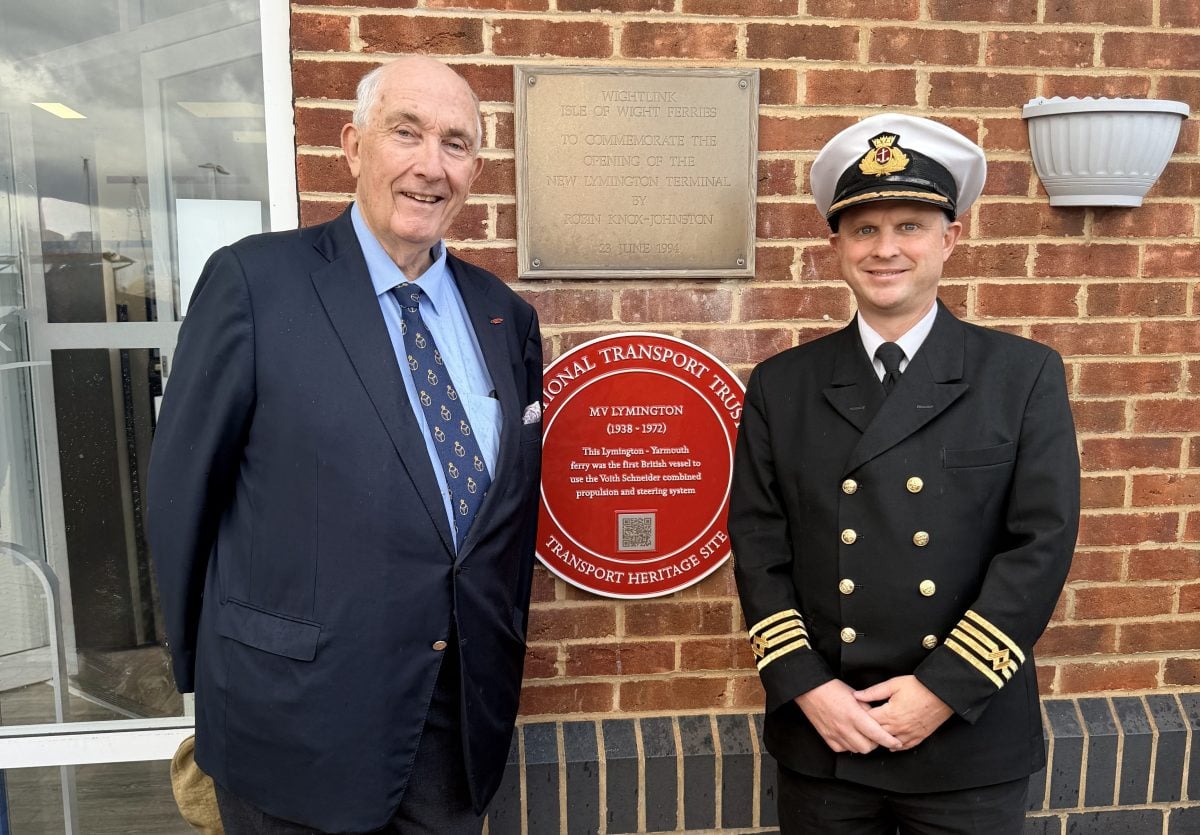
The plaque was officially unveiled by Richard Muir Beddall, Vice President of the National Transport Trust, in the presence of Captain Sam Mitchell, Wightlink’s Head of Fleet Operations, and guests from Lymington and the Trust.
Jerry Swift, Deputy Chairman of the National Transport Trust, has said:
“National Transport Trust Red Wheels are all about celebrating Britain’s rich and fascinating transport history, and through that lens looking to the future.
“MV Lymington was a pioneer that demonstrated that forward-looking spirit, and we are delighted to mark her importance to the development of marine safety.”
Sam Mitchell, Wightlink’s Head of Fleet Operations, has said:
“The story of Lymington is a fascinating part of our maritime heritage, but what makes it particularly special for Wightlink is that the technology she introduced to Britain is still very much in use today.
“Voith Schneider propulsion helps our crews manoeuvre safely and precisely in the waters around our terminals. It’s wonderful to see this Red Wheel plaque recognising the importance of that innovation and Lymington’s place in British maritime history.”
The Red Wheel is now on display at Wightlink’s Lymington terminal, providing passengers and visitors with a permanent reminder of the vessel’s contribution to Britain’s maritime history.
The National Transport Trust Red Wheel scheme celebrates locations and achievements that have played an important role in Britain’s transport history.