










































The most complete dinosaur discovered in this country in the last 100 years – which was found at Compton Bay here on the Isle of Wight – has been described in a new paper published after a decade of analysis. The specimen, which is around 125 million years old, was found in the cliffs of Compton Bay in 2013 by fossil collector Nick Chase, before he tragically died of cancer. Jeremy Lockwood, a retired GP and University of Portsmouth PhD student, helped with the dinosaur’s excavation and has spent years since analysing the 149 different bones that make up the skeleton According to this week’s Journal of Systematic Palaeontology, Jeremy has been able to determine that the skeleton represents a new genus and species, which he has named Comptonatus chasei in tribute to Nick. Jeremy said:
“Nick had a phenomenal nose for finding dinosaur bones – he really was a modern-day Mary Anning. He collected fossils daily in all weathers and donated them to museums. I was hoping we’d spend our dotage collecting together as we were of similar ages, but sadly that wasn’t to be the case. “Despite his many wonderful discoveries over the years, including the most complete Iguanodon skull ever found in Britain, this is the first dinosaur to be named after him.”
 When it was first discovered, the specimen was thought to be a known dinosaur called Mantellisaurus, but Jeremy’s study revealed a lot more dinosaur diversity. Indeed, this is the second new genus to be described by Jeremy. He said:


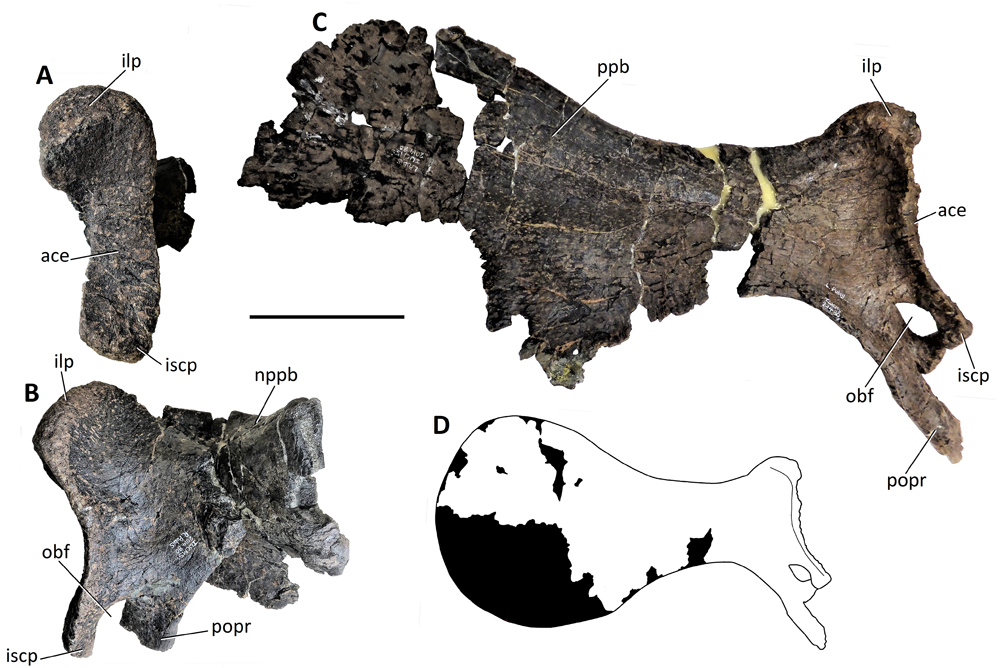
“I’ve been able to show this dinosaur is different because of certain unique features in its skull, teeth and other parts of its body. For example, its lower jaw has a straight bottom edge, whereas most iguanodontians have a jaw that curves downwards. It also has a very large pubic hip bone, which is much bigger than other similar dinosaurs. It’s like a dinner plate!”
Dr Susannah Maidment, Senior Researcher and palaeontologist at the Natural History Museum and senior author of the paper completed whilst supervising Jeremy’s PhD, comments:
“Comptonatus is a fantastic dinosaur specimen: one of the most complete to be found in the UK in a century. “Its recognition as a new species is due to incredibly detailed work by NHM Scientific Associate Dr Jeremy Lockwood, whose research continues to reveal that the diversity of dinosaurs in southern England in the Early Cretaceous was much greater than previously realised. “The specimen, which is younger than Brighstoneus but older than Mantellisaurus (two iguandontian dinosaurs closely related to Comptonatus) demonstrate fast rates of evolution in iguandontian dinosaurs during this time period, and could help us understand how ecosystems recovered after a putative extinction event at the end of the Jurassic Period.”
Despite only 4 new dinosaur species being described on the Isle of Wight in the whole of the 1900s, there have been 8 new species named in the last 5 years. 
“Ongoing research on the museum collection continues to reveal exciting new discoveries. Most of Nick’s most important finds have remained on the Island, a lasting legacy. “We can look forward to many more new types of prehistoric creatures being discovered from the Island’s cliffs and collection.”
Article continues below this advertisement

Mike Greenslade, General Manager for the National Trust on the Isle of Wight, said:
“This extraordinary discovery at National Trust’s Compton Bay highlights the rich natural heritage of the Isle of Wight. “Finding the most complete dinosaur in the UK in a century not only showcases the island’s palaeontological significance but also underscores the importance of preserving our landscapes for future generations to explore and learn from. “Nick Chase’s remarkable find and Jeremy Lockwood’s dedicated research are a testament to the incredible history waiting to be uncovered here. We are thrilled to be part of this ongoing journey of discovery and scientific advancement.”










Great find but a sad loss
A description of all the bits in the picture above would be good…
You can read the full article for free if you visit the journal’s website.
C and D appear to be part of a hip / pelvis. Hope this helps.
It’s a Seeleyaurus. It’s only been extinct for less than a week.
Haha, very good
Great story, keep them coming.
The Island is run by Dinosaurs
Look at all the speeding that in 2024 is allowed to
take place on our Island Roads.
No one at the Council addresses the speeding on the Island.
Hopefully the 2 new MPs are not Dinosaurs, and move the
island into the 21st century and put in measures to
SLOW vehicles down.
Oh, give it a rest!! Not EVERY story is about speeding!
Everyday there seems to be a serious accident on the
Island.
Someone needs to be concerned about speeding
motorists or motorcyclists.
It will make the Island a safer place for everyone.
If you had children you might be concerned.
i take it you dont like living here so do us all a favour and move to north island
The island is a lovely place, it is just lawless
when it comes to traffic rules.
The island needs speed cameras etc
I suddenly have a desire for jacket potatoes
Dinosaurology a great career i’m sure but like those ‘scientists’ who claim we’ve seen cosmic objects some 40 million light years away,lol l firmly believe a few random finds hither and yon reveal bugger all of any real relevance.
Most of our real past is probably buried miles down into the clay (lost civilizations) from previous 12k year,cyclical disaster events-Solar,Sea-floods and mud-slides etc.In fact we’re heading for one now which began in 2012.Solar Flaring’s increasing from Sun-Spots 8 times the width of earth.It’s all mostly well remunerated guessology for those involved.
Dinosaur,Schminosaur sez me.