

























































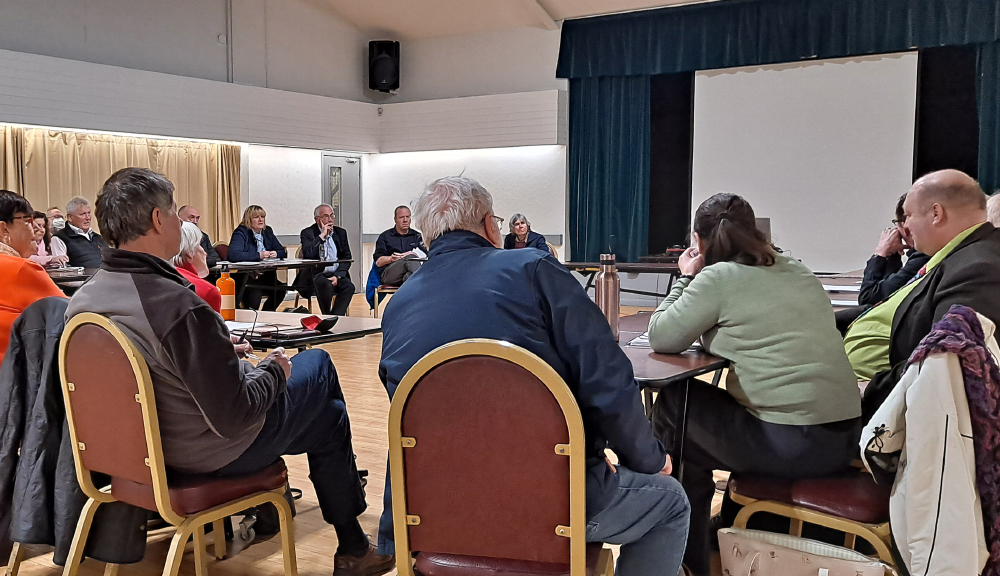

 Members of 18 local parish, town and community councils met with representatives from the Isle of Wight Council and local housing providers last week to discuss how they can work together to increase the supply of affordable housing on the Island, as it is revealed there has been an 82% reduction in the number of private rental properties available locally in the past 2 years.
The meeting, held on Thursday, was organised by the Isle of Wight Association of Local Councils (IWALC).
Introducing the meeting, Councillor Diana Conyers, Chair of IWALC, said:


“We get lots of complaints from our members about housing developments imposed on them from above. They are not against housing per se. Their concern is that these developments don’t provide the sort of housing that local residents need or can afford.
“But we cannot change the planning system, at least not overnight. So we need to explore other ways of getting the sort of housing we really need”.
The leader of the Isle of Wight Council, Councillor Lora Peacey-Wilcox, welcomed participants. She spoke passionately about the current housing crisis on the Island, particularly the need for more social housing. She said:
“Having grown up on a large council estate in Cowes, I understand the need for social housing. Knowing you have a roof over your head is vital to wellbeing”.
She emphasised that the Council is determined to address this issue and to work with local councils in doing so.

The Cabinet members responsible for housing and planning, Councillors Ian Stephens and Paul Fuller, were also in attendance. Cllr Stephens reported that the Council’s 2022/23 budget, which had been approved the previous evening, includes £40million for housing development.
The nature and extent of the current housing crisis was explained by Jamie Brenchley, the Council’s Strategic Manager for Housing and Homelessness. He said there has been an 82% reduction in the number of private properties available for rent over the last 2 years, resulting in increasing demand for the limited stock of social housing and an unprecedented number of households in temporary accommodation. He was particularly concerned about the number of families currently in temporary accommodation, which includes 325 children.

The next 3 speakers focused on ways of addressing the problem. John Prickett, the Council’s Community-Led Housing Officer, explained how local community groups, including local councils, can get technical and financial assistance to establish their own housing schemes. Martyn Pearl, Chief Executive of Vectis Housing, the only 1 of the Island’s 3 main housing associations that is locally-based, described how Vectis works with local communities to provide the sort of housing they need.
Meanwhile, Peter Griffiths, Director of Capture Housing, a new affordable housing provider, said that it’s possible for private developers to provide more than the statutory minimum number of affordable homes. He urged local councils to negotiate with the developers on this and other concerns.
There followed a lively debate, in which councillors demanded to have more say in all aspects of housing development, from the assessment of need and identification of sites to the design of developments and allocation of properties. It was agreed that, in order to meet the enormous housing challenge, it is essential that everyone work together.











Perhaps SOME of the onus for the housing crisis should be put upon our Governments immigration policy AND our own population for having children when they can barely make ends meet as it is, yet bring in another body to be fed, clothed and housed with LITTLE regard for the childs future, only it seems to gain more child benefit and tax credits for them to spend as they please now.
Ironic then that the Chairman of Shalfleet Parish Council and Mayor Of Yarmouth is wanting to build housing for mainland retirees and prospective second home owners in the West Wight. The proposals have zero allocation of affordable housing despite a 35% requirement for a development of this size.
Maybe not so much irony as just blatant opportunism and exploitation of weak planning policy. So, if you’re a local dignitary then pay attention, there’s money to made in those green fields. It’s not just about solar panel tariffs.
A major cause of the reduction in Private rented properties in the last two years is down to COVID. Landlords we’re not able to evict Tenants who failed to pay rents, so, there was no incentive to enter or even stay in the market. After all Taxes and other costs are taken into account, Landlords do not make a huge income on rentals, and again, why bother to struggle to make a living?
As regards ‘affordable’ housing. STOP allowing developers paying a ‘supplement’ to local authorities so that they can get out of including such properties in their developments.
Nick not just down to covid, it has been Government policy to make it less attractive to be a landlord, via tax easements taken away, more rules and regulations and far more rights for a growing dishonest population who sue, blame, and abuse property.
Hence now big businesses such as Lloyds bank and others are getting into the rental sector.
Too many low life people think the world owes them and everything they ‘create’ an expensive home and all that it contains.
Goverenment allowing or not actively stopping migrants has made it all worse too.
Ending child allowance and child tax credits would slow the misery for the next generation
Make it easier for people to get on the property ladder full stop, bring back 100% mortgages