













































In the first of our Isle of Wight at War series, we revisit the French invasion of 1377 and the legend of Sir Peter de Heyno’s silver bow.
Smoke hung over the Isle of Wight. Newport was burning, villages had been plundered and Islanders had surrendered a fortune in silver to spare what remained. Yet the French commanders had not come simply to loot the Island. Their greatest prize still lay ahead: Carisbrooke Castle. It was during the siege that followed that Sir Peter de Heyno’s silver bow entered Island folklore.
The invasion came in August during the Hundred Years’ War. A powerful Franco-Castilian fleet commanded by Jean de Vienne and Don Fernaõ Sánchez de Tovar had already attacked the Sussex coast before an unexpected gale drove the ships into the Solent. Seizing an unexpected opportunity, the commanders abandoned their original plans and struck the Isle of Wight instead.


Sánchez de Tovar knew the Island well from earlier raids and understood that Carisbrooke Castle was the key to controlling it. French troops landed in the north of the Island before dividing into separate forces. One column marched on the castle while others advanced on Newport, Newtown and Yarmouth. Mounted raiders fanned out across the countryside, driving off livestock, looting homes and leaving burning buildings in their wake. Large parts of Newport were devastated by fire as flames swept through its tightly packed timber-framed streets, while villages across the Island also fell victim.
With much of the Island at their mercy, Jean de Vienne demanded a ransom of 1,000 marks in silver, worth around £1 million today. At a time when the Isle of Wight’s population is thought to have been less than 5,000, that amounted to the equivalent of about £200 (in today’s values) for every man, woman and child. Churches, landowners and ordinary Islanders were forced to contribute until the vast sum had been assembled and handed over to the invaders. Rather than ending the invasion, however, the payment merely cleared the way for the French to march on Carisbrooke Castle, convinced the fortress would eventually fall.
Inside the castle, its governor, Sir Hugh Tyrell, prepared for the assault. Responsible for defending the Island’s principal fortress, he gathered supplies, strengthened the defences and readied his garrison for a siege. Outside the walls, French soldiers assembled timber siege engines, confident they would soon batter their way into the castle.
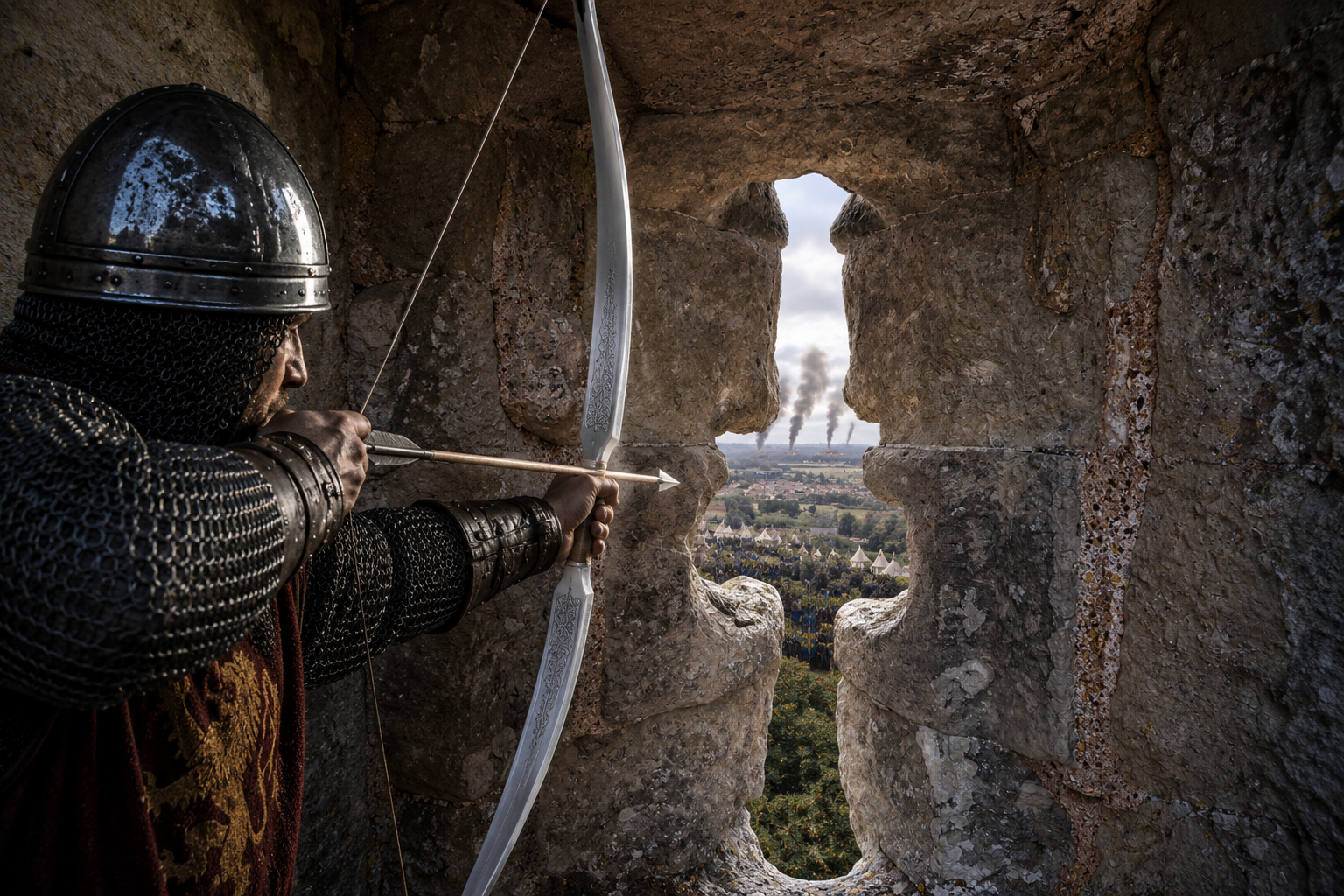
Among the defenders was Sir Peter de Heyno of Stenbury. Believing he could strike the French commander from the castle walls with his silver bow, he shared his plan with Tyrell before taking up position behind one of the castle’s narrow arrow slits. Waiting patiently until the enemy leader rode within range, De Heyno drew the bow to its fullest extent and released a single arrow. It struck the commander in the chest, throwing him from his horse and sending the besieging army into confusion.
Tyrell reacted instantly. The castle gates flew open and the garrison charged downhill before the French had time to recover. Carrying burning brands and bundles of kindling, the defenders set about the wooden siege engines, sending flames racing through the dry timber as fierce fighting erupted beneath the castle walls. Their objective achieved, the garrison withdrew through the castle gates before the French could mount an organised response, leaving the siege engines blazing behind them.

Without the equipment needed to breach the walls, the French abandoned the assault and withdrew towards the coast. Although they carried away the Islanders’ silver, they had failed to capture the fortress that dominated the Isle of Wight.
The fighting around the castle also gave rise to two place names that survive in Newport today. French soldiers advancing towards Carisbrooke entered a narrow lane where Tyrell’s men had prepared an ambush. Many of the invaders were killed there, giving the route the name Deadman’s Lane. The French dead were reportedly buried beneath a nearby mound that became known as Noddies Hill. Although the mound later disappeared beneath development and Deadman’s Lane became Trafalgar Road, the name Noddies Hill gradually evolved into today’s Nodehill.
The French invasion of 1377 left deep scars across the Isle of Wight. Newport, Newtown and Yarmouth had been devastated by fire, villages across the Island had been plundered and the Islanders were forced to pay a huge ransom in silver. Yet the prize the invaders had crossed the Solent to capture remained beyond their reach: Carisbrooke Castle still stood.






































Very interesting please keep the island history alive
Looking forward to more in this series!
Excellent article.
Thank you – more please!
Great stuff, Warren! Do keep it coming, please! As a kid, i was always aware that in Nodehill I was walking through part of the history of Newport and its surrounding area.
Great article, always great to read what a great country
we once was.
History is a wonderful thing, keep the stories coming.
Interesting story and few similarities to a few movies 😛 There are many stories who knows which one is real. The story from English heritage is different were the castle was sieged but due to lack of water gave up.
Well done Warren and the Echo. Fascinating stuff and as someone said, it’s good to keep history alive.