






















































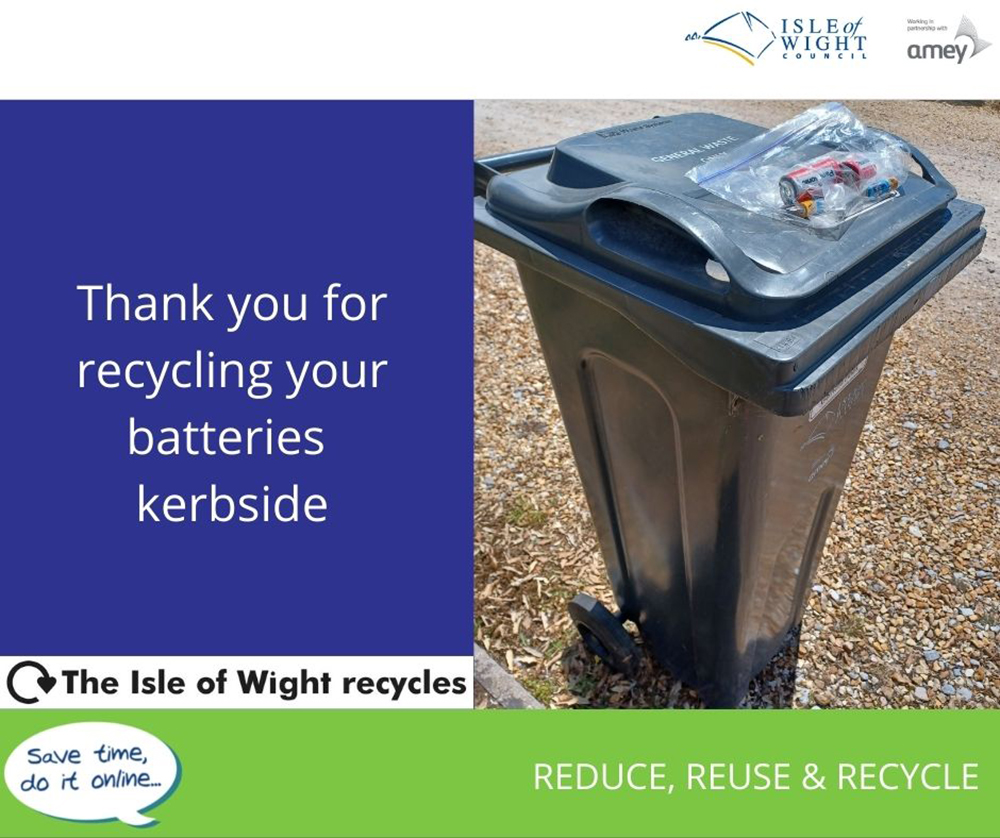
 Islanders are being thanked for supporting the new household battery collection service after 1.9 tonnes of batteries have been collected from Island residents.
The Isle of Wight Council, in partnership with its waste service provider Amey, launched the scheme on 2nd May and since then have collected the weight of nearly 3.5 polar bears.
Batteries can easily get squashed, compacted, punctured, shredded, or soaked in liquids. When this happens, they can ignite. This can lead to fires that endanger lives, cause expensive damage and disrupt waste services, so recycling them is the best solution.


Councillor Karen Lucioni, Cabinet member for waste, said:
“I would like to extend my thanks to Islanders and our waste treatment partner Amey’s collection staff for supporting this.
“Fires caused by items such as batteries can cause a lot of damage at waste treatment sites, as well as putting crews at risk and it is heartening to see how popular this scheme is already becoming.”
Natasha Dix, the council’s strategic manager for environment, said:
“These figures show the enthusiastic commitment we know our community has for recycling. Although early days in this scheme, more and more people are getting involved.

“This scheme also plays a part in our wider aim of reducing waste and encouraging re-use and recycling. We still need our communities to help in reducing household waste as we move together to our goal of zero non-essential waste to landfill.”
If you haven’t joined the residents already taking part, it couldn’t be any easier:
- Place your spent household batteries safely and separately in their own clear sandwich sized bag.
- Leave the clear bag containing the batteries on top (not inside) of your general waste (black bins/black gull-proof sacks) on your general waste collection week.
- All the batteries collected by the crews are placed in a special box fitted to the collection vehicles and sent for sorting and processing.
- Metals and chemicals are removed and used to make new batteries and other products.
- Batteries thrown into ordinary bins, household waste or with other recycling are dangerous.
More information about Household battery disposal can be found here.











Why can’t thy use examples that are easy to understand. I have no Idea how much a polar bear weighs nor do I care to learn. Why not say how many wheelie bins full would give an idea of the amount. Or why not use simple weight measure like a ton or kilogram..