





































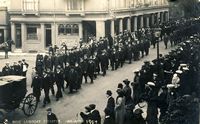
Thousands of Ryde citizens lined the streets of the town to pay their respects at the funeral of 2 lifeboatmen ‒ Frank Haynes and Henry Heward ‒ on 7th January 1907.
The lifeboatman had tragically died on New Year’s Day.
On 1st January, a man ‒ Augustus Jarrett ‒ was seen rowing with some difficulty off Ryde. Had he realised it was low tide, he could have waded ashore, as he was only in about 3ft of water. The signal to call out the lifeboat ‘Selina’ was given just after 17:00.


The Selina ‒ a 30ft wooden lifeboat ‒ had been designed to provide help in smooth and shallow waters to yachts when anchored off Ryde. She was never intended to be a sea-going vessel.
The lifeboat left Ryde at around 17:30 with a full complement of 9 men on board. They were William John Bartlett, George Jeffery, Ernest Cotton, Alfred Linington Snr, Alfred Linington Jnr Daniel Reeves, Albert Reeves, Henry Heward and Frank Haynes.
The search for the rower proved futile. They decided to return to Ryde. The sea was choppy and the weather squally. About 200 yards from the pier, the Selina was struck by a huge wave and capsized. The crew were thrown into the ice-cold Solent.
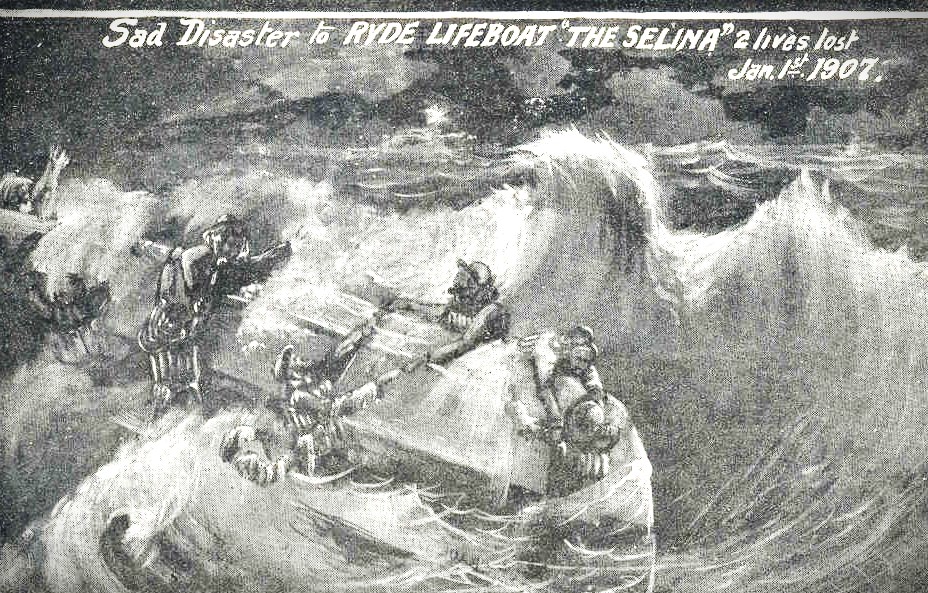
In conditions of total darkness, the boat drifted across the Solent with the crew clinging to its keel. It finally beached at Southsea at around 01:30.
A policeman ‒ PC Vines ‒ heard the cries of the crew and summoned the Coastguard. The survivors were rescued in an exhausted state. Sadly, 2 of the lifeboat crew ‒ Frank Haynes and Henry Heward ‒ had died of exposure in the icy seas, despite the efforts of their comrades to keep them above the water. Their bodies washed up at Southsea later that morning.
The man they set out to rescue had managed to row across the Solent, landing at Southsea earlier that same evening. It appeared he had never been in any real danger.
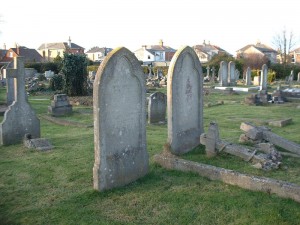
The funeral of Frank Haynes and Henry Heward was attended by huge crowds. The funeral cortege was led by a firing party of the Coastguards from the Cowes Division. Flags were flown at half-mast at the Town Hall, the Pier, the Coastguard Station and the Castle.
The funeral was particularly tragic for Frank Haynes’ widow, Elizabeth. Her 3-month-old daughter Edith had died a few days before her husband, and her tiny coffin accompanied her father’s to the graveyard. Elizabeth was pregnant with Frank’s child, Harold, who was born after her father’s death.
The Mayor of Ryde, Albert J Coombes, opened a fund for the benefit of the dependant relatives of the 2 deceased lifeboatmen. Grants were also made to the survivors and to those who gave assistance on the day of the accident. The RNLI donated £200.
An inquest into the deaths of Haynes and Heward was held at Portsmouth on 4th January 1907. The Coroner, T A Bramsdon MP, said that looking at the whole case from beginning to end, he could not see that there was the slightest blame to attach to anyone.
The coroner also stated:
“A very great deal of praise should be accorded the crew who so gallantly went out to save life, and to the members of the police force and coastguard service who, with equal gallantry, prevented a further disaster”.
The coroner commended the efforts of the Bembridge RNLI Lifeboat, which had spent 3-and-a-half hours searching the Solent for the Selina and the rowing boat.
The jury returned verdicts of accidental death on the 2 lifeboatmen and commended the conduct of the Coastguard and Police.






True Hero’s. Not todays Media hyped individuals or collectives. Up most respect.
And what does a knuckle-dragger like you volunteer for?
It’s “heroes”, not “hero’s” and “utmost”, not “up most” you thick twunt.
I don’t live in ryde, but if I did I would go and lay flowers at their grave
Very brave men, never forgotten.
Thank you Island Echo for bringing these local stories to our attention.