




























































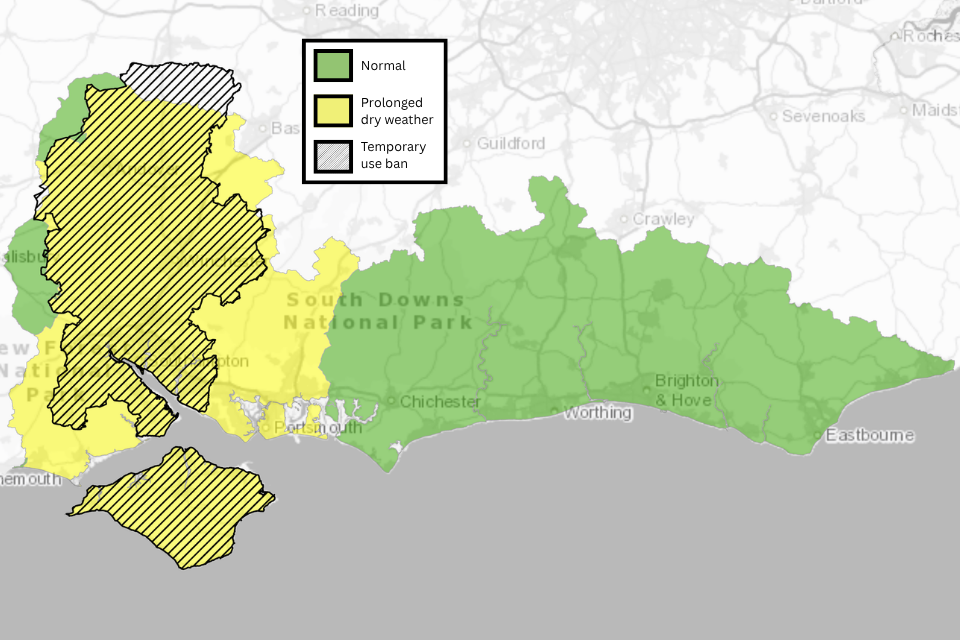
The Environment Agency has changed the environmental status of parts of Hampshire and the Isle of Wight to prolonged dry weather following England’s warmest Spring on record.
The agency has said the move, which came into force today (Friday), has placed the Isle of Wight into the first stage of drought and reflects the growing pressures on the environment and demand for water.
A prolonged dry weather status is the first official stage of drought response and means that the areas affected have experienced below-average rainfall that is on the cusp of stressing the natural environment, such as the flow of rivers, groundwater levels and reservoirs.


As previously reported by Island Echo, the region saw a Temporary Use Ban (TUB) come into force today, prohibiting the domestic use of hosepipes in order to protect the water levels in the River Test, which are now at critically low levels at around 25% below what would normally be expected for this time of year.
Environment Planning & Engagement manager at the Environment Agency, Richard O’Callaghan said:
“The changing climate has seen a whiplash from an exceptionally wet start of the year to prolonged dry weather.
Article continues below this advertisement “The pressures on the environment will become heavier. The Environment Agency is positioning itself to get ahead of that.
“We are ready to tackle any incidents during this time and make sure that the needs of the environment are balanced against demands for more water from our most sensitive waterways.”

In early Summer 2025, high temperatures struck water sources across Hampshire, the Isle of Wight and Sussex, with the counties then, on 10th July 2025, placed in a prolonged period of dry weather lasting a total of 6 months.
Moving towards the Winter of 2025, the Environment Agency issued a warning to the public in November that reduced amounts of rainfall over the winter period could push the Isle of Wight as well as other parts of the South Coast into drought.
It was said that unless sufficient rainfall occurs before the end of March 2026, all 3 counties (Hampshire, the Isle of Wight and Sussex) were at risk of entering drought, which could easily see the return of a hosepipe ban once again next year.
At the time, England had experienced below-average rainfall in 8 out of the 10 months recorded by November 2025.
Contrary to the very dry and hot weather the Island has experienced this month, we faced one of the wettest starts to the year on record, with Southern Water revealing in March that the equivalent of 6 months’ rainfall fell across January and February alone.
As reported by Island Echo, figures showed relentless downpours over the winter months which led to groundwater levels reaching extremes, placing significant pressure on the wastewater network.
In January, 176.1mm of rainfall was recorded, more than double the typical 71.9mm, equating to 245% of the monthly average.
In fact, the Island suffered so severely that Southern Water had to deploy more than 130 tankers to over 30 locations as intense downpours left the ground saturated and aquifers full, requiring urgent action to prevent widespread sewer flooding.
The timeline of how the Island suffered such significant flooding only to be entering the first stages of drought just 6 months later, begs the question: where did all that water go?











































Millions of gallons of water rush down from St Boniface Down every hour and end up wasted in the sea at Monks Bay
For years it has been suggested by many observers that Southern Water could, and indeed SHOULD, harvest this free water.
Unfortunately, the Southern Water Protocol is a carbon copy of other water “companies” – i.e, do not spend investors dividends on infrastructure – frighten the customers to death – threaten them with droughts – double the water bills – simples!
This government needs to re-nationalise water. End of!
very true, it’s easier for them to blame us.
Maybe if over the years gone past Southern Water had payed more attention to maintaining the existing reservoirs around the Island and used them to store water rather than just letting them stagnate or be sold off for building etc we could have at least postponed this hosepipe ban for a while even if it could not be totally avoided.
Excellent report, especially regarding where all the winter water went, probably knowing Southern water gradually release it into the sea instead of saving it for the summer
Exactly.
We have had so much rain until the last month
and now they are complaining of drought.
Would help if on the Isle of Wight we had some reservoirs, even tiny Alderney in the Channel Islands has a reservoir.
Perhaps instead of building more and more houses someone thought about building a reservoir then we would not be as dependent on the mainland!
Alderney have brains, one thing that the island lacks.
Sad but true.
Interesting interview on the Radio 4 Today programme this morning.
The interviewee was asked whether the country had stored the rain that fell n January and February and he confirmed it had not, because, NO new reservoirs had been built in the last 35 years – in spite of predictions that summers would get hotter and the population would increase.
We are all doomed.
So it’s all the water company’s fault. Which the general public have known for years. Stuff the new waste sewage system and get off you asses and build NEW RESERVOIRS NOW
Water harvesting is key to water conservation and enabling water to remain at optimal levels.
The UK needs to learn from hotter countries as to proven ways of conserving water. After all , we do usually get a lot of rain in some months of the year
It’s quite obvious that the world has changed in the last 30 years.we get heavy rainfall at certain times of the year. But we don’t store it for summer. We need to build a reservoir at least. I have 4 water butts but they last around two weeks in this heat.some investment is needed for sure.
Drought was 1976 when we had more than 3 months of hot sun.
Now we get a few weeks of hot weather and they are bleating hosepipe bans and drought.
Give us a break. Get a life .
If the summers are going to get hotter as they have been broadcasting these last few years then measures should have been taken to store up the months and months of rainfall we had.
They do love a drama . How people live in these hot countries and have no rainfall yet survive beats me .
English media love a drama
Drought, they don’t even know what a drought is .
My thoughts exactly
Years and years of lack of investment have led to this situation. We had a very wet winter and spring and still have water pouring out of the ground into the sea but no way to capture it as Southern Water squandered the money they should have been investing on infrastructure. But shareholders got their bonuses and water execs got their obscene salaries and bonuses so that’s all right, isn’t it? The legacy of Margaret Hilda Thatcher just keeps giving.
If there’s an excessive amount of water in the spring time why is this water not being contained in reservoirs, to be used in the summer times?
Minimal investment to the water systems. Prosecuting volunteers that have cleaned sections of rivers of toxic waste. Broken mains for months.
Handing over fat bonuses to the ones at the top.
Don’t mention all the sewage poured into our seas.
It’s a joke!
It rained nearly all winter and early spring it was horrendous.
I had never seen so much rain, the garden was like a
massive sponge / swamp.
I knew the Hosepipe ban would be coming
it’s like council tax increases an every year ritual.
I remember the days when you could nearly buy an
house with todays yearly council tax bill.
In 1970 average house prices in the UK were
£4,480, actually cheaper on the island.
Some properties on the island are paying over £3,000.00
a year council tax.
It’s becoming a joke.
So, presumably now we’re building even more homes on the island. Cowes development, new development in Ryde both fairly large schemes. We are going to build some new Reservoirs right?
oh no probably not…