





















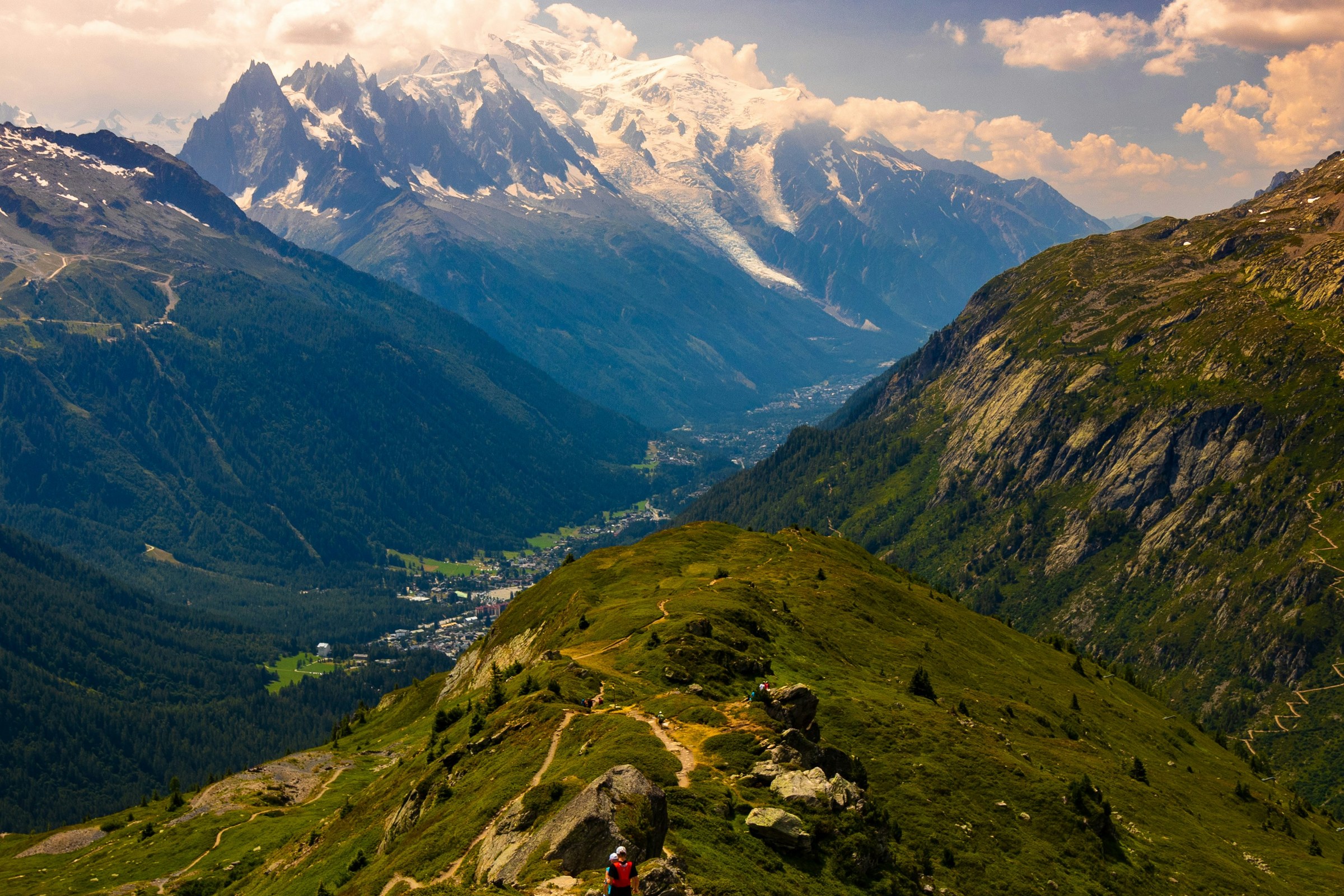

The Tour du Mont Blanc is a circuit of about 170 kilometres around the Mont Blanc massif, crossing France, Italy and Switzerland in around ten or eleven days of walking. Each night ends in one of three kinds of place: a mountain refuge, a gîte in a village, or a hotel in a valley town.
The choice affects more than comfort. It decides how much you carry, how early you need to book, and how the stages are divided, because refuges sit high on the route while hotels are found only where the road reaches.
Mountain Refuges
Refuges are staffed mountain huts, called rifugi in Italy, and many stand close to the passes, at or above the tree line. Beds are usually in dormitories with bunks, duvets and pillows, and a sleeping bag liner is required in many of them. Boots are left at the door and hut shoes or sandals are worn inside, showers are limited and sometimes charged extra, and dinner is served at a set time at shared tables.


Most refuge guests book half board, which covers dinner, a bed and breakfast. Packed lunches can usually be ordered the evening before, and in Switzerland the bill is normally in Swiss francs rather than euros. Some refuges have a few smaller rooms, but these are limited and are often the first beds to go.
Well-known refuges include Rifugio Elisabetta, owned by the Milan section of the Italian Alpine Club and set at 2,195 metres in Val Veny beneath the Lée Blanche glacier, and Rifugio Bonatti, at 2,025 metres above Val Ferret, which opened in 1998 and faces the Grandes Jorasses. The small Refuge du Col de Balme, at about 2,190 metres on the border between Switzerland and France, sleeps around 20, and guests bring their own sheet sleeping bag.
Gîtes and Valley Hotels
A gîte d’étape is a walkers’ lodging in a village or hamlet, usually privately run and reachable by road. Gîtes offer dormitories or small rooms, hot showers and half board, and they fill the gaps between the high refuges at stops such as Les Chapieux, La Fouly and Trient. They are often a little more comfortable than a refuge and a little cheaper than a hotel.
Hotels are found in the valley towns and villages, including Les Houches, Courmayeur, Champex-Lac and Argentière. They give private rooms with their own bathrooms, which many walkers value after several nights in dormitories. Champex-Lac, set beside a small lake at around 1,470 metres, has several hotels and is a common overnight stop on the Swiss section.
Many itineraries mix all three types. The Swiss section, in particular, has more hotels and gîtes than refuges, while the French and Italian sides offer the best choice of high refuges. A typical itinerary might combine hotels in Les Houches and Courmayeur, a gîte in Les Chapieux, and refuge nights at Elisabetta and Bonatti.

Season, Closures and Booking
The refuges on the route generally open from mid-June to mid-September, with a few staying open until the end of September. In June some may not yet be open and snow can lie on the higher passes, such as the Col du Bonhomme and the Col de la Seigne.
Plans for the next few summers also need to allow for the Refuge de la Croix du Bonhomme. At 2,443 metres it was the highest night on the classic route, but it closed in August 2026 for rebuilding and is expected to reopen in 2029. Walkers now either stop before the climb, at refuges such as Nant Borrant or La Balme above Les Contamines, or carry on over the pass to Les Chapieux in a single day.
Bookings for most refuges and gîtes open in mid-October for the following summer, through a shared online system run by the association of refuge keepers, while a few places are booked directly. Beds sell out early because many refuges are small and most walkers go anticlockwise from Les Houches in July and August, so a single full night can break an entire itinerary.
Why the Bookings Shape the Trip
A refuge-based walk needs each night to fall in the right place, since there are few alternatives once you are high on the route. Luggage can be moved by road only between gîtes and hotels, so refuge nights mean carrying everything needed for those days. Changing one booking often means changing several others around it.
Walkers who want private rooms every night can follow a hotel-based version instead, using short transfers and cable cars to reach valley towns at the end of some stages. The trade-off is fewer evenings high on the mountain, where the refuges give the best views of the massif at sunset and first light.
With so many pieces to fit together, many walkers leave the arrangements to Tours du Mont Blanc, which can book the full sequence of refuges, gîtes and hotels as soon as reservations open. Luggage transfers are arranged between the road-accessible stops, and the stages are planned around current closures such as the Croix du Bonhomme.