









































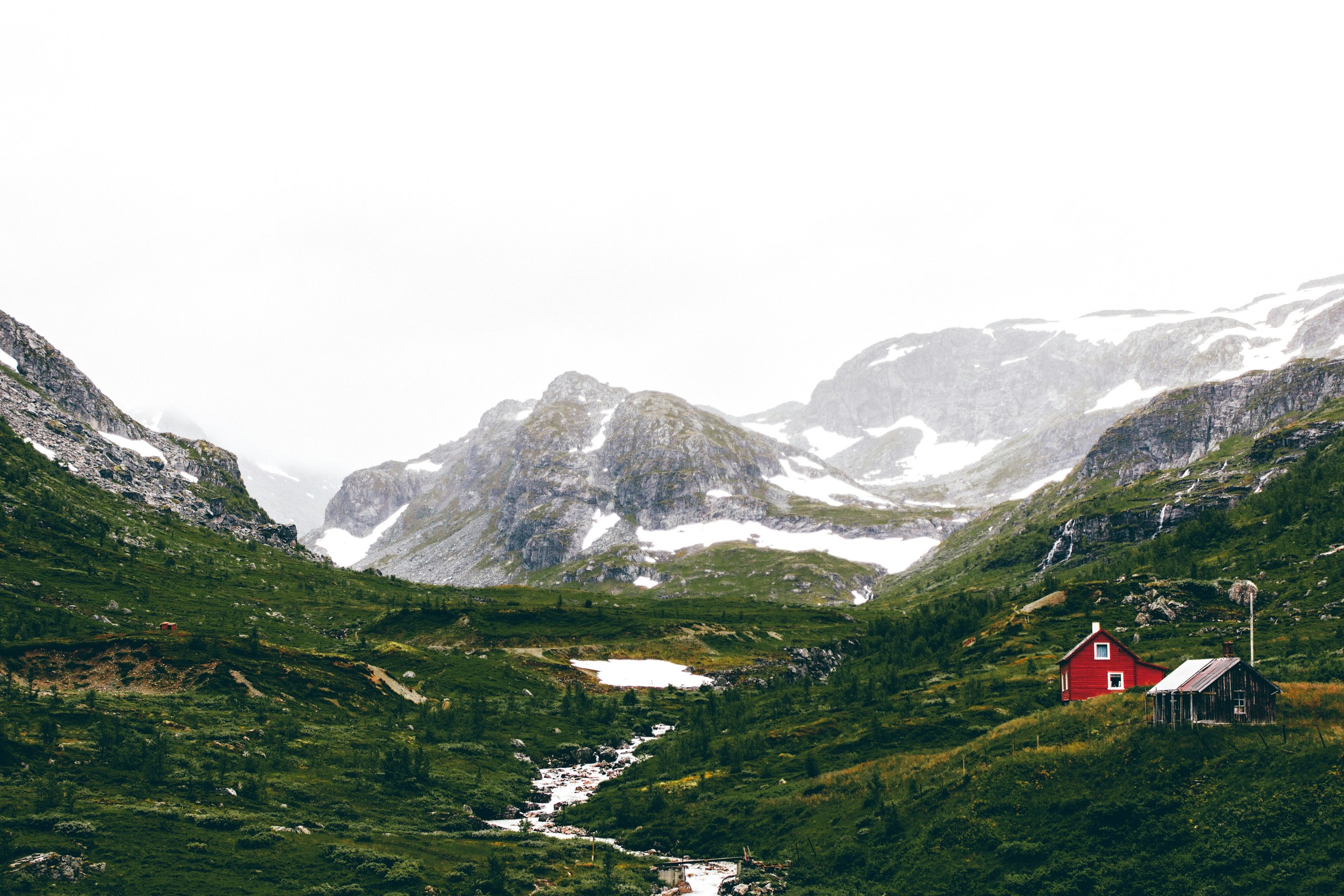

Rallarvegen is a gravel road across the high mountains between eastern and western Norway. It runs for roughly 80 kilometres from Haugastøl, a station on the Bergen Railway, to Flåm at the head of the Aurlandsfjord, climbing to just over 1,300 metres before dropping all the way to sea level.
It is one of the best-known cycle routes in Norway, ridden by more than 20,000 people a year. Most riders travel from east to west, so that the long descent comes at the end, and return to the start by train.
A Road Built for the Railway
Rallarvegen was built between 1902 and 1904 as a construction and supply road for the Bergen Railway, which opened between Oslo and Bergen in 1909. Its name comes from the rallare, the navvies who laid the line across the mountains, and the road is still maintained as an access route for the railway. The stations at Haugastøl, Finse and Myrdal remain the natural access points for the ride.


Volunteers began turning it into a cycle route in the 1970s, and the work was completed in 1974. The surface is gravel and stone, with rough patches, puddles and the occasional loose section. Motor traffic is not allowed on most of the route, so most of the traffic is other cyclists and walkers.
Over the Plateau to Finse and Beyond
The ride begins at Haugastøl, close to 1,000 metres above sea level, and the first section to Finse follows lakes and open moorland for around 26 kilometres. The climbing is gentle here, and this stretch is popular with families and with riders who want a shorter day. Finse sits at 1,222 metres and is the highest station on the Norwegian railway network, with the Hardangerjøkulen glacier rising to the south. The village has no road connection, and scenes for The Empire Strikes Back were filmed on the snowfields nearby in 1979.
Beyond Finse the route reaches its highest point near the lake at Fagervatn before dropping towards Hallingskeid. Snow lingers longest on this section, sometimes with banks beside the track well into summer. The road usually opens fully in July, and late July to early September is the safest period for a snow-free ride, although conditions change from year to year.
Many riders start at Finse rather than Haugastøl, which leaves a little over 50 kilometres to Flåm, most of it downhill with a few short rises. Trains from Oslo and Bergen stop at both stations, so either start can be reached in a few hours from the two cities. The plateau is exposed and has very few buildings, and the weather can turn cold and wet even in August, so warm and waterproof layers are essential.
The Descent Through Myrdal to Flåm
West of Hallingskeid the road heads towards Myrdal, where the Flåm Railway leaves the Bergen line. On the way, the steep descent through the Klevagjelet gorge is narrow and partly unprotected, and local advice is to walk the bike on this stretch. Myrdal itself has no road access and is reached only by train, bike or on foot. Just beyond lies Vatnahalsen, the starting point for the most famous part of the ride.

Below Vatnahalsen the road drops into Flåmsdalen through the Myrdalssvingene, a set of 21 tight hairpin bends on loose gravel. Speed needs to be kept low, with brakes used before each bend rather than in it. At the bottom the valley opens out into farmland, waterfalls and birch woods, and the rest of the way to Flåm is a steady, easy descent beside the river.
Flåm lies at sea level at the head of the Aurlandsfjord, an arm of the Sognefjord, and the Brekkefossen waterfall drops into the valley just above the village. From here the Flåm Railway, one of the steepest standard-gauge railways in the world, climbs back up to Myrdal in about an hour, with a stop on the way at the Kjosfossen waterfall. At Myrdal it connects with Bergen Railway trains to Finse, Haugastøl, Oslo and Bergen.
Choosing a Bike and Planning the Trip
A road bike is not suitable for Rallarvegen. A mountain bike, gravel bike or sturdy hybrid with wide tyres and good brakes is the right choice, and bikes can be hired at Haugastøl and Finse. Riders should also carry spare tubes, a pump and basic tools, since help can be a long way off on the plateau.
Space on the trains is limited in summer, so tickets and bike places are best booked early. An organised tour takes care of this kind of detail, with train tickets reserved, hotels booked at both ends of the ride, luggage moved ahead and route notes that cover each section and its hazards. With bike tours in Norway, riders can follow Rallarvegen from the mountains to the fjord with the bikes, beds and transfers arranged before they arrive, and their luggage waiting at the hotel in Flåm.