


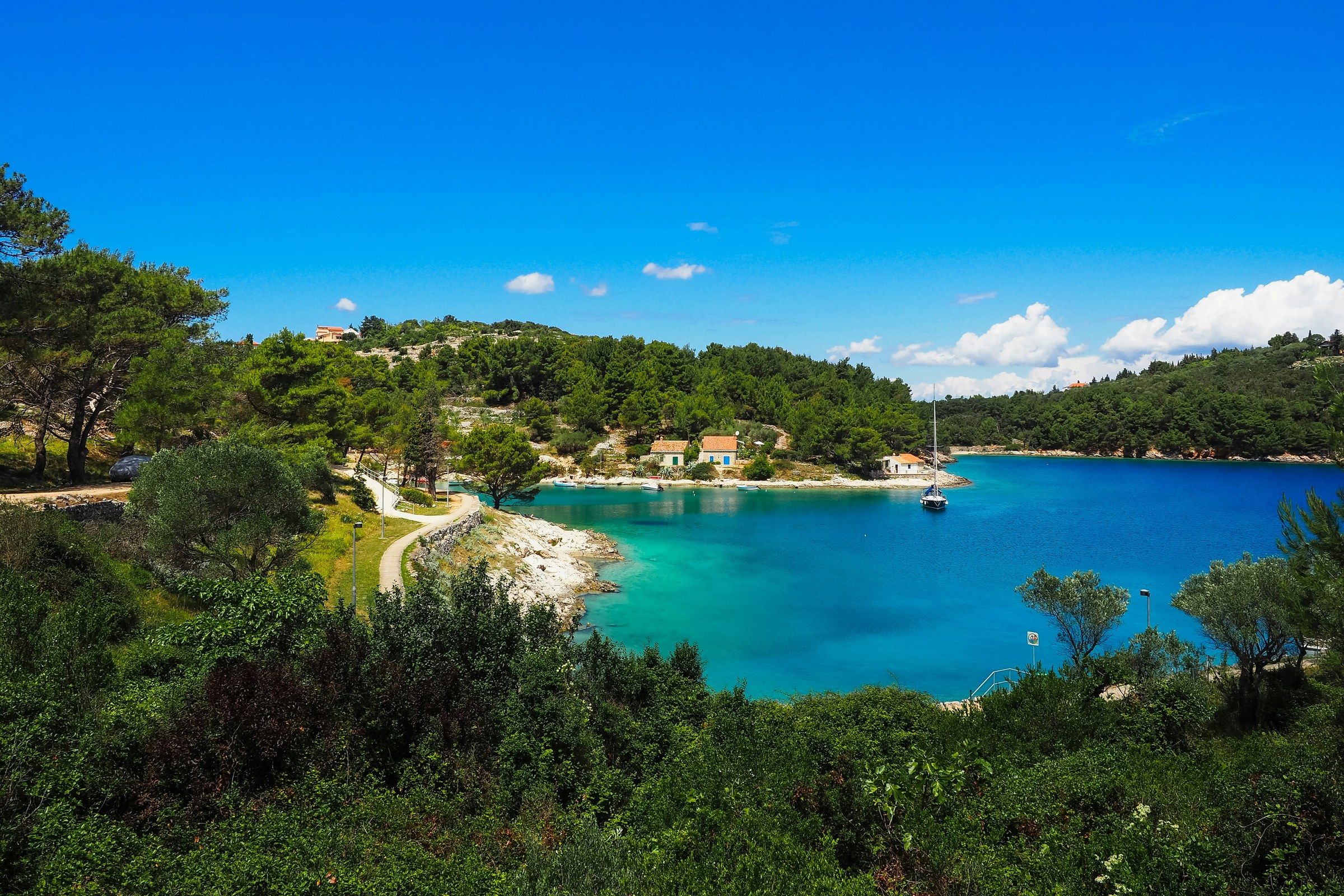





































The Kvarner Gulf, at the northern end of Croatia’s Adriatic coast, holds a group of large islands linked by short car ferries and bridges. Krk, Cres, Lošinj and Rab can be cycled as a loop or a one-way route, with a ferry crossing on most days and a different landscape on each island.
The distances are modest, but the riding is not always easy. The islands are hilly, many roads are narrow, and the climbs are rewarded with views across the gulf to Istria and the mountains of the mainland.
Krk and the Ferry Links
Krk is the easiest island to reach. It is joined to the mainland by a road bridge near Rijeka, and Rijeka’s airport is on the island itself, at Omišalj. Its towns include Krk, with its old walls, Vrbnik on a cliff above the sea, and Baška in the south, near the small church where the Baška tablet was found, a stone from around 1100 that carries one of the oldest inscriptions in the Croatian language.


The ferry port at Valbiska, on the west coast of Krk, is the hub for island hopping. Car ferries run from here to Merag on Cres, a crossing of about 25 minutes, and to Lopar on the northern tip of Rab, a longer crossing of well over an hour with up to four sailings a day in summer. Bikes go on board with foot passengers, and tickets can be bought at the port. Cres can also be reached directly from Istria by the ferry between Brestova and Porozina.
The Climbs of Cres
Cres is the longest and wildest of the four islands, a narrow ridge of stone walls, sheep pasture and scrub. The main road runs along its spine, so landing at Merag is followed by a climb up from the coast, and the ride south towards Osor rises and falls for much of the day. Side roads drop steeply to the sea, which means every detour to a village or beach has to be climbed back out of.
The best-known of these detours leads to Lubenice, a village on a cliff almost 380 metres above the sea, with a narrow, steep road up to its walls. In the north of the island, around Beli, griffon vultures nest on the sea cliffs. The town of Cres, a short ride from the Merag ferry, sits on a sheltered bay on the west coast and has a small harbour lined with Venetian houses.
Osor’s Bridge and the Island of Lošinj
At the southern end of Cres, the small town of Osor stands beside a narrow channel that separates Cres from Lošinj. The two were once a single island, and the channel was cut in ancient times to give boats a shorter route. A swing bridge carries the road across, and it opens twice a day, usually at 9am and 5pm, to let yachts through, so riders arriving at those times may have a short wait. Osor is now a village of a few dozen residents, but in the Middle Ages it was a bishop’s seat and the main town of both islands.
Lošinj is smaller and greener, with pine woods planted in the nineteenth century and a mild climate that made it a health resort under Austria-Hungary. Mali Lošinj, the main town, is home to the Museum of Apoxyomenos, built for a Greek bronze statue raised from the seabed nearby in 1999. Veli Lošinj, a quieter harbour town, lies a short ride to the east. Bottlenose dolphins live in the surrounding waters, and a marine education centre in Veli Lošinj explains the research carried out on them.

Rab, the Seasons and Planning
Rab is reached from Valbiska by the ferry to Lopar, and the contrast with Cres is clear soon after landing. The north-east side of the island is bare rock, stripped by the bora wind, while the south-west is green with pine and holm oak woods. Lopar has some of the few sandy beaches in this part of Croatia, and Rab town, on a narrow peninsula, is known for the four bell towers that rise above its old streets.
The best months to cycle the Kvarner islands are May, June, September and early October, when the sea is warm enough for swimming and the roads are quieter than in high summer. July and August bring heat and heavy traffic around the ferry ports. The bora, a strong cold wind from the north-east, is most common in winter but can blow at any time of year.
Matching each day’s ride to the ferry timetables, which change through the season, is the hardest part of planning a trip here. An organised tour books hotels on each island, provides bikes geared for the climbs, moves luggage between ports and supplies route notes or GPS tracks for the side roads. Many riders choose cycling holidays in Croatia for this reason, so the ferries, beds and bags are arranged before they arrive.