
































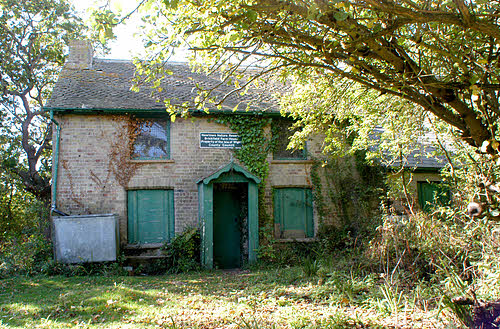

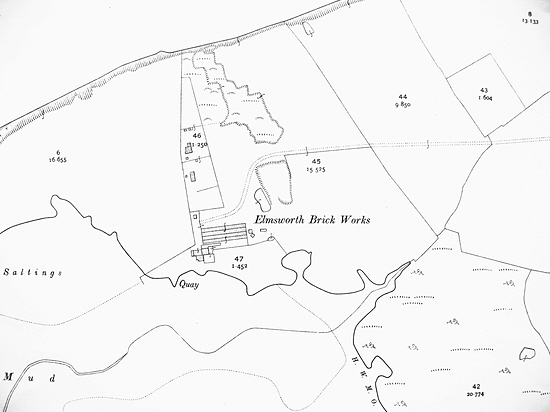
Do you know the location of the Isle of Wight’s most isolated house, Brickfields Cottage?
Brickfields Cottage lies on Elmsworth peninsula, 2 miles from the nearest dwellings on Elmsworth Lane, and was last occupied in 1954.
There are no roads, nor even a track leading to the cottage. There never were. Transport to and from the cottage was primarily by boat. A newspaper reporter asked to write an article about the cottage in 1953 took 2 days to find its location.


The cottage was built for the Prangnell family: owners of the nearby brickworks. They ceased making bricks shortly before the start of World War 1. However, 4 of the Prangnell family – brothers and sisters Annie, Mary, Ned, and Billy – continued living there until the cottage was abandoned in the middle of the previous century.
The 4 Prangnell children lived a simple life without electricity, gas, water, or drainage. They kept a cow for milk and butter, caught rabbits for meat, and drew water from a nearby pond. Their only luxury was a radio set. They were, however, apparently content with their isolated and spartan existence.
When the newspaper reporter who visited the Prangnell brothers and sisters remarked that it must be pleasant to have no electricity bills, Miss Annie Prangnell replied: “Yes, but the income tax man knows where to find us!”
It is hard to imagine what income a household that kept a cow for milk and butter and caught rabbits for the pot for their supper might have earned.

Their lack of contact with the outside world led to their conversing in their own dialect of English. 1 brother – Bill – would row to Newtown for farm supplies or to leave farm produce. His sister Annie would traipse the 2 miles to Porchfield across the fields once a week for shopping, occasionally venturing as far as Newport by bus.

Their life on the Elmsworth peninsula was not entirely uneventful. Remarkably, Brickfields cottage was hit by a doodlebug in the Second World War, leading to the Prangnells spending 7 weeks in an air raid shelter while their cottage was repaired. The house was also broken into by some boys attempting to escape from borstal.
For almost half a century – from 1866 – the Prangnells had been the most famed brickmakers on the Isle of Wight.
The brickworks were located near Newtown to take advantage of the abundant high-quality clay in the vicinity. At that time, the most efficient method of moving large quantities of bricks was by boat. Bricks were transported to mainland towns and cities such as Lymington, Southampton, and Portsmouth, as well as to Isle of Wight coastal resorts such as Sandown.
If you have a yellow-brick house built before World War 1, most likely the bricks came from the Prangnells’ Newtown works.

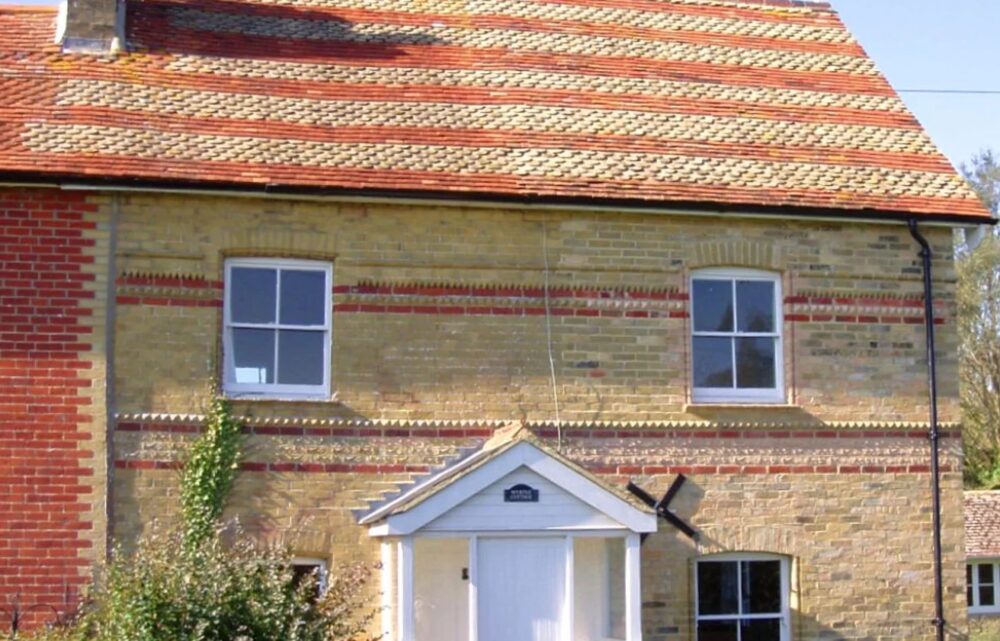
The Prangnell brickworks were known for producing ornate bricks, for which they won prizes at competitions. Formerly, Brickfields cottage had a very decorative chimney made from their more ‘fancy’ designs. The chimney was taken down to be displayed in Newtown town hall.
Some of their ornate brick designs can still be seen at Myrtle cottage in Newtown.
Brickfields Cottage is currently owned by the National Trust and is in a poor state of repair. The nearby brickworks can still be found but are said to be unsafe to explore.
Reaching the cottage is far from easy. To do so requires a 2-mile trek from Elmsworth Lane, Porchfield, across a firing range. There is neither a recognisable track nor public right of way.
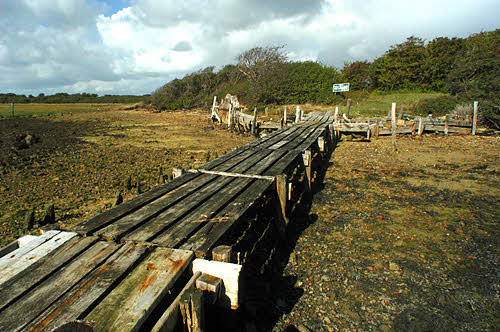
It is possible to approach the cottage by boat as the jetty close to the brickworks still exists. However, it is in a poor condition, and visitors are not advised to land there.
The cottage and the former brickworks appear destined to remain in splendid isolation for the foreseeable future.






That was interesting. More articles like this, please. Thank you.
I live in Myrtle Cottage, Newtown and admire the bricks which were made by the Prangnell family. There are ornate cills and facing bricks to all the windows with birds depicted on the bricks. It is so sad the National Trust have let the brickyard and house of the Prangnell family go to ruin. I was under the impression Grants could be obtained to preserve such interesting history. We have so much to cherish about the old trades which no longer exist.
If you read the book on Newtown by Keir Foss (his father was born in Newtown) it would open your eyes about the family.
I arranged for several original families to come and have tea with Keir who surprised us with a slide show viewed on my TV. One of the Prangnell children had a stammer and every time he stammered at school he was canned. Needless to say he left school as quick as he could. We have come a long way…….
As building is one of our main industries and we have a famous brickyard on our doorstep with examples of the bricks in Myrtle Cottage surely we should arrange to purchase the land, house and brickyard from the National Trust as so much could be learnt from it. To have the chimney pot stored in Newtown Town Hall which is closed is sacrilege!
‘Brick-Fields’ could there be a more apposite term ?
I came across this cottage a few years ago while out with my dog.
Lovely brickwork and very isolated.
I hope the national Trust maintain it. Shame to let more of our island history go.
Interesting story. You should do more like that
Perfect for a DFL bolt hole. Secret history should be as intended.
Why are the NT not maintaining it? Such a shame for an important part of the Island History to slowly deteriorate in a very sad way. The fact it is still standing proves it wants to be saved, 2 word wars and it is still here.
I visited this beautiful unique site a few years ago,
Very difficult to find, I kayaked from Thorness .
I hope it gets looked after.
I took some photos of the lovely brickwork designs before I was asked to leave the private land,
But it was worth it,
Just don’t attempt it if the firing range is active.
The jetty no longer exists now, all washed away. I visited brickfield farm house earlier this year and it is completely overgrown compared to the photo of it in “recent years!”
I camped out here a couple of times with my school back in the early 2000’s, it was so lovely and peaceful. We used to maintain the pathways and building as best we could. Unfortunately the recently appointed headteacher at the time declared “that learning only took place in the classroom” and the trips were subsequently stopped. I recently visited it again, and I am sad to say it is not in a good state.
Hi Kris, It is very sad to see ‘our’ house has fallen into such a poor state. If Newtown Camp had been allowed to continue, then things would be very different! Cat and other campers have suggested a reunion…. It would be lovely to see you all again!
A restoration builder wants to rebuild it for his own house bringing it back to life if all
Delete please thank you
The National Trust should be ashamed of themselves for letting this important part of history fall into such a terrible state of repair. They are supposed to be preserving local historic areas but they are ruining Newtown too, encouraging people to a Nature Reserve which is ruining the village and it’s wildlife and nesting birds whilst the walkways on the Quay are deteriorating at a rapid rate and they are not maintaining them.
In the late 60s I was part of a party of school children and teachers from Cowes Secondary & Priory Girls schools camped on the peninsular and our catering area was in front of Brickfield cottage. We were there to record species of birds nesting and rodents in the area. We were transported there by boat from the end of Newtown harbour wall. We erected hides out on the foreshore and took it in turns to observe and take notes. We caught voles and mice in humane traps recorded them then released them. The teachers were a Mr Dutton from cowes sec, and mr Frazer. I have a photo some where of us all waiting for the boat to return us to Newtown
It was a form of English!!!! They were flemish Annie’s father was a, sea captain they were our neighbours in Carisbrooke until they all died! Do your research! There us a very old interview with Annie and Mary done by the County Press