




































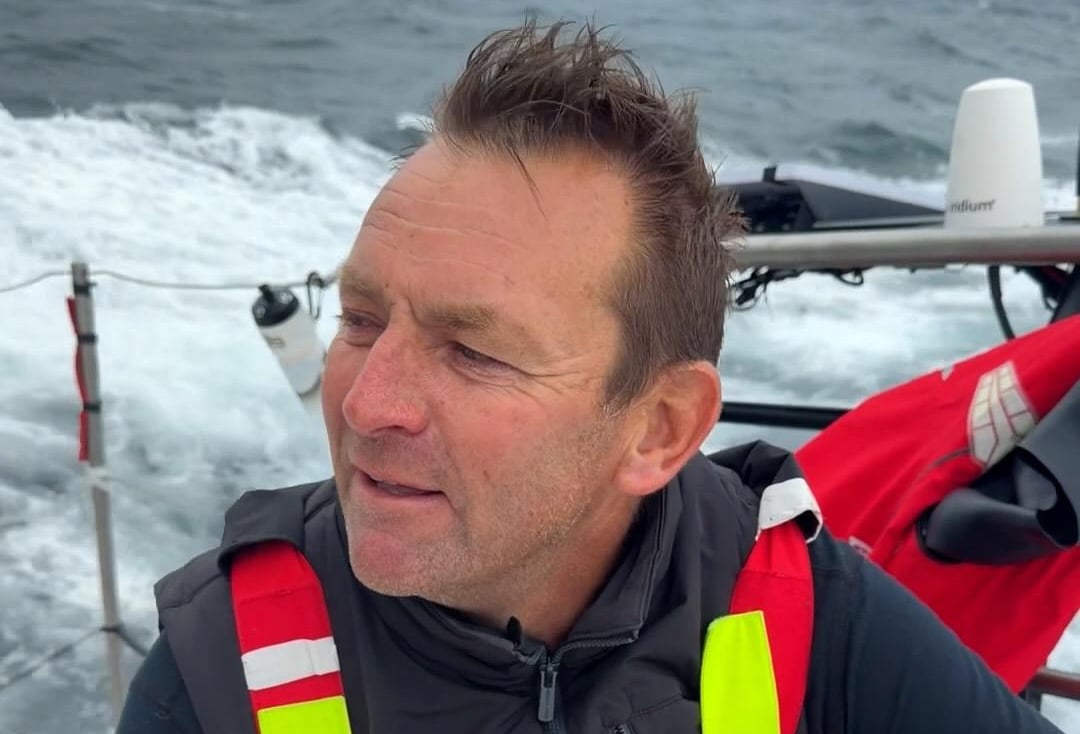

Island-raised navigator Jules Salter has reflected on the special experience of starting and finishing a 2,000-mile race in his hometown, after helping Pace become the first monohull across the line in the RORC Round Britain and Ireland Race.
Following the start of the RORC Round Britain and Ireland Race from Cowes on 9th August, a very slow race is still taking place for the 30+ teams.
In the past, fast yachts have completed the race in around 3-4 days however, this year after a week of racing only one boat is back in Cowes.


Johnny Vincent’s Volvo 70 Pace has completed the 50th anniversary RORC Round Britain and Ireland Race. As well as being the first to cross the RYS line and winning Monohull Line Honours, after a race that combined raw speed, complex navigation it was a deeply personal offshore journey for the owner.
Pace crossed the Royal Yacht Squadron finish line in Cowes at 04:17:31 on Sunday (16th August). Her elapsed time for the 1,805-nautical-mile course was 6 days, 14 hours, 47 minutes and 31 seconds.
The YB tracker recorded 2,113 nautical miles sailed, close to the shortest route, save two deviations after Black Rock and in the northern North Sea. The great acceleration came off the west coast of Ireland and towards Muckle Flugga where the Juan Kouyoumdjian design exploited the conditions that suited her. Pace recorded a 486-nautical-mile run in 24 hours with boat speeds of 26 and 27 knots.
For Vincent, the fastest miles produced one of the defining memories of the race.
Vincent said:

“We did 486 miles in a 24-hour stretch.
“We had a good solid breeze and a fantastic wave pattern. Surfing at 27 knots is exciting for anybody. It was absolutely thrilling.”
Navigator on Pace was Jules Salter, from the Island, who has raced thousands of miles in Volvo 70s and won the 2008-09 Volvo Ocean Race aboard Ericsson 4. However, this was Salter’s first RORC Round Britain & Ireland Race.
Salter said:
“When you are racing around Britain, you are effectively turning right at every corner.
“You combine that with the weather and keep the boat at its fastest and most efficient angle. If you minimise the distance and sail faster for a shorter distance, you will do better.
“There were opportunities to push hard when it was easy to push hard and to gain from a wind shift, a wind bend or something in the forecast. We tried to do that all the way around the course.”
That explains why the shortest line was not always the fastest route.
Salter explained:
“In a corrected time race, the boats have different speeds and characteristics.
“We were in the North Sea while other boats were still in the North Atlantic. You have to play the weather hand you are dealt and do what is right for your boat.
“The crew were incredibly sharp at getting the right sails up and down, then making the small angle changes needed to keep the boat fully on pace. You are looking at the sea state, wave angles and which little shifts to take. If you keep doing that, suddenly the boat covers hundreds of miles relatively easily.”
For Salter, the race also carried a strong Isle of Wight connection.
He said:
“I have grown up on the Isle of Wight, so it is very special to start and finish in Cowes.
“All the great races used to be here, and now the Admiral’s Cup is back as well. It is pretty cool to do a 2,000-mile race starting and finishing in your hometown.”
At the time of writing, Pace was also in pole position for IRC Overall after time correction. Her corrected time was fixed, but Vincent and his crew were waiting for the remaining contenders, including Antoine Magre’s Mach 50 Palanad 4, to finish before the overall result could be decided.