






































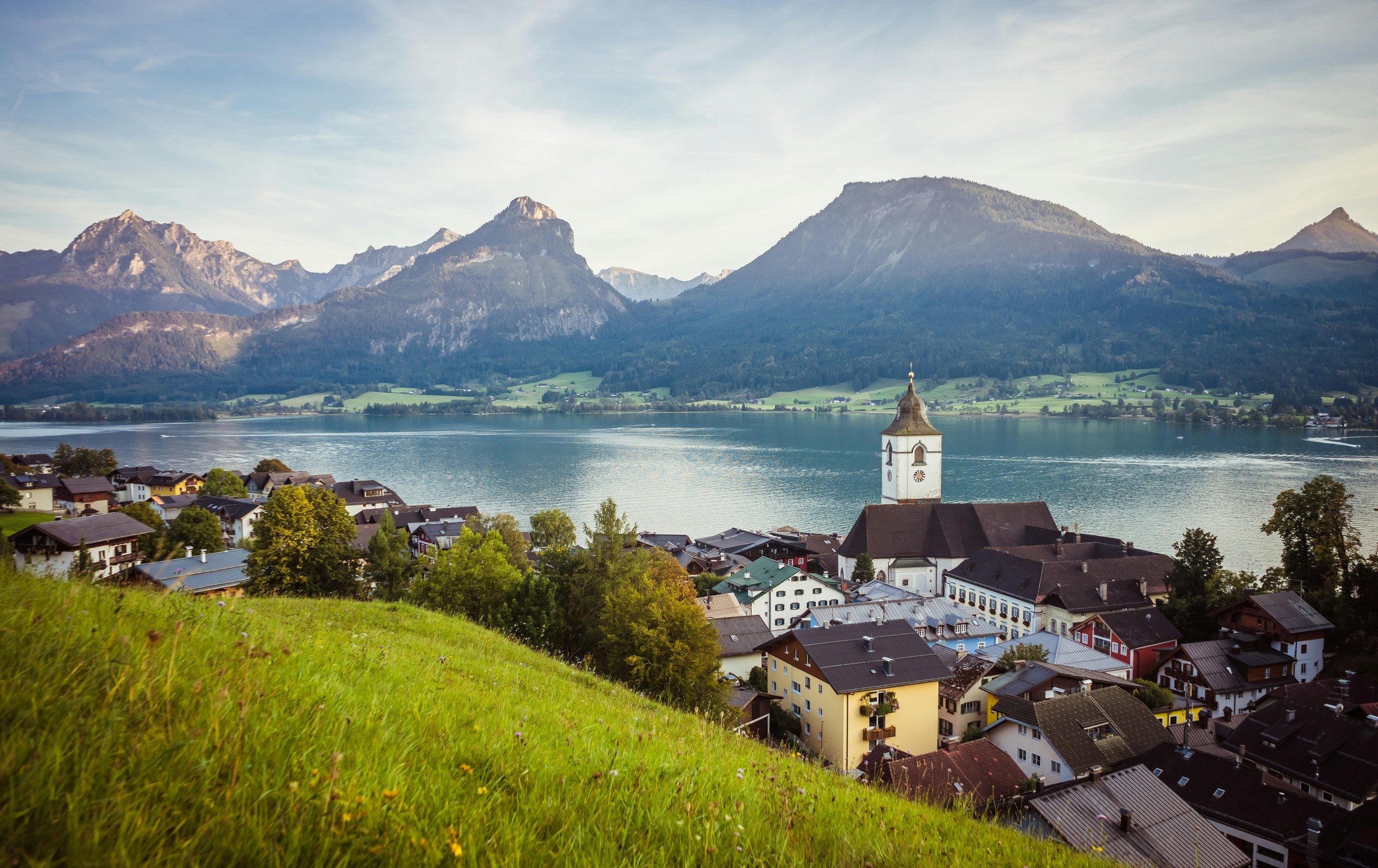

The Salzkammergut is a region of lakes and limestone mountains east of Salzburg, spread across the Austrian states of Salzburg, Upper Austria and Styria. It has dozens of lakes, and five of the best known, the Wolfgangsee, Mondsee, Attersee, Traunsee and Hallstätter See, can be linked by bike in about a week.
The main route through the area is the Salzkammergut Radweg, a signed loop of more than 300 kilometres that passes 13 lakes. Much of it runs on lakeside paths and quiet roads, with climbs between the lakes and boats and trains to shorten the harder sections.
The Salzkammergut Radweg
The route is signed as the R2 in Upper Austria and the R19 in Styria, with green signs in the state of Salzburg, so the markings change as you cross from one state to the next. It is a loop that can be joined almost anywhere, and most riders choose a section rather than the whole circuit. Depending on the variant, the full loop involves between 2,000 and 4,000 metres of climbing.

Most of that climbing comes between the lakes rather than along them. From the Mondsee, a short climb over the Scharflinger Höhe, past the small Krottensee, leads to St. Gilgen on the Wolfgangsee. The stage from Bad Goisern over the hills to Bad Aussee in Styria is the hardest of all, and many riders put their bikes on the train for that section.
Surfaces are a mix of asphalt and gravel, and the route suits touring bikes, hybrids and e-bikes. E-bikes can be hired in most of the larger towns and make the climbs between the lakes far easier.
Wolfgangsee, Mondsee and Attersee
St. Gilgen, at the western end of the Wolfgangsee, is the birthplace of Mozart’s mother, and lake boats link it with St. Wolfgang and Strobl. St. Wolfgang has a pilgrimage church with a carved altar by Michael Pacher, completed in 1481. A rack railway climbs from the village to the summit of the Schafberg, with views over several of the region’s lakes. The village is also home to the White Horse Inn, the lakeside hotel that gave its name to a well-known operetta.
The Mondsee, a short ride to the north, is one of the warmer lakes in the region for swimming, and the basilica in the town of Mondsee was used for the wedding scene in the film The Sound of Music. To the east, the Attersee is the largest lake lying entirely within Austria, almost 20 kilometres long. Gustav Klimt spent many summers on its shores and painted the lake and its villages.
Bad Ischl, Hallstatt and the Traunsee
Bad Ischl, at the centre of the region, was the summer residence of Emperor Franz Joseph, and his Kaiservilla is open to visitors. The town’s spa tradition began in the 1820s, when salt-water cures made it popular with the court in Vienna. Bad Ischl and the wider Salzkammergut were a European Capital of Culture in 2024. From Bad Ischl the cycle path follows the River Traun south through Bad Goisern towards the Hallstätter See, with only gentle gradients along the valley floor.

Hallstatt sits on a narrow strip of land between the lake and the mountains, and is part of a UNESCO World Heritage Site. Salt has been mined in the mountain above the village for around 7,000 years, and the salt trade shaped the region and gave it its name. A small ferry links the village with its railway station on the opposite shore, which is useful for riders joining or leaving by train.
To the north, the Traunsee is the deepest lake in Austria, at 191 metres. Gmunden, at its northern end, is known for its ceramics and for Schloss Ort, a castle on a small island joined to the shore by a wooden bridge. The paddle steamer Gisela, which dates from the 1870s, still carries passengers on the lake in summer. Traunkirchen, on a small peninsula on the west shore, has a church with a carved pulpit in the shape of a fishing boat.
Seasons and Planning
The cycling season runs from May to early October. June and September are often the most comfortable months, while July and August bring the warmest water and the busiest roads around Hallstatt and the Wolfgangsee. Hallstatt is crowded with day visitors from mid-morning, so arriving early or staying the night gives a quieter view of the village. Rain is fairly common in summer, so a waterproof is worth packing.
Linking the lakes means fitting rides around boat and train timetables and finding beds in small lakeside towns that fill early in summer. An organised tour handles these details, with hotels booked in advance, bikes or e-bikes provided, luggage moved each day and route notes that show where to take the boat or the train. With cycling holidays in Austria, riders can follow the lakes at their own pace while the practical side is arranged for them.