




































































Open an online casino and the first row of games can look like a simple list of what is popular. It usually is not. Behind those tiles sits a mixture of recommendation software, editorial choices, commercial priorities, new releases, player behaviour and sometimes basic factors such as where you live and what device you are using. A comprehensive online casino guide can help explain the games themselves, but understanding why particular titles appear in front of you requires looking at the lobby as something closer to Netflix or an online shop: it is a storefront whose shelves can move every time you return.
The important point is that an online casino lobby is not a neutral catalogue. Two people can sign into the same operator and see different games near the top, while the same player may find the order has changed between Monday morning and Friday evening.
Here is what actually determines those positions.


Is the first game in the casino lobby really the most popular?
Not necessarily.
A casino may have hundreds or thousands of games available, which makes displaying everything equally impossible. The operator therefore has to decide what deserves the most valuable screen space.
That can include genuinely popular titles, but popularity is only one signal.
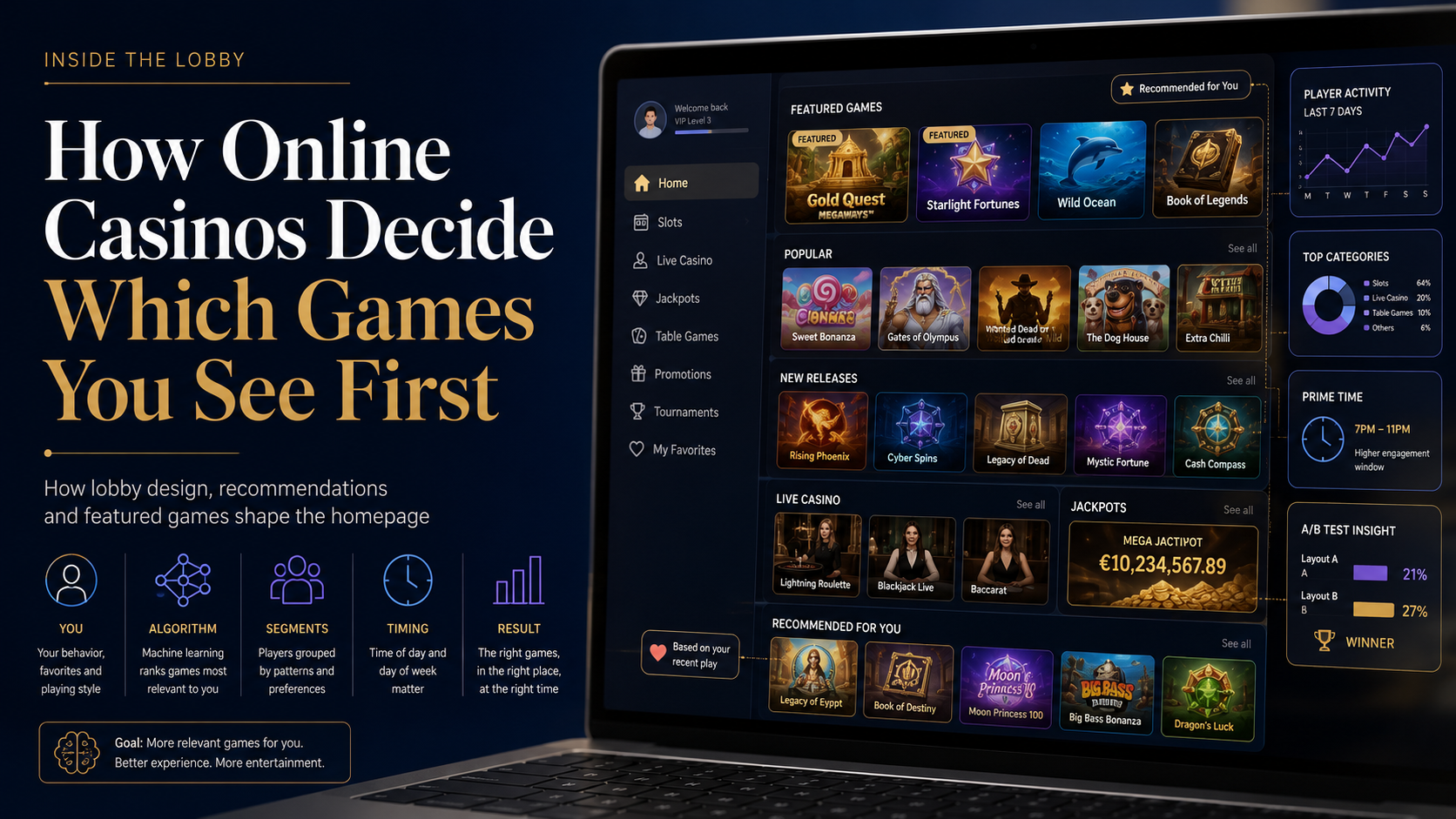
A typical homepage might contain sections such as:
- Recommended for You
- Popular Games
- New Games
- Live Casino
- Jackpots
- Recently Played
- Exclusive Games
- Trending Now
Each row can be produced differently.

“Recently Played” is straightforward: it can simply reflect your account history. “Popular” may be based on what players across the site are currently opening. “Recommended for You”, however, can be considerably more sophisticated.
EveryMatrix, which supplies casino technology to operators, says its CasinoEngine recommendation system can automatically recommend games using factors including player preferences, location, age and gender. Its recommendation engine uses collaborative filtering to calculate similarities between games, with its similarity data refreshed regularly.
In other words, the lobby does not always ask, “What is the best game?”
It may be asking, “What game is this particular visitor most likely to open next?”
How does a casino recommendation system know what you like?
The basic idea is familiar from streaming services.
If you repeatedly play one type of game and other people with similar behaviour also play another title, the system can identify a relationship between the two.
It does not need to understand that one game contains Vikings and another contains Egyptian temples. It can infer similarity from behaviour.
EveryMatrix describes its system as using collaborative filtering, a recommendation technique based on relationships between users and products rather than simply matching categories manually.
Gaming marketing platforms can go further.
Optimove says operators can use historical behaviour, real-time gameplay, deposits, preferences and predictive signals to place customers into continually changing segments. Those segments can then influence messages, promotions and game recommendations shown through websites, apps and casino lobbies.
That creates a feedback loop.
Play several live blackjack sessions and you may see more live tables.
Spend most of your time on slots and the lobby has little reason to lead with baccarat.
Regularly return to jackpot games and jackpot-oriented recommendations become more relevant.
What feels like a static homepage gradually becomes a record of what you have previously clicked.
Does everyone see a personalised casino lobby?
No.
Personalisation can operate at several levels.
At the simplest level, an operator can show the same lobby to everybody and manually decide what appears in each position.
A more sophisticated site can create categories for groups of players.
A still more advanced system can personalise recommendations at individual level.
Those approaches can also exist together.
The top banner may be selected by the operator because a major new game is launching, while the row below it is generated from your playing history. A third section might show the same live games to everybody because they are currently busy.
This is why “the algorithm chose it” is an incomplete explanation.
There is rarely one algorithm controlling the entire page.
Human merchandising and automated recommendations can operate side by side.
Why do new casino games appear so high in the lobby?
New games face the same problem as new products in any marketplace: nobody can discover them if nobody sees them.
Providers release titles throughout the year, and operators regularly integrate new content into their portfolios. Play’n GO, for example, maintains a continual release schedule, with new titles appearing across its catalogue throughout 2026.
A new game therefore often receives temporary visibility.
It may enter a “New Games” carousel, occupy a banner position or appear near the beginning of a provider-specific section.
That does not necessarily mean players already love it.
Sometimes the prominent position exists precisely because the operator is trying to find out whether they will.
There is an important difference between popular because people choose it and popular-looking because everybody has been shown it.
The two can eventually reinforce one another.
Give a game premium placement, more people open it. More people opening it can push it up a popularity ranking, giving it still more exposure.
That is one reason the first week of a game’s life can matter disproportionately.
Commercial deals can influence visibility too
Casino lobbies are shops as well as recommendation systems.
Game developers want distribution. Operators want content that keeps their catalogue attractive. Platform suppliers provide the technical connection between the two.
Pragmatic Play, for example, distributes slots, live casino and other products through a single API to operators across regulated markets.
Providers also run network promotions around groups of games. Pragmatic Play’s Drops & Wins programme, for instance, connects participating slots and live casino products to tournaments and prize mechanics.
When an operator is supporting a launch, tournament or exclusive campaign, participating games may naturally receive additional lobby visibility.
That does not make the games unfair or change their mathematics.
It means their position on the shelf may have a commercial explanation.
A supermarket places some products at eye level. A streaming service puts new originals across the home screen. An online casino has the same basic problem: limited attention and a very large catalogue.
Can the same slot have a different RTP at another casino?
This is where players should separate lobby placement from game mathematics.
RTP, or return to player, describes the designed proportion of stakes returned as prizes over a very large volume of play. It is not a prediction of what will happen during one session.
For gambling products regulated in Great Britain, games must undergo appropriate testing before they can be offered, and remote operators must continue monitoring live game performance after launch to identify situations where actual performance deviates unexpectedly from the designed RTP.
The Gambling Commission defines theoretical RTP as the designed percentage shown in the player-facing game rules, while actual RTP is calculated from real turnover and winnings generated after the game goes live.
Some games can exist in more than one mathematical configuration, depending on the supplier and jurisdiction. Therefore, recognising the artwork of a game is not by itself enough to establish every mathematical detail of the version being offered.
The practical lesson is simple: check the information attached to the game itself rather than assuming that two identical-looking tiles at different operators necessarily represent every setting in exactly the same way.
And remember what RTP does not mean.
A theoretical RTP of 96% does not mean that £100 played today should return £96. The Gambling Commission stresses that RTP is an average achieved across a significant number of plays, not a guarantee for an individual session.
Does a higher lobby position mean a better RTP?
No.
The two questions are separate.
A game can be placed at the top because it is:
- new;
- popular;
- part of a promotion;
- personally recommended;
- exclusive to that operator;
- connected to a tournament;
- relevant to your previous activity.
None of those conditions automatically tells you its RTP.
This is probably one of the most useful things a player can understand about casino design.
Visibility is a merchandising decision. RTP is a mathematical property of the game.
Do not use one as evidence of the other.
Why does your country change the games you see?
Online casinos cannot necessarily offer every game everywhere they operate.
Suppliers distribute content across multiple regulated jurisdictions, languages and currencies. Pragmatic Play, for example, describes its portfolio as being supplied through regulated markets internationally, while Play’n GO says its games are delivered to licensed operators across more than 35 jurisdictions.
That means location can become one of the first filters applied to a lobby.
A recommendation engine cannot sensibly suggest a game that is unavailable in the player’s market.
The result is that the catalogue itself may already be different before personalisation begins.
After that, language, local popularity and market-specific promotions can further change the order.
So two customers using the same international casino brand from different countries may effectively be shopping from different shelves.
Why does the lobby change at different times of day?
Time matters most where casino activity has a live or social component.
An RNG slot exists whether anybody else is playing it or not. Live casino tables depend on operating studios, dealer schedules, table availability and player demand.
Pragmatic Play, for example, operates live casino products delivered via video streaming to desktop and mobile devices, with some tables promoted as operating around the clock.
But even where a service operates 24/7, the mix of active players changes.
Friday evening traffic is not the same as Tuesday morning traffic.
More customers online can make live tables, jackpots, tournaments and “popular now” categories appear more active. Operators can therefore choose to emphasise different content when different sections of their audience are most engaged.
Marketing technology also allows lobbies and banners to react dynamically. Optimove describes personalised casino experiences in which game launches, jackpot alerts and recommendations can be highlighted according to customer activity and business rules.
That produces a kind of digital prime time.
The casino never closes, but its shop window does not have to remain identical all day.
What does “popular” actually mean?
This is worth questioning whenever a lobby uses the word.
“Popular” could mean the games with:
- the most players right now;
- the most launches today;
- the most stakes over a period;
- the highest number of unique users;
- the strongest recent growth;
- the highest internal popularity score.
Unless the casino explains the methodology, the label alone cannot tell you which definition is being used.
A player should therefore treat “popular” as a navigation aid rather than an independent quality rating.
The same applies to “trending”.
It tells you something about how the casino is organising content. It does not automatically tell you whether the game suits you.
Can casino operators deliberately steer you towards certain games?
They can certainly control visibility.
That is what lobby design does.
The more important consumer question is how that presentation interacts with gambling regulation.
Great Britain’s Gambling Commission requires licensed operators to treat customers fairly and transparently, and online gambling products must comply with relevant technical and consumer-protection requirements.
Game design itself is also regulated. For example, online slot rules in Great Britain include a minimum 2.5-second interval between game cycles, while maximum stakes are £5 per game cycle for customers aged 25 and over and £2 for those aged 18 to 24.
Those rules do not prevent operators from organising their libraries.
They set boundaries around the products being presented.
Personalisation, recommendation and merchandising therefore sit on top of a regulated game environment rather than replacing its underlying rules.
How can you tell why a game is being shown to you?
You usually cannot know with certainty from the tile alone.
But there are clues.
If it appears under Recently Played, the reason is obvious.
If it appears under New, release timing is probably driving the placement.
If the same title occupies a promotional banner and appears in a tournament, commercial promotion is a likely factor.
If a strangely specific group of games begins appearing after you repeatedly play one particular style, recommendation software may be involved.
And if the homepage looks different after signing in, that is the clearest sign that account-level information is shaping at least part of the experience.
The useful habit is simply to stop treating lobby order as a ranking of quality.
It is a ranking of relevance, commercial importance, recency, popularity or some combination of all four.
The casino lobby is closer to Netflix than a game shelf
That is ultimately the easiest way to understand modern online casino design.
A physical casino has to decide which machines occupy the entrance and which sit at the back of the room.
An online casino can rebuild that entrance for every visitor.
Recommendation engines can analyse preferences. Marketing systems can segment customers. Operators can promote new releases. Live content can rise during busy periods. Campaigns can temporarily push selected games forward.
The result looks effortless because that is the point.
You open the site and see a row of games.
What you do not see is the collection of decisions that put those particular games in those particular positions.
So the next time the same slot appears in the first row three visits in a row, do not automatically assume it is the casino’s “best” game.
It may be popular.
It may be new.
It may be promoted.
Or the lobby may simply have learned that you are the person most likely to click it.