







































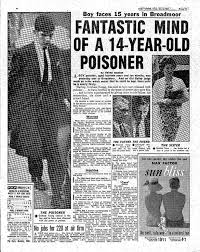
 In the 2nd of our series of Parkhurst prisoners, Island Echo examines the strange case of prolific poisoner Graham Young, who died at HMP Parkhurst 32 years ago.
Graham Young poisoned literally hundreds of people during his ‘career’, which started as a young teenager while still at grammar school. His victims included family members, friends, workmates, and later prisoners and prison staff. He was only convicted of 2 murders, although he was strongly suspected of being responsible for more, including that of his stepmother.
The ‘teacup poisoner’ was born in 1947. His mother died when he was only 14 weeks old. His father remarried when he was 7.


Young had a fascination for poisons and their effects from a very young age. His hero was the Victorian poisoner, William Palmer. His father Fred noticed his passion for science and made the fatal mistake of buying a chemistry set.
The budding young scientist never hit it off with his stepmother, Molly. He blamed her for breaking his toy planes. She was destined to be Young’s 1st victim, dying in 1962, after having been poisoned by antimony.
At his stepmother’s wake, Young proceeded to put antimony in a jar of mustard pickle, poisoning a male relative. He then went on to poison his father, sister and schoolfriends.

Meanwhile, at school, Young’s science teacher – Mr Hughes – discovered poisons in his student’s school desk, and spoke to the headmaster about his suspicions. They arranged for their maladjusted student to be interviewed by a psychiatrist masquerading as a careers adviser. Young told the psychiatrist of his extensive knowledge of poisons and toxicology. The psychiatrist contacted the Police.
Young was arrested and under interrogation, he confessed to his crimes. At his trial, psychiatrist Dr Christopher Fysh testified that the accused had a psychiatric disorder that prevented him from developing a normal moral sense of right and wrong. Fysh further believed it extremely likely he would re-offend.

The teacup poisoner had told the psychiatrist:
“I am missing my antimony. I miss the power it gives me.”
Young pleaded guilty and was sent to Broadmoor mental hospital at just 14 years old, making him 1 of the youngest people to ever be incarcerated at that institution.
However, being placed in a mental institution failed to stop Young from attempting to poison others. He managed to make cyanide from laurel leaves found in the prison grounds. He also put toilet cleaner in the tea urn. But nothing was proven at the time.
After Young had been in Broadmoor for 8 years, Edgar Unwin, the hospital psychiatrist wrote to the then Home Secretary, recommending his release.
Unwin stated:
“Young is no longer obsessed with poisons, violence, and mischief. He is no longer a threat to others.
However, Young had ominously told a prison nurse:
“When I get out, I’m going to kill 1 person for every year I’ve spent in this place.”

The consequences of Young’s release were entirely predictable. He found a job as a storekeeper at a laboratory in Bovingdon, Hertfordshire and began to administer poison to others once again. Broadmoor had not informed his new employers of his criminal record.
One of Young’s duties in his new job was to make the tea. The inevitable happened. His fellow workers fell ill with symptoms including vomiting, stomach pains, diarrhoea, and nausea. Men complained of impotence and on being admitted to hospital, their hair fell out. 2 died.
Suspicion fell on the then 24-year-old Young, who had shown an unhealthy interest in war, Nazi Germany, and famous murderers. In 1971, he was arrested. On searching his bedroom, police found a collection of toxic substances. They also discovered his diary, containing detailed notes on whether he would allow his victims to live or die.
On being arrested, Young was said to have asked police:
“Which one are you doing me for?”
On 29th June 1972, Young was found guilty of 2 counts of murder, 2 of attempted murder, and 2 of administering poison. After being sentenced to life imprisonment, he requested that he be sent to a regular prison rather than a mental hospital. He was 1st imprisoned in HMP Park Lane and then transferred to Parkhurst here on the Island.

On being incarcerated, Young immediately got up to his old tricks, making toxic substances out of common household articles. After he was discovered, he was regularly moved between cells.
At Parkhurst, Young befriended Moors murderer Ian Brady. Both shared admiration for Nazi Germany. They would play chess together.
Brady said of Young:
“He was genuinely asexual, finding even discussion of sexual matters not only uninteresting but also distinctly distasteful. Power and death were his aphrodisiacs and raison d’etre.”
Young got to know the Kray twins inside and painted their portraits.
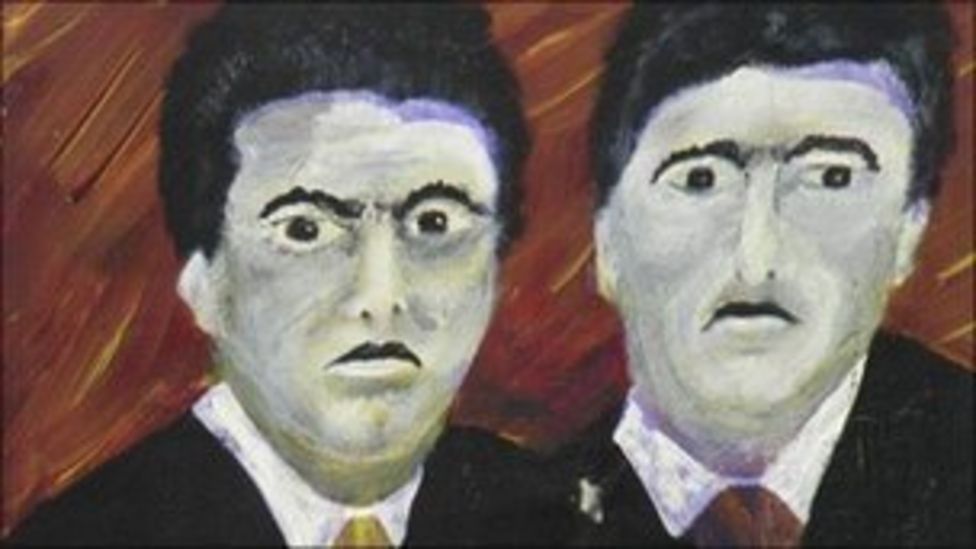
1 former prisoner described the inmates’ reaction to the infamous poisoner:
“Young was deadly. We just avoided him. If he poured a cup of tea, you couldn’t have it, even if he drank some first. He would know how much to take so it wouldn’t hurt him, and the other person would get a fatal dose.
“Nobody took chances with him. I couldn’t even sit at a table with him in case he dusted it with something. He made the Krays or any of the other bad men look like amateur streetfighters.”
The serial killer was thrilled when a waxwork of himself was added to the Madame Tussaud’s Chamber of Horrors, alongside his boyhood hero, Dr Crippen.
Graham Young died in his cell at Parkhurst on 1st August 1990, aged 42. The official cause of death was heart failure, although some believe that fellow inmates, who – except for Brady – were always extremely wary of Young, may have poisoned him. It is also possible that he grew tired of prison life and poisoned himself, in a final gesture of control.
The remains of the infamous poisoner are buried on the Island in Parkhurst Prison cemetery.
In 1995, a film was made loosely based on Graham Young’s life, entitled The Young Poisoner’s Handbook. See the trailer for the film below:






Really interesting articles, please keep it up.
It was Bovingdon Hertfordshire with a D ..
Oh look they changed it
So this shows, as if we didn’t already realise, just how wrong those can be who deem fit prisoners for early, or eventual release.
That is after being assessed by professional shrinks. Imagine then when you consider all the thousands of unchecked dingy arrives, who never have their backgrounds checked that it goes some way to explain that 30% of our prison populace is now of Albanian decent.
Sadly such infamous criminals such as him, Brady, Saville, Sutcliffe, Hindley etc are the only names mentioned, but with gangs doing the most hideous crimes now, whose names are so unpronounceable and Media attention to such cases kept as low key as feasible, it is now wonder that gullible people assume it is only Brits who are evil.