





































Puglia, the heel of Italy, is one of the gentlest regions in the country for cycling. Apart from the Gargano peninsula and a few upland areas, most of it is low plateau and coastal plain, crossed by quiet lanes between dry-stone walls, olive groves and vineyards.
The best-known riding is in the Valle d’Itria, between Bari and Brindisi, where small hill towns sit a short distance apart. Further south, the Salento peninsula is flatter still and runs down to the point where the Adriatic meets the Ionian Sea.
The Valle d’Itria and Its Towns
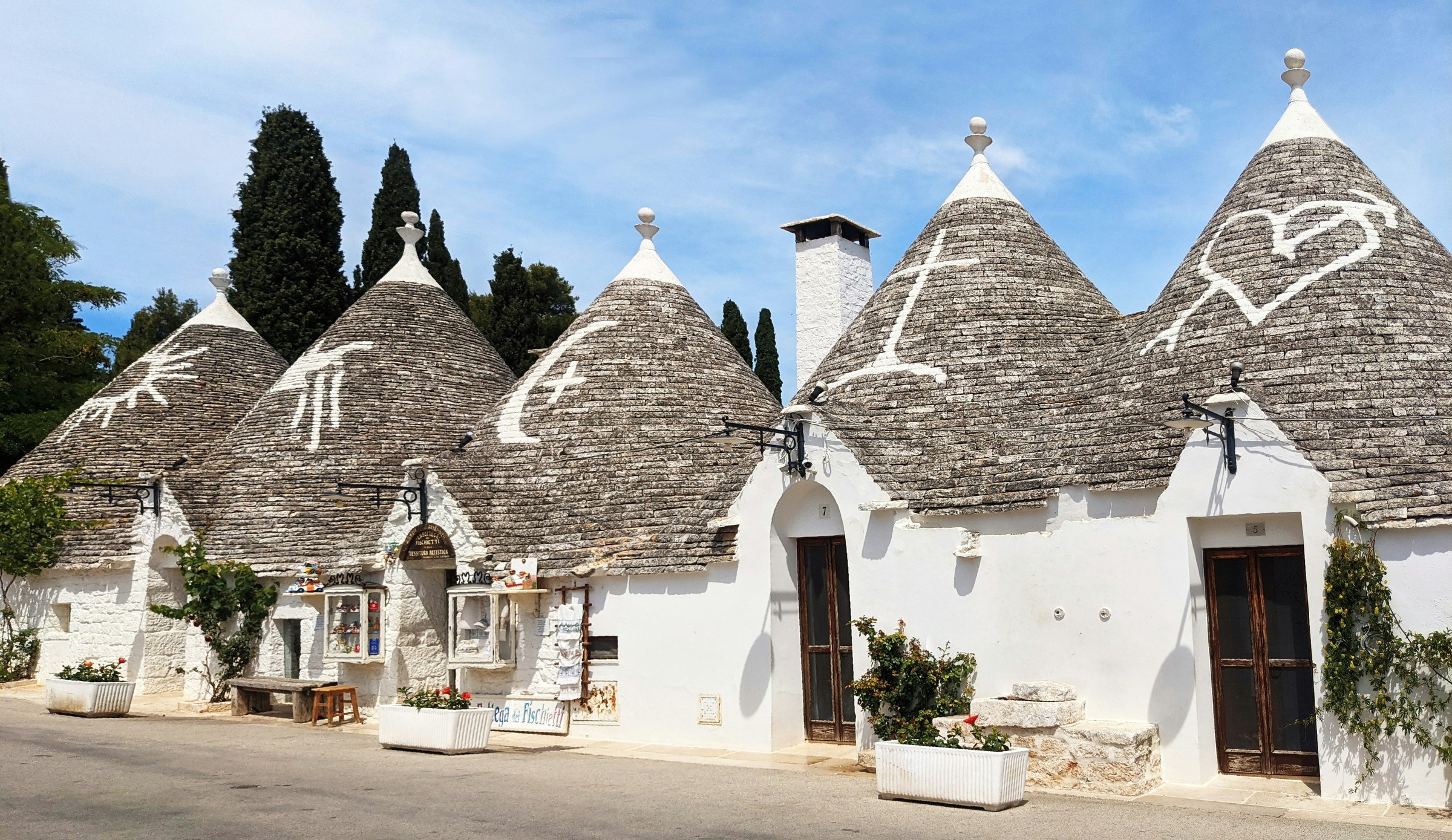
The Valle d’Itria is a shallow basin on the edge of the Murge plateau, dotted with trulli, the round stone houses with conical roofs that are typical of this part of Puglia. Alberobello has the largest concentration, in the Rione Monti and Aia Piccola districts, and its trulli have been a UNESCO World Heritage Site since 1996. Many are still lived in, and others have been restored as holiday homes or small hotels.


Locorotondo, a short ride away, is built in a circle on a hilltop and gives its name to a local white wine. Cisternino is known for butchers’ shops that grill meat to order in the evening, and Martina Franca has baroque churches and palaces and a summer opera festival. The rides between neighbouring towns are short, with gentle climbs up to each old centre.
A section of the Ciclovia dell’Acquedotto Pugliese, a traffic-free path laid along the service road of the regional aqueduct, runs for around 15 kilometres through the valley between Locorotondo, Cisternino and Ceglie Messapica. The aqueduct itself was begun in 1906 to carry water from springs in Campania to Puglia, a region with very few rivers of its own. The path’s unpaved surface and easy gradients make it one of the most relaxed rides in the area.
Ostuni and the Plain of Ancient Olives
Ostuni, known as the white town for its whitewashed houses, stands on a ridge at the edge of the Murge, looking down over the plain to the Adriatic. Its cathedral, completed in the late fifteenth century, is at the top of the old town. Below the town lies the Piana degli Ulivi Millenari, the plain of ancient olive trees that stretches between Ostuni, Fasano, Monopoli and Carovigno.
Many of the trees here are several centuries old, with thick, twisted trunks, and some are thought to be more than a thousand years old. The plain is crossed by narrow lanes and by the line of the Via Traiana, the Roman road that ran to Brindisi. The ruins of the ancient town of Egnazia lie close to the coast below Fasano.
Scattered across the plain are masserie, the fortified farmhouses built when this coast was exposed to raids from the sea. Many are still working farms that produce olive oil, and a good number now take guests, with rooms set around old courtyards and oil mills cut into the rock below. Meals are often made with the farm’s own oil, vegetables and wine.

The Adriatic Coast and the Salento
The coast between Polignano a Mare and Brindisi is low and mostly flat, with small harbours, coves and old watchtowers, many of them built in the sixteenth century to warn of raids from the sea. Polignano stands on limestone cliffs above the sea, Monopoli has a busy old port, and the Torre Guaceto nature reserve protects dunes, wetlands and a marine area north of Brindisi. The EuroVelo 5 cycle route, which starts in London, ends at Brindisi.
The Salento is the flattest part of Puglia, a peninsula of red soil, dry-stone walls and baroque towns. Lecce is built from a soft golden limestone carved into elaborate church fronts, Otranto has a cathedral with a twelfth-century mosaic floor, and Santa Maria di Leuca marks the tip of the heel. Since 2013 a plant disease, Xylella fastidiosa, has killed millions of olive trees in the Salento, and riders will see bare groves alongside new planting.
When to Ride and How to Plan
Spring and autumn are the best seasons. April, May, June, September and October bring warm days, with wild flowers in spring and the olive harvest beginning in autumn. July and August are often too hot for long rides, with temperatures regularly above 30C, and the plain offers little shade, so early starts help at any time of year.
Getting there is straightforward, since Bari and Brindisi airports both have direct flights from the UK and the Valle d’Itria lies within easy reach of each. Many riders still book an organised tour so that hotels and masserie are reserved in advance, bikes are delivered and fitted, luggage is moved between towns and the route is supplied as notes or GPS tracks. Planned in this way, cycling holidays in Italy leave each day free for the lanes, the towns and a long lunch in the shade.