





































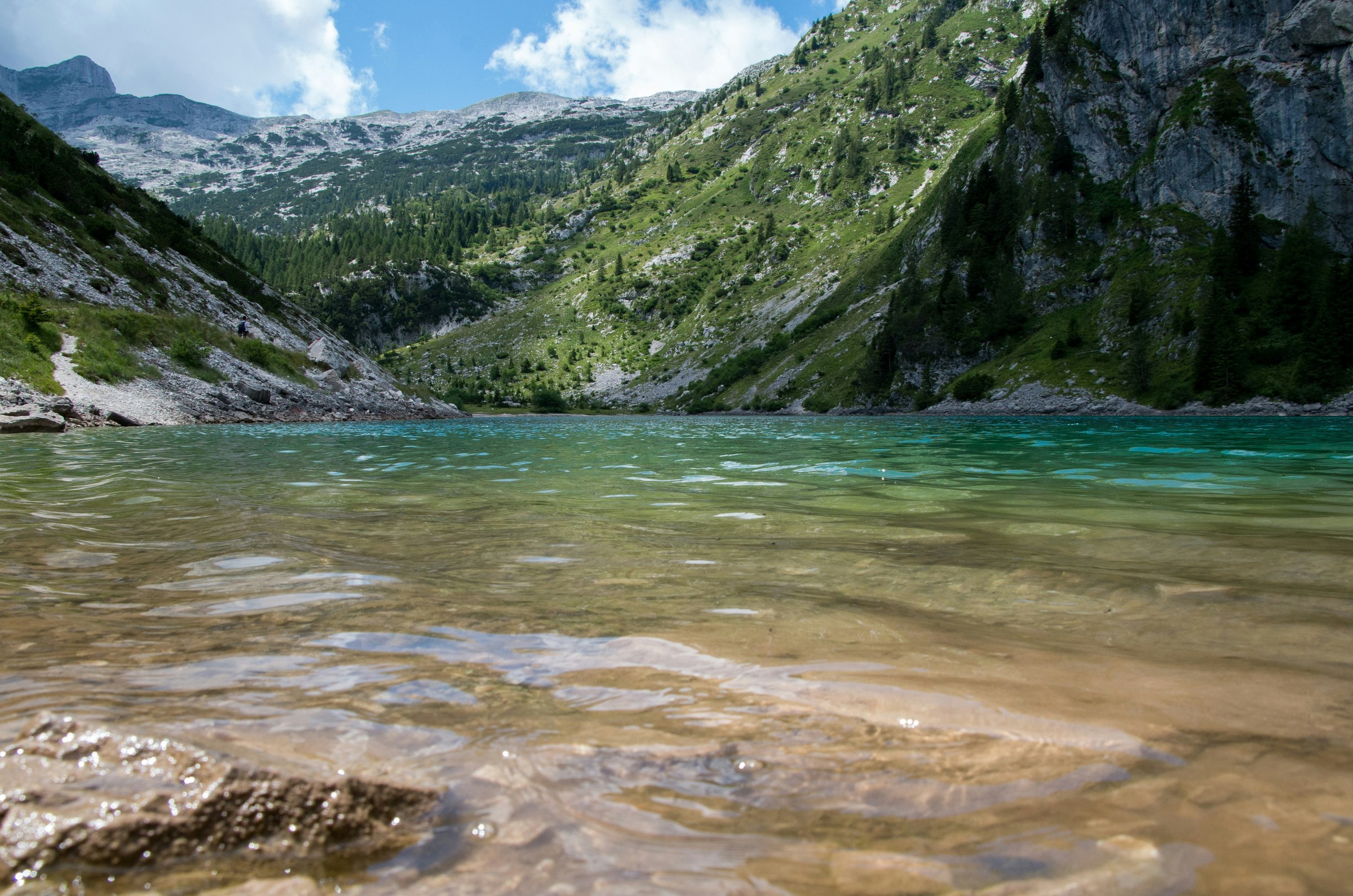

The Triglav Lakes Valley, Dolina Triglavskih jezer in Slovene, is a high, rocky valley in the Julian Alps south-west of Triglav. It lies below the peaks of Tičarica and Zelnarica and rises from about 1,300 metres at its lower end to just under 2,000 metres at its head.
Its other name, the Valley of the Seven Lakes, is not quite accurate, because there are ten lakes in the valley, though some of the smaller ones dry out at times. Most walkers spend at least one night here, and the valley links easily into longer routes across the Julian Alps. Its bare limestone and dwarf pine look very different from the green farmland around Lake Bohinj below.
Two Ways Up From Bohinj
The most direct approach starts at Koča pri Savici, the hut near the Savica waterfall above Lake Bohinj. From here the path climbs the Komarča, a steep limestone wall, with steel cables on the harder passages, and reaches Črno jezero in around an hour and three quarters. The hut at the lakes is roughly three hours from the start, and the upper part of the wall is not suitable for anyone with a poor head for heights.


The gentler approach starts at Planina Blato, a high pasture above Stara Fužina reached by a toll road with a car park. The path passes Planina pri Jezeru, where a small hut stands beside a pasture lake, and climbs through forest and open meadows to the lakes in about three and a half hours. It avoids the exposed wall, which makes it the better choice in wet weather and for the descent.
A third, longer approach crosses the Komna plateau from Bohinj in about five hours, passing the hut Dom na Komni on the way. Some walkers go up one way and down another, with a transfer between the two starting points.
The Lakes and the Hut
The lowest lake, Črno jezero or the Black Lake, lies at about 1,300 metres in forest below the main valley and is home to the Alpine newt. Above it, Dvojno jezero, the Double Lake, is formed of two neighbouring pools that join when the water is high. The largest and deepest lake is Veliko jezero, also called Jezero v Ledvicah for its kidney shape, at 1,838 metres.
Further up, the Green Lake is only about two metres deep, and the highest of all, Jezero v Podstenju, lies at 1,993 metres beneath the cliffs at the head of the valley. Between them the ground is bare limestone, dwarf pine and scree, with fewer trees the higher you go.
Koča pri Triglavskih jezerih stands beside the Double Lake at around 1,685 metres and is run by a Ljubljana mountaineering club. It is busy in July and August, when many walkers stop here on their way to Triglav, so beds need booking well in advance.

Linking Into Longer Routes
From the lakes hut, a path continues north to Zasavska koča na Prehodavcih, a hut at 2,071 metres on the northern edge of the valley, in about two hours. From Prehodavci walkers can continue towards the Dolič saddle and Triglav, or descend to the Trenta valley on the Soča side.
The Slovenian Mountain Trail, which opened in 1953 and crosses the country from Maribor to Ankaran on the coast, passes through the valley. It is often described as the first long-distance mountain route in Europe to cross an entire country.
A common multi-day loop starts at Lake Bohinj, climbs to the lakes, crosses to Prehodavci and Dolič, reaches Triglav from the south, and returns via Planika and Vodnikov dom. This combines the lakes with the summit in three to five days. Because the huts here are only a few hours apart, there is usually time for a detour to another lake or a quiet hour by the water.
Rules in Triglav National Park
Protection here began in 1924, when the valley was set aside as an Alpine conservation park, the forerunner of Triglav National Park. The park was enlarged in 1981 to cover most of the Julian Alps. The lakes are fragile, and fish introduced into one of them in the past contributed to a bloom of algae.
Swimming is not allowed in the high mountain lakes, for people or dogs, and dogs must be kept on a lead. Camping and bivouacking are not allowed outside designated areas, so nights are spent in the huts, and fires, picking flowers and flying drones without the park’s consent are all prohibited. The same rules on camping, fires and drones apply across the whole park, not only around the lakes.
Hut beds in July and August sell out early, and stages need to be matched to the steep ground. Many walkers book hut to hut hiking in Slovenia for this, with nights at the lakes and on the onward route reserved, a route chosen to suit their experience, and luggage sent round to the valley where the walk finishes.