



















































The islands between Korčula and Dubrovnik make one of the most rewarding stretches of the Croatian coast to explore by yacht. The distances are short, the islands are largely green with pine and maquis, and there are fewer marinas than further north, so many nights are spent at anchor or on village moorings.
A week here usually links Korčula, the national park on Mljet, the remote island of Lastovo and the small Elaphiti Islands, before finishing at Dubrovnik. Most passages take between two and four hours, which leaves time for swimming and going ashore each day.
Korčula and Lastovo
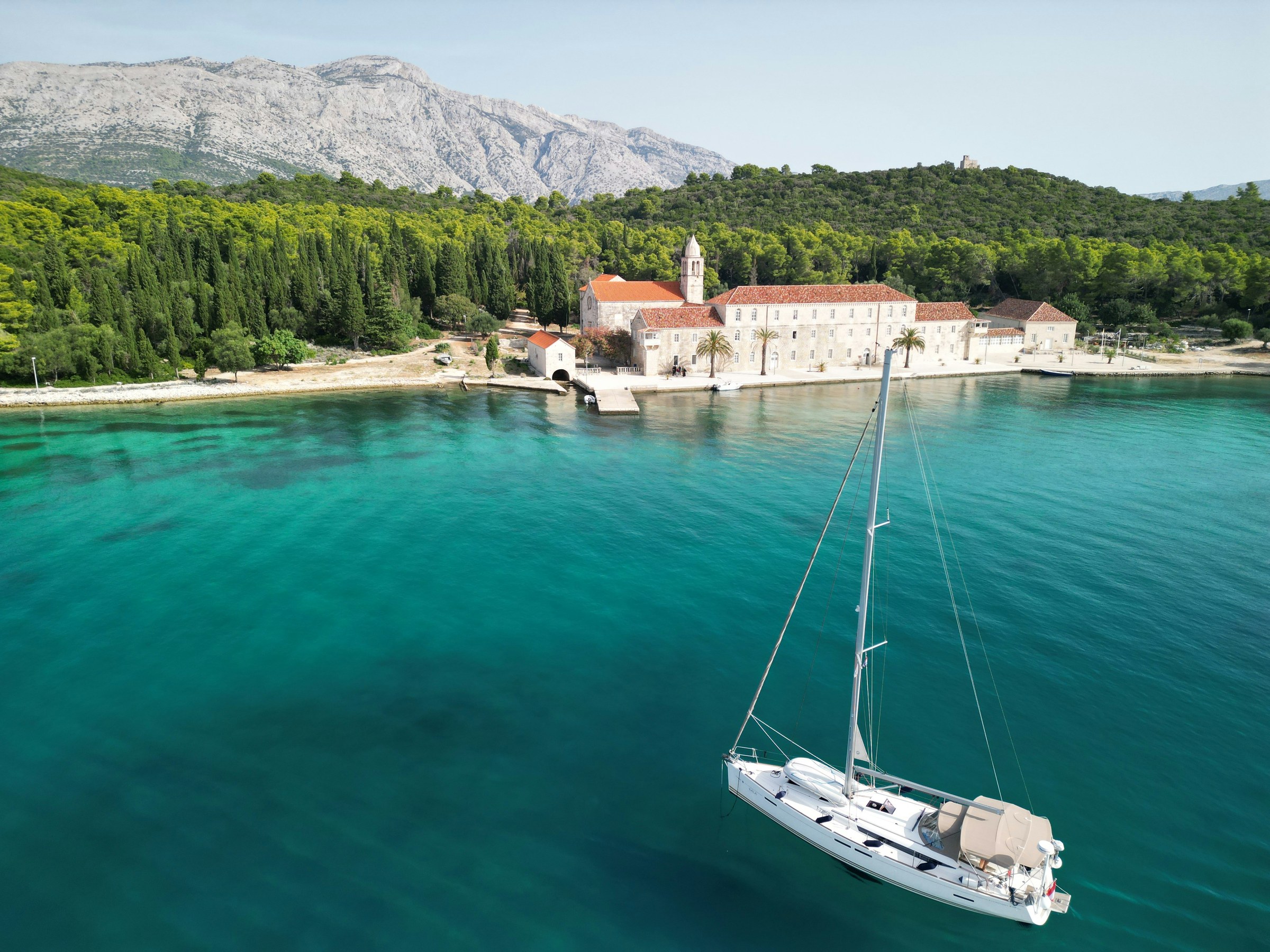
Korčula town stands on a small peninsula at the eastern end of the island, with its walled old town laid out in a herringbone pattern of narrow streets. Yachts can berth at the marina just outside the walls or anchor nearby off the islet of Badija, which has a Franciscan monastery. The village of Lumbarda, a short sail to the south-east, is known for Grk, a white wine made from a grape grown almost nowhere else.


Lastovo lies about 25 nautical miles south-west of Korčula town, making it one of the longer open-water legs of the week. The island and its surrounding islets form the Lastovo Islands Nature Park, created in 2006 and made up of 46 islands, islets and reefs. It is one of the most remote inhabited islands in Croatia and sees far fewer visitors than its neighbours.
The two main harbours for yachts are Skrivena Luka, a sheltered bay on the south coast whose name means hidden harbour, and Zaklopatica on the north side, where restaurants offer moorings to guests. Both are good places to spend a night, with clear water for swimming and dark skies after sunset.
Mljet National Park
From Lastovo to Mljet is around 25 nautical miles east, while the passage from Korčula town to Polače is shorter at about 15 to 17. Mljet National Park was established in 1960 and covers the western part of the island, which is thickly forested with Aleppo pine and holm oak. Yachts usually moor at Polače, beside the ruins of a late Roman palace, or at Pomena near the park entrance.
Inside the park are two saltwater lakes, Veliko jezero and Malo jezero. The smaller lake is joined to the larger one, which opens to the sea through a narrow channel. Walking and cycling paths run around the shores, and swimming in the lakes is a popular way to spend an afternoon. A park ticket is needed to visit, and it includes the boat to the islet in the larger lake.
That islet, Sveta Marija, holds a Benedictine monastery and church founded in the twelfth century by monks from Puglia. The eastern end of Mljet lies outside the park and has quieter anchorages such as Okuklje, and the sandy bay at Saplunara near the south-eastern tip.

The Elaphiti Islands and Dubrovnik
From Mljet the route runs east for about 20 nautical miles to Šipan, the largest of the Elaphiti Islands, a group named after the Greek word for deer. Šipan has two harbours, Šipanska Luka and Suđurađ, at either end of a fertile central valley planted with olives and vines. Both have sheltered anchorages and a few waterside restaurants.
Lopud, a short sail further east, is almost free of cars and has the sandy beach of Šunj on its southern side, a popular lunch stop. Koločep, the smallest of the three inhabited islands and the closest to Dubrovnik, has two small villages and pine woods running down to the water.
The final leg into Dubrovnik is short. Most yachts finish at the marina at Komolac, a few miles up the river estuary of Rijeka Dubrovačka, from where the walled old city is a short taxi or bus ride away. Finishing here also leaves time to walk the city walls before the flight home.
When to Go
The best months for sailing southern Dalmatia are May, June, September and early October, when the sea is warm, the anchorages are quieter and restaurant moorings are easier to find. July and August are the busiest months, with the most boats at Mljet and the Elaphiti Islands, and many mooring spots taken by mid-afternoon.
In summer the main wind is the maestral, a north-westerly breeze that builds in the afternoon and makes for steady sailing. The jugo, a south-easterly wind more common in spring and autumn, brings swell and cloud, while the cold north-easterly bura can blow hard at any time of year. A good skipper plans each day around the forecast and chooses the anchorage that gives the best shelter.
The longer open-water legs to Lastovo and Mljet, the national park rules and the busy moorings in high summer all reward local knowledge. Many travellers choose luxury yacht charter in Croatia for this reason, with an experienced skipper and crew who know the anchorages, berths reserved where needed, and a route planned around the weather for a week that finishes at Dubrovnik.