
















































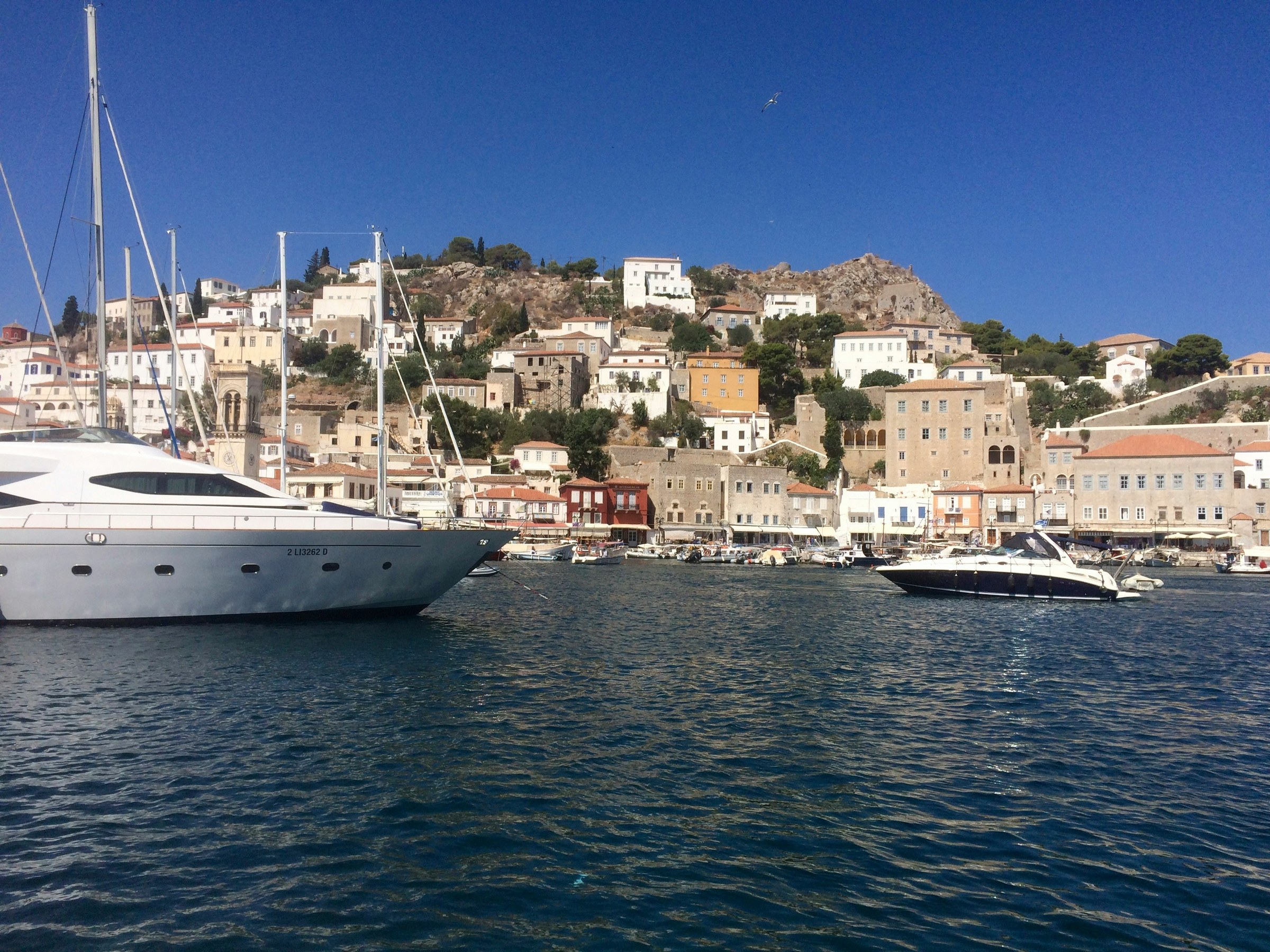

The Saronic Gulf opens to the south-west of Athens, and its islands are the closest to the Greek capital. Aegina, Poros, Hydra and Spetses lie within a short sail of each other, and beyond them the Argolic Gulf leads to Nafplio and the east coast of the Peloponnese.
For a yacht charter this makes an easy area to sail. The hops are short, the water is sheltered by land on most sides, and a week is enough to see the main islands without any long passages.
Short Passages and Sheltered Water
Charters usually start from the marinas on the coast south of central Athens, such as Alimos, and Aegina is around 15 nautical miles away, a passage of two to three hours under sail. The marinas are within an hour of Athens airport by taxi, so most charters can begin on the day of arrival. Most of the hops between the islands that follow are under 25 nautical miles, so there is time each day for a swim stop in a quiet bay before reaching the next harbour.


The meltemi, the strong summer wind from the north that blows across the Cyclades in July and August, reaches these gulfs in a much weaker form. Attica and the Peloponnese shelter the Saronic from the worst of it, which makes the area a good choice for families and for anyone who prefers calmer seas. Afternoon breezes still build in summer, giving good sailing without the rough conditions found further east.
Aegina, Poros and Hydra
Aegina was briefly the seat of the first government of modern Greece, in 1828 and 1829, and its harbour town still has neoclassical buildings from that period. The Temple of Aphaia, from around 500 BC, stands on a pine-covered hill in the north-east of the island, and Aegina’s pistachios are sold all along the waterfront. The smaller island of Agistri, a short hop to the west, has clear water and quiet anchorages.
Poros is separated from the Peloponnese by a narrow channel, with the town climbing a hill to a clock tower on one side and the village of Galatas on the other. Yachts moor along the town quay, and the lemon groves of Lemonodasos lie across the water on the mainland. On the way from Aegina, the volcanic peninsula of Methana has a small harbour and an old spa town.
Cars and motorbikes are banned on Hydra, apart from a few service vehicles. Goods are carried by donkeys and mules up stepped lanes from the harbour, which is lined with the stone mansions of the shipowning families who funded much of the Greek fleet in the War of Independence. The harbour is small and fills quickly in summer, so yachts arriving after midday often have to raft up or anchor in a nearby bay.
Spetses and the Crossing to Nafplio
Spetses, at the entrance to the Argolic Gulf, is greener than Hydra, with pine woods and few cars, and most visitors get around by bike, scooter or water taxi. It was the home of Laskarina Bouboulina, a naval commander in the War of Independence, whose house is now a museum. Each September the Armata festival marks a naval battle fought off the island in 1822, and the old harbour, where boatyards still build wooden caiques, gives good shelter for yachts.

From Spetses, yachts head north up the Argolic Gulf to Nafplio, a passage of around 25 nautical miles, or call first at Porto Heli and Ermioni on the Peloponnese coast. Nafplio was the first capital of modern Greece, from 1829 to 1834. Its old town of Venetian and Ottoman buildings lies below the Palamidi fortress, and the small island castle of Bourtzi guards the harbour entrance.
Nafplio is also the base for trips inland to the ancient sites of Mycenae and Epidaurus, whose theatre still holds performances each summer. Built in the fourth century BC, it is known for acoustics that carry a voice from the stage to the back rows. Tolo, a short sail to the south-east, and the small harbour of Palaia Epidavros on the Saronic side of the peninsula offer further stops on the way back towards Athens.
When to Go and How to Charter
The sailing season runs from May to October. June and September bring warm sea temperatures, steady breezes and fewer boats in the harbours, while August is the busiest month, when Greek holidaymakers fill the islands closest to Athens. May and October are quieter still, though the sea is cooler for swimming.
Many visitors book a crewed yacht rather than sailing themselves, since the skipper handles the stern-to mooring in crowded harbours such as Hydra, knows which bays give shelter in each wind and plans the route around the forecast. The crew can also take care of provisions and suggest tavernas ashore. Booking a yacht charter in Greece through an experienced operator puts these arrangements in place, so the week can be spent swimming, exploring and moving between harbours at an easy pace.