
























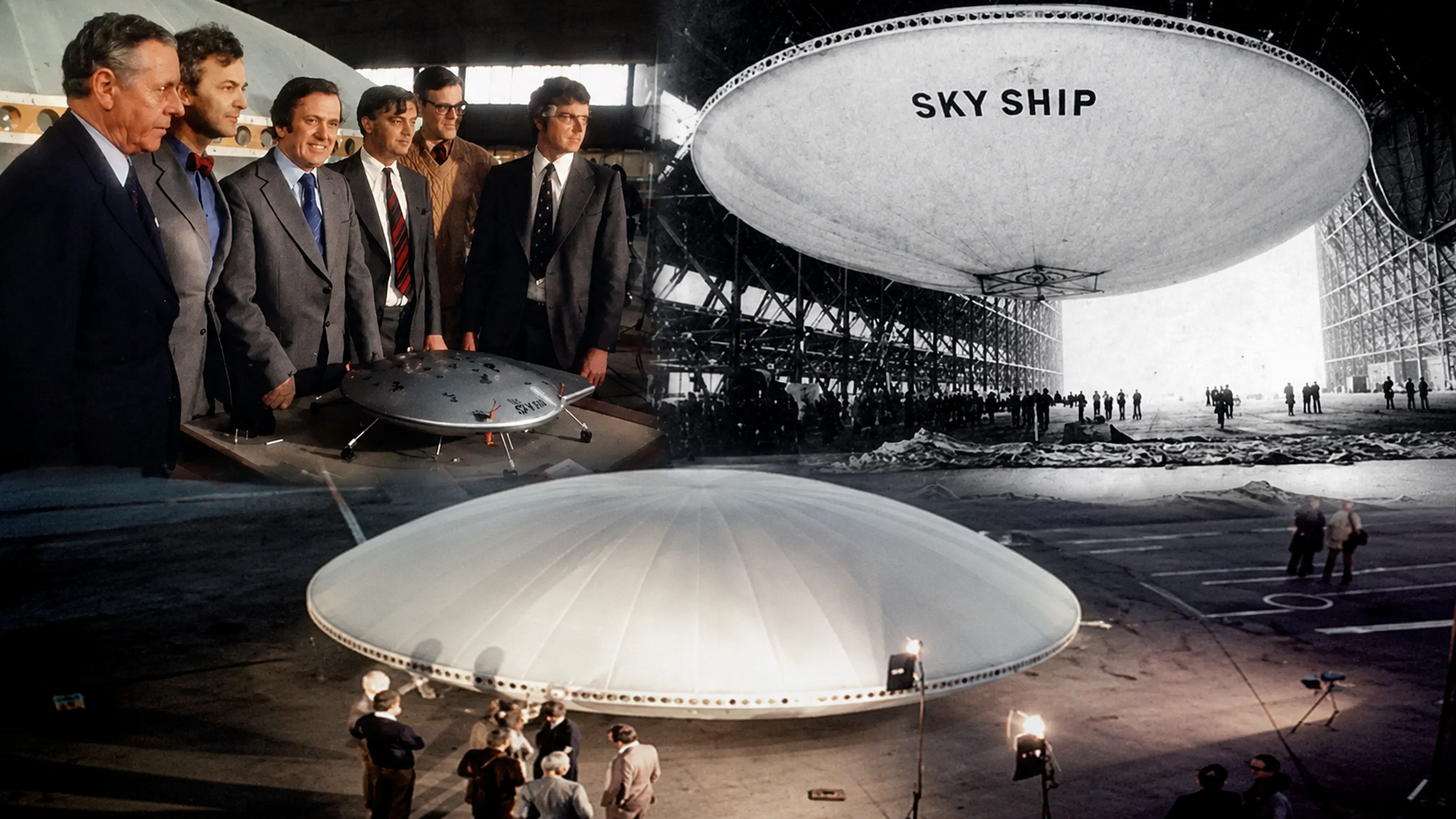

50 years ago, a hush-hush project in Cowes promised new jobs and a place at the forefront of aviation for the Isle of Wight.
In November 1976, engineers in Cowes were working on a 70ft-wide ‘flying saucer’ which they hoped could lead to enormous aircraft transporting hundreds of tonnes around the world.
The experimental Skyship was being developed by Solent Gas Turbines Ltd and associate company Turbine Technology Ltd, with the work carried out under tight security. The companies employed around 40 people in Cowes and hoped successful development would lead to increased production and an expansion of the Island workforce.


The 2-man prototype was expected to be completed the following summer. Rather than the cigar shape associated with traditional airships, it featured a rigid central section surrounded by a huge wheel-like structure around 70ft in diameter, giving it the unmistakable appearance of a flying saucer.
Power was to come from a propulsion system based on the Rolls-Royce Gnome gas turbine engine. The craft was expected to be considerably quieter than a helicopter, while helium would provide buoyancy without the dangers associated with the highly flammable hydrogen used in earlier airships.
A smaller 30ft radio-controlled Skyship had already flown successfully, demonstrating technology which its backers hoped could be scaled up dramatically.
Success with the Cowes prototype could have opened the way for Skyships around 200ft in diameter, with even larger machines eventually capable of carrying as much as 400 tonnes. Heavy machinery, vehicles and other bulky loads could be carried directly to places where building roads or other infrastructure would be difficult or prohibitively expensive.
Military applications were envisaged alongside civilian freight operations, while a proposed 150ft version capable of carrying a 20-ton payload was estimated to cost around £850,000 and was expected to compete favourably with helicopters.

The project attracted serious attention at Westminster. On 28th April 1977, the Thermo-Skyship was discussed in the House of Lords, where the Earl of Kimberley memorably described the aircraft as a “fat flying saucer”. He told peers that it combined characteristics of an airship, helicopter, hot-air balloon and Harrier jump jet.
For all its science-fiction appearance, the Skyship was being developed in an area with an extraordinary record of technological innovation. Sam Saunders’ East Cowes yard had constructed gondolas for some of Britain’s early airships, while Saunders-Roe later produced the experimental SR.A/1 jet-powered flying boat and the world’s first practical hovercraft, the SR.N1, which made its maiden journey from East Cowes in 1959.
Perhaps the most striking comparison with the Skyship could be found just down the road at Somerton. From 1973, workers there assembled the pioneering Enfield 8000 electric car – decades before electric vehicles became a familiar sight on Britain’s roads.
Production of the Enfield ended in May 1976, only around 6 months before news emerged of the Cowes flying-saucer project. One futuristic Island transport venture had barely ended before another was promising jobs and a new technological future.
Plans for the 70ft Cowes prototype appear never to have come to fruition, although development of the Skyship concept continued elsewhere and increasingly ambitious versions were proposed. By the early 1980s, estimated research and development costs had reached around £100million and wind-tunnel tests had produced disappointing results, and the Thermo-Skyship was abandoned.
The Cowes flying saucer therefore joined a remarkable list of Isle of Wight technological ventures ranging from the hugely successful to the tantalising might-have-beens.
Did you work for Solent Gas Turbines or Turbine Technology, or were you involved with the Cowes Skyship project? If you have memories, photographs or information about how far the Island project progressed, Island Echo would love to hear from you.